Where Tex Murphy Began
Every long-running detective series has to start somewhere, and for Tex Murphy that somewhere is 1989’s Mean Streets. Developed and published by Access Software, it introduces the private investigator in a dystopian, neo-noir vision of the future and kicks off what would become one of the most technically ambitious detective series in classic PC gaming. It launched exclusively for MS-DOS in North America before The Code Monkeys ported it to the Commodore 64, Atari ST, and Amiga, with the Atari ST and Amiga releases limited to Europe.
It’s easy to forget just how experimental this pitch was for the time. A private-eye adventure with light driving and shooting segments, aimed squarely at a North American MS-DOS audience before wider ports followed, was a real gamble for a studio that had made its name on flight simulators and sports titles rather than narrative games.
RealSound and Why It Mattered
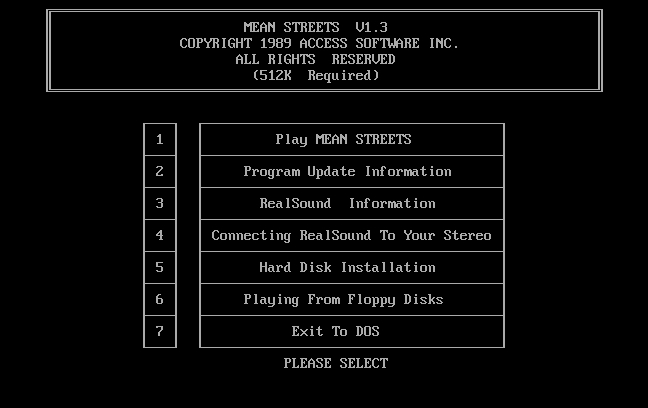
The technical highlight here is Access Software’s RealSound technology, which let the PC version play digitized speech and sound effects directly through the PC’s internal speaker at a time when dedicated sound cards were still rare and expensive. For a lot of players in 1989, this was the first time a PC game had spoken to them at all, and it gave Mean Streets a level of audio presentation that stood out sharply from its contemporaries, most of which were still limited to beeps and simple tones.
Tips for the Investigation and Driving Segments
- Don’t treat the driving and shooting sequences as pure arcade filler — they’re relatively light, but failing them can set your investigation back, so give them your full attention rather than rushing through on the assumption they don’t matter.
- Use the keyword-based conversation system deliberately. Suspects and witnesses respond to specific terms you’ve picked up elsewhere in the city, so a dead-end conversation often just means you’re missing a clue, not that you’re genuinely stuck.
- Revisit locations after gathering new information. Mean Streets expects backtracking as new evidence unlocks previously unhelpful conversations that seemed like a dead end the first time through.
- If RealSound audio sounds distorted or absent in DOSBox, double-check your sound configuration before assuming the game itself is broken — internal-speaker audio needs specific setup to emulate correctly, unlike a standard Sound Blaster title.
How Mean Streets Set Up Martian Memorandum
Mean Streets is rougher around the edges than its sequel — the verb-command interface and static scene presentation are fairly basic by adventure game standards even for 1989, and the arcade-style driving and combat segments feel more like padding than a core pillar of the design. Martian Memorandum kept the detective-noir DNA but largely dropped the arcade sequences in favor of denser interrogation and dialogue, which in hindsight reads as Access Software figuring out what actually worked about their new franchise. That kind of self-correction between a first game and its sequel is rarer than it should be in this era of PC gaming.
Legacy: The First Domino
Without this game’s modest success, there’s a real chance Access Software pivots away from narrative adventure entirely, which makes it far more consequential to PC gaming history than its rough presentation might suggest at first glance.
It’s worth remembering that in 1989, a detective adventure game with a distinct protagonist, digitized voice, and a persistent world was a genuinely novel pitch, and Mean Streets’ modest commercial success is the reason Access Software kept investing in Tex Murphy for the better part of a decade. Every technical leap the series made later — the branching FMV dialogue of Martian Memorandum, the full 3D environments of Under a Killing Moon — traces back to this one game proving there was an audience willing to follow a hardboiled PC detective across multiple sequels. Few franchise-starting games age gracefully as pure entertainment, and Mean Streets is no exception, but its historical importance to the series is hard to overstate.
DOSBox Setup Notes
Install your copy, then mount the folder in DOSBox with mount c [folder], switch to it using c:, and run the executable. Our DOSBox guide has notes on getting RealSound-era audio working correctly if you run into sound configuration issues, which is more common with this title than with later, sound-card-native Access Software games, since RealSound was specifically engineered around the PC speaker rather than dedicated audio hardware.
Is It Worth Playing Today?
Mean Streets is a foundational piece of adventure game history, introducing Tex Murphy and setting the tone for a series that would go on to become one of the most technically ambitious in the genre. Its blend of detective work, light action sequences, and pioneering internal-speaker audio made it a standout release in 1989. Playing it now, the seams show — the interface feels clunky next to what the series became, and the arcade segments haven’t aged particularly gracefully, with driving controls that feel stiff even by the standards of other late-80s vehicle sequences.
I’d still recommend it to anyone curious about the roots of the Tex Murphy series, but go in treating it as a historical curiosity first and a great game second; Martian Memorandum and Under a Killing Moon are the better entry points if you just want to see the series at its best. As an origin story, though, it’s genuinely worth the couple of hours it takes to see where Tex’s voice first took shape.
Watch Gameplay
You might also like: