Tex Murphy’s Cyberpunk Turn
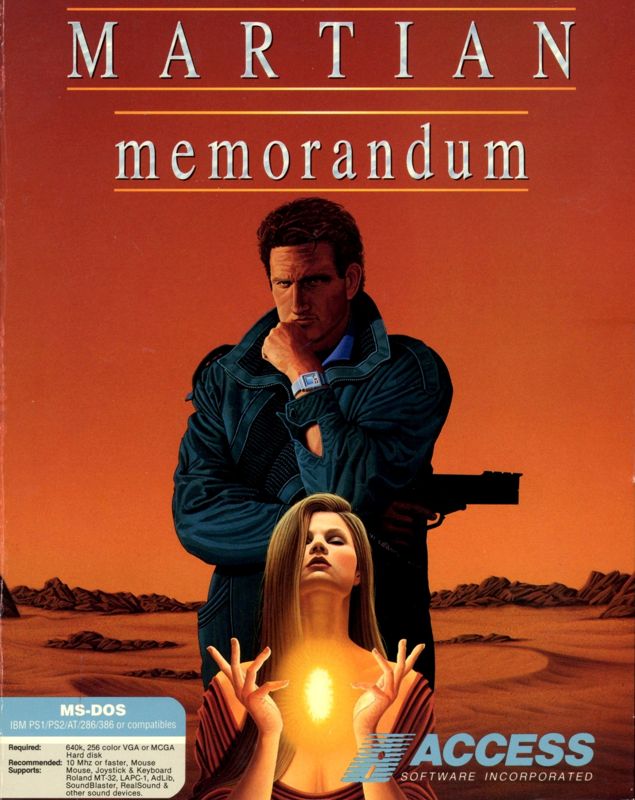
The second Tex Murphy game trades some of Mean Streets’ arcade trappings for a tighter, more story-forward mystery. Martian Memorandum is a cyberpunk noir graphic adventure developed and published by Access Software in 1991, with Tex hired by wealthy industrialist Marshall Alexander, founder of TerraForm Corporation, to track down his missing daughter Alexis. That setup pulls the player into a dystopian near-future story of corporate intrigue, betrayal, and off-world colonization that feels noticeably more ambitious than the original game’s plot. Designed by Brent Erickson and Chris Jones, it continued Access Software’s push toward cinematic presentation, with digitized voice acting and small video clips of human actors playable even through a PC’s internal speaker.
It’s a much darker, more grown-up premise than Mean Streets attempted, trading that game’s more straightforward murder mystery for corporate conspiracy and off-world colonization, and the shift in scope shows Access Software gaining confidence in Tex Murphy as a franchise worth investing real ambition in rather than a one-off experiment.
Interrogation Over Inventory
The basic structure carries over from Mean Streets: you guide Tex through a series of static, illustrated locations, using verb-command menus to examine, take, and interact with objects and characters. What’s different is the balance — interrogation scenes are a major focus here, often outweighing traditional object-based puzzles as the primary way you extract information and move the plot forward. Conversations run through branching dialogue trees, where choosing the right question or approach can open new leads or shut a suspect down entirely, and the moody cyberpunk setting of corporate skyscrapers and off-world colonies keeps the hardboiled detective tone front and center.
A Few Tips for the Interrogation Rooms
- Exhaust every dialogue option with a suspect before leaving. Because information gathering matters more here than in most adventure games, walking away early can genuinely leave you stuck later with no obvious indication why.
- Take note of names, places, and details mentioned in conversation — Martian Memorandum expects you to remember and cross-reference what people tell you rather than relying purely on inventory items to progress.
- If a conversation goes cold, look for a new piece of evidence elsewhere before trying the same suspect again; new leads often unlock previously unavailable dialogue branches you couldn’t have reached otherwise.
- Don’t skip through the digitized voice and video clips — small details in delivery occasionally hint at who’s lying, and they’re also simply worth watching given how novel this technology was in 1991.
Martian Memorandum vs. Mean Streets
Mean Streets split its time between investigation and light arcade-style driving and combat sequences. Martian Memorandum drops most of that in favor of a denser, more dialogue-driven mystery, which makes it feel like a more mature, focused successor rather than a simple retread. If Mean Streets was Access Software finding its voice, Martian Memorandum is the studio committing to detective fiction as the series’ real strength — a direction it would push even further in Under a Killing Moon. It’s the clearest early sign that Tex Murphy was going to be a writing-first franchise rather than an action one.
Legacy: Proving the Formula Could Grow
It’s a reminder that not every important sequel needs to reinvent its predecessor completely — sometimes proving a format can scale is just as valuable as innovating on it, and that lesson clearly stuck with Access Software for the rest of the series.
Martian Memorandum’s 2014 Steam re-release, alongside Mean Streets, is a real sign of the enduring interest in the Tex Murphy series decades after its original run — most games this obscure from 1991 never get that kind of second life. More importantly for the series itself, it proved Access Software could grow the format beyond a first attempt, setting expectations for scale and ambition that the studio would keep raising through Under a Killing Moon and The Pandora Directive. Without Martian Memorandum showing that a denser, more dialogue-focused mystery could work, it’s fair to wonder whether the series would have taken the bigger creative swings it did later on.
Running It in DOSBox
Once installed, mount the game’s folder in DOSBox using mount c [folder], switch to that drive with c:, and launch the executable. Check our DOSBox guide for advice on configuring sound cards to get the most out of the game’s digitized voice clips, which are a highlight worth hearing properly rather than through default settings, and our free DOS games list is worth a look if you want a shorter game to pair with it.
Final Thoughts
Martian Memorandum shows Access Software refining the formula it introduced with Mean Streets, leaning harder into cinematic dialogue and a memorable cyberpunk mystery. Tex’s sardonic voice carries the story well, and the interrogation-heavy structure makes it a distinct experience from most adventure games of its era. The static, illustrated-scene presentation does feel like a step behind Sierra’s more polished contemporaries visually, and a few of the branching dialogue paths dead-end without much warning, leaving you to wonder whether you missed a line rather than whether the suspect simply had nothing more to say.
Still, it’s a great pick for players who enjoy noir mysteries and branching dialogue, and a genuinely useful stop for seeing how the Tex Murphy series evolved on its way to the far more ambitious Under a Killing Moon. Judged purely on writing, it’s aged better than most of its visually flashier contemporaries.
Watch Gameplay
You might also like: