
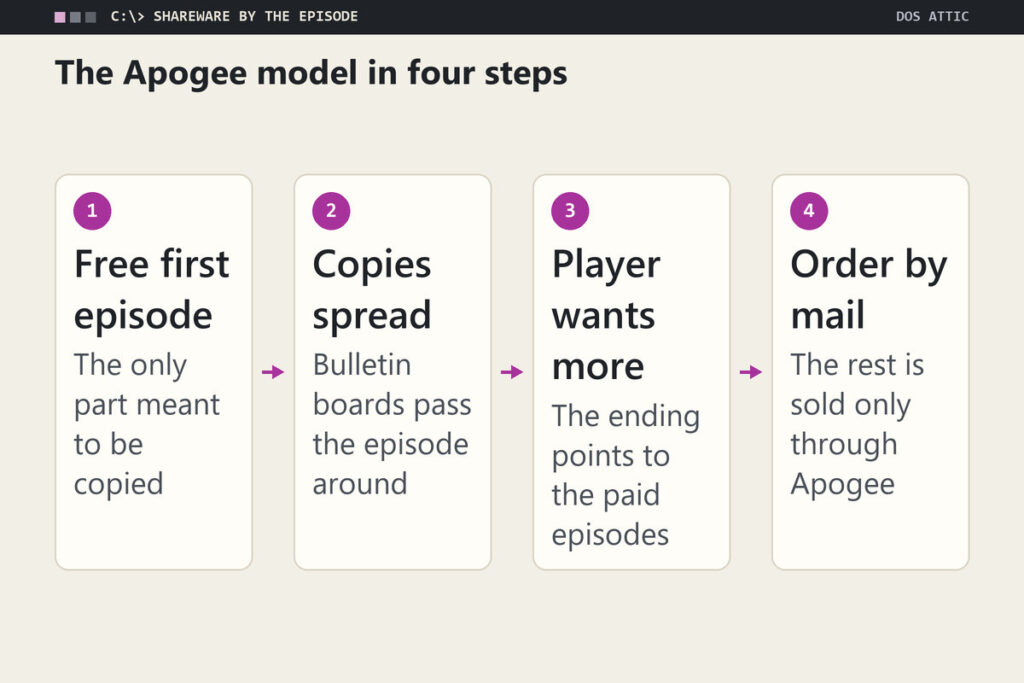
Monday was always the big day at Scott Miller’s mailbox. Miller later recalled that checks for his shareware game Kingdom of Kroz sometimes added up to $500 on a single Monday, on top of $100 to $200 on an ordinary day, according to Game Developer’s excerpt from his interview. The checks were mailed to Garland, Texas, by players who had finished a free first episode and wanted to see the next one. That small piece of arithmetic, free first and paid afterwards, is the business every Apogee game was built on.
Apogee-era games can be bought legitimately today. Commander Keen on Steam lists Invasion of the Vorticons, with Episode 1, “Marooned on Mars,” dated December 14, 1990, and Apogee’s own back catalogue is on sale as well: GOG lists Crystal Caves, a 1991 platformer published by Apogee Entertainment, and its store page says the game runs in DOSBox. A shareware episode found on an old disk is a different thing, because the terms covered copying only the first part of a game, as a later section explains.
Why asking for donations paid so little
Before Kroz, Miller released games on the honor system. A secondary history of the company puts the combined take from Beyond the Titanic and Supernova at roughly $10,000 over a year, a figure Miller does not repeat in his own interview. He says that when the rights to his games came back to him he went looking for another way to earn from them, and found shareware circulating on bulletin boards and CompuServe. What he does describe in detail is the research behind his next move. He contacted other shareware authors directly and found that every one of them told him not to expect any money, even when they asked players for $10 or $20.
Miller’s reading was that the authors were doing it wrong. His fix was to release only a portion of a game, break the game into episodes, and let that first portion hook the player so they would have to order the rest from him. The free part became the advertisement, and the withheld part became the product. Nothing about this required a retailer, a box or a publisher, which is the point that mattered for a one-man company.
Cutting Kroz into three parts
Kroz was written with 60 levels, more than Miller wanted to hand out for nothing, so the game was split into three episodes and only the first went onto bulletin boards. According to the same secondary history, the game displayed Miller’s mailing address to players who finished the free part and asked them to buy the rest. Released in 1987, it was the first game to carry the name Apogee Software Productions.
Miller’s own account adds the detail that made the loop close. The first Kroz game carried advertising for two more Kroz games, so every free copy that circulated pointed straight at the paid ones. In the first year, he says, checks from players added up to somewhere between $80,000 and $100,000. A figure like that explains why he never went back to donations, and why the three-episode shape kept appearing in Apogee releases afterwards.
Ordering by mail, as a magazine saw it
A 1992 Computer Gaming World review of Wolfenstein 3-D shows the model from the customer’s side. The review header lists the price as $50 for six scenarios and names Apogee of Garland, Texas, as the distributor. The text then pauses to explain shareware to readers: the first scenario was free to copy, usually through a bulletin board, and a player who wanted to keep it was asked to register, which meant paying. The reviewer admitted that shareware policy was new to him before writing the piece.
The same review makes the key point about the other five scenarios. They were not shareware, and they were available only through Apogee. In other words, the withheld episodes could not be found anywhere else, which is the “no honor system” rule Miller had designed around. Anyone who wanted episode two had one path: contact the company that held it. A disk labeled with an old Apogee title therefore carried permission to share one episode, not the whole trilogy, and when a rights holder has since released a complete game for nothing or sells it through a store, that is a separate fact to check for each title.
A Game Developer feature on the making of Doom puts numbers on why this mattered to id. A retail copy of Spear of Destiny, handled by the separate distributor FormGen, left id with about $8, which was half of the return. A Nintendo cartridge of Wolfenstein would have returned about $2. A shareware sale of the full Wolfenstein cost under $5 in materials and was priced at $50, and although id split that profit with Apogee, the margin was far better than either alternative. This is the arithmetic behind a model that looks like a promotional trick from the outside.
Fake fan mail and a $2,000 check
Apogee’s most important recruit came through an odd route. The same Doom feature tells how Miller saw a game that John Romero’s Softdisk team had made and wanted it for his shareware business. Knowing that mail to Softdisk was opened at the front desk, he wrote letters to the programmers under several invented names, each ending with the same request to write to him at a certain address. Romero noticed the repeated address and realized that most of his fans were one person.
The one real fan changed Romero’s career. Miller sent the team a $2,000 check and received a paragraph describing a game idea, which became the first Commander Keen trilogy. Keen’s first episode went on sale on December 14, 1990, according to its Steam page, and id Software formed soon afterwards with Apogee as its distributor. The same article reports that Wolfenstein 3D gave away its first ten levels, sold the rest through Apogee, and passed 100,000 units by the end of 1993, beating the shareware record held by Keen by more than five times.
Other writers on the same terms
Apogee was not only an id Software story. The Game Developer excerpt notes that the model was successful enough to start publishers such as Epic following in the same footsteps, and Epic’s Jill of the Jungle trilogy has an article of its own on this site. Within Apogee, designers who had run their own tiny labels came in through the same door: George Broussard folded his company, Micro-FX, into Apogee, and Apogee’s 1991 platformer Duke Nukem followed the three-episode pattern with only the first episode free.
It is easy to forget how unusual that arrangement was for 1990. A solo developer with a day job could finish one episode, ship it, and see from the order mail whether the idea had legs, with no publisher to convince in advance. The id Software story starts in the offices of Softdisk, and the overnight Mario demo built around Dangerous Dave is the other half of that story.
Overseas orders and translated graphics
The free episode also crossed borders without a publisher’s help. The Doom feature says the free Wolfenstein 3D teaser spread around the world, with over 20 percent of the orders for the complete version coming from overseas, and it adds that id expected foreign orders to reach a third of Doom’s sales.
That experience changed how id built its games. Because foreign markets mattered, the feature says, the designers drew the characters as graphics instead of font text, so id could hand the graphics files to foreign distributors for translation without recompiling the game.
Names and dates in order
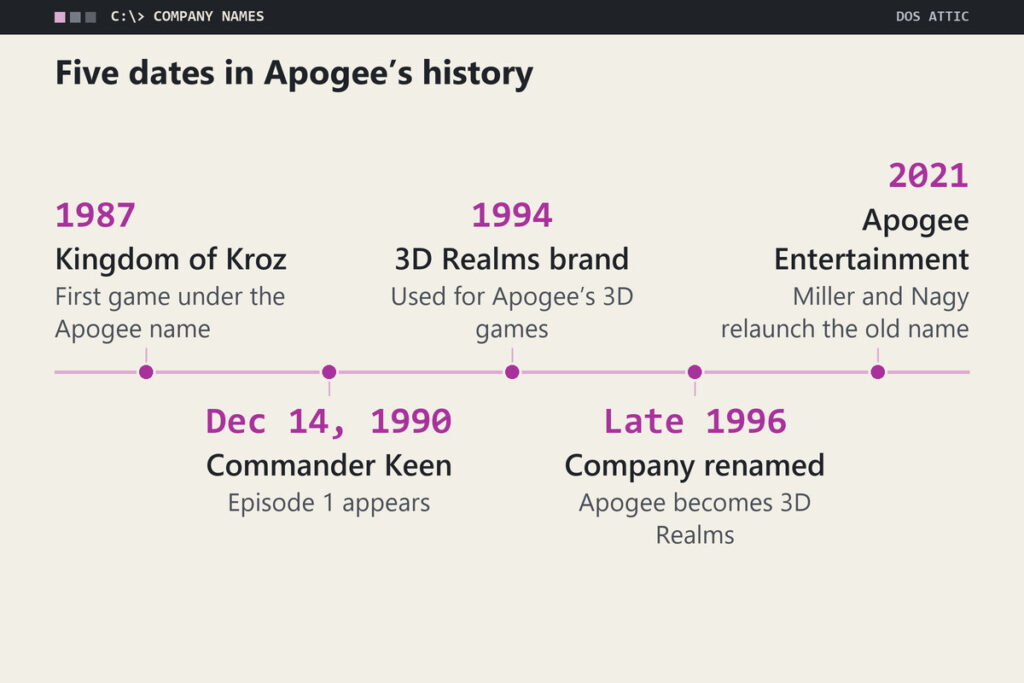
- 1987: Kingdom of Kroz becomes the first game released under Apogee Software Productions.
- December 14, 1990: Commander Keen, Episode 1, appears with Apogee as the distributor.
- 1992: Wolfenstein 3-D sells six scenarios by mail, with the first free to copy.
- End of 1993: Wolfenstein 3D passes 100,000 units sold.
- 1994: Apogee starts using the 3D Realms brand for its 3D games.
- Late 1996: the company itself is renamed 3D Realms, and Stargunner is the last game released under the Apogee name.
- 2008: the Apogee name and library are licensed to Terry Nagy.
- 2021: Miller and Nagy relaunch the old label as Apogee Entertainment, and Saber Interactive acquires 3D Realms.
Seen together, the dates show a company that built its reputation on a pricing trick, outgrew it with 3D games, and eventually saw its founder relaunch the old name. The later dates come from the same secondary history of the company that the earlier sections used.