X-Wing looks like a shooter and asks for a power plant. LucasArts’ 1993 Star Wars game puts three starfighters in your hands, but the reviewer in the June 1993 issue of Computer Gaming World found the real work somewhere else: each ship is a flying battery whose output must be sent to the engines, the lasers or the shields, and diverting power to one area reduces what is left for the others.
That gap between the cinematic promise and the bookkeeping runs through everything below. The review’s credit box names Lawrence Holland and Edward Kilham as designers, and its text places the game with the combat-simulation group Holland headed, whose earlier titles it lists as Battlehawks 1942, Their Finest Hour and SWOTL. The same review praises a polygon flight model that ran smoothly on a 386/33 and calls the missions unbalanced.
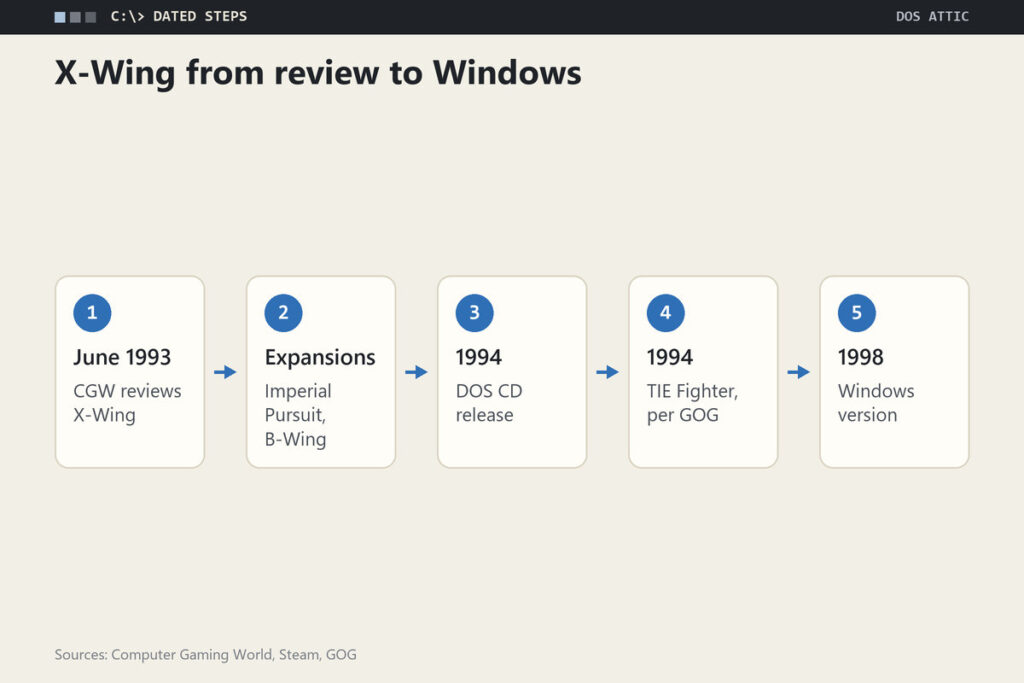
The legal routes are two stores. Steam’s X-Wing Special Edition includes X-Wing and the Imperial Pursuit and B-Wing expansions in both the 1993 DOS and 1998 Windows versions, and promises more than 120 missions. GOG’s Special Edition lists the 1993 DOS, 1994 DOS CD and 1998 Windows versions, says the game is powered by DOSBox, and records in a changelog entry of 28 April 2025 a tweak to the DOSBox configuration of the 1994 release to boost performance. Steam adds that the 1993 version plays with mouse and keyboard, while the 1998 Windows version requires a controller or joystick.
One Battery Shared by Three Fighters
The review sorts the three craft by what they carry. The X-wing sits in the middle, with mid-range speed and turning, four wing-mounted lasers and a small pack of torpedoes. The Y-wing is an older model and the slowest in the fleet, with two frontal lasers, an ion cannon for disabling ships and a healthy supply of torpedoes. The A-wing is the newest, fastest and most manoeuvrable. Missions use them somewhat randomly, so the reviewer advises training in all three.
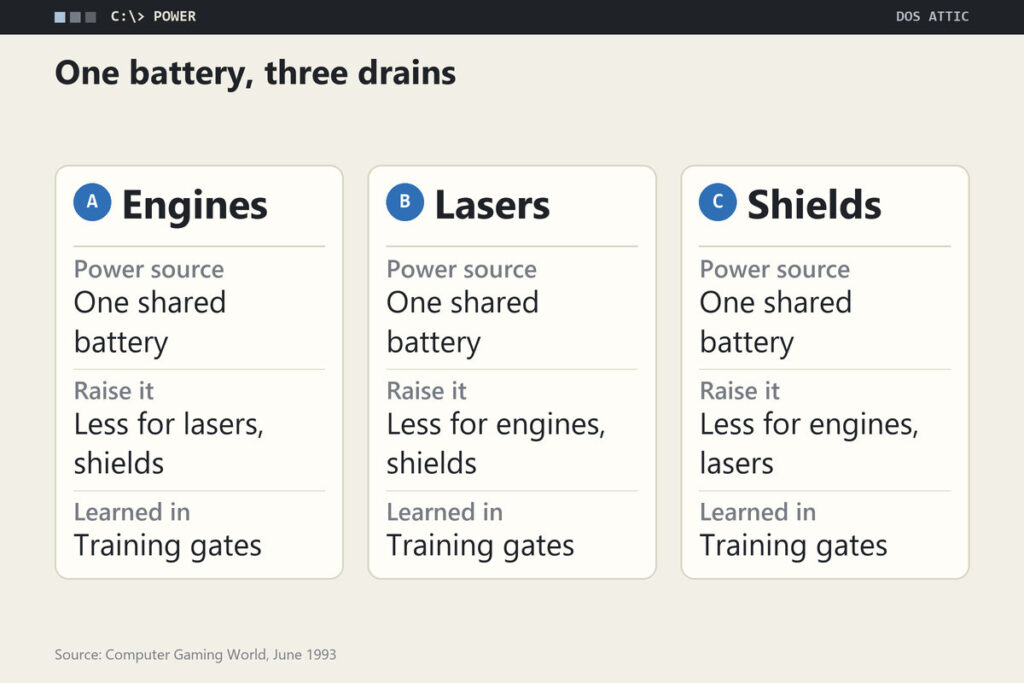
Whatever the airframe, every ship is flown the same way. Power arrives at a slow, steady rate and can be sent to the engines, the lasers or the shields, and sending more to one leaves less for the other two. The training missions teach the keystrokes, and the review names working out the power systems as the first steep learning slope. Taken at its word, the design turns every dogfight into a small budgeting problem: topping up the lasers for a strafing run means accepting weaker shields and slower engines until the next adjustment, so the three settings behave less like upgrades than like one dial with three ends.
The craft differences then sit on top of that dial. An A-wing’s speed and handling give its pilot more ways to avoid fire, while the Y-wing’s ion cannon changes what a shot is for. That reading is an inference from the review’s descriptions; the reviewer does not draw it out in so many words.
A Campaign Built Like a Puzzle Book
A new pilot starts in a training ground of several hundred flight gates, each level adding laser-firing obstacles and shortening the time allowed. After a few flight badges come the historical missions, six for each craft, which introduce the TIE fighter, the TIE bomber and the larger ships on both sides. The campaign proper is three tours of duty, the first two with 12 missions and the third with 14, each opened by a text crawl in the manner of the films and carried along by briefings and a few cinematic sequences: two for each of the first two tours and three for the last. Failure does not branch the story; the pilot replays a mission until it succeeds.
The reviewer reports that LucasArts told him the missions were designed as puzzles to be solved, which is the nearest thing in the sources to a statement from the makers. He agrees, and describes the harder ones as having a single solution that must be executed with precision: fly to point A and destroy fighters, race to point B for the bombers, reach point C in time to catch a second squadron. Difficulty does not climb smoothly either. Four straight missions pass without trouble, then one stalls the pilot for hours, and he suggests a player-controlled difficulty setting.
A route like that is the kind of plan a power budget forces on a pilot: shields up while crossing guns, lasers up for the kill, engines up for the race to the next waypoint. Seen that way, the puzzle framing and the battery are one design viewed from two sides, and the same logic explains why the game asks for repeated attempts instead of branching.
A Polygon Flight Model on a 386
The review’s data panel lists IBM compatibles with VGA graphics, a 386/33 recommended and 1 MB of RAM required with more advised, a price of $69.95 and a documentation look-up for copy protection. How DOS machines of that class reached memory above 640 KB is its own subject. Whether X-Wing counts as a simulator was debated at the time; the reviewer called it a genre-mixing game, part adventure and part simulator, and noted that LucasArts stressed the simulation side, most likely for marketing reasons.
The heart of it, he writes, is the polygon-based flight model, cleanly implemented. On a 386/33 it plays smoothly with a dozen or so ships in a scenario and turns choppy with more ships and especially several torpedoes in the air, and a quick switch to a lower detail level usually smooths the ride. At the highest level ships show identifying colours, insignia, textured panels, gun emplacements and antennae. Cockpit views are drawn separately for each of the three fighters, and a camera function records a mission and replays it from the viewpoint of any object in it. LucasArts also earned a nod for quality assurance: in more than 30 hours the game crashed once.
Pushback in the 1993 Review
The complaints cluster around the pilot, not the ship. A pilot who is killed or captured can only be recovered by reviving him from the pilot screen, which wipes score and rank but keeps medals, so finishing the campaign with rank intact is, in the reviewer’s bet, virtually impossible. Players backed up or edited pilot files outside the game, and he wanted the game to offer that choice itself. Wingmen, in his words, were about as useful as a rowboat on Tatooine.
The manual stung more because Holland’s earlier simulators had set the standard for lavish documentation. The first 100,000 copies carried a 100-page book from Prima Publishing, written as the account of a fictional pilot, and later buyers got a dry 20-page booklet. Even so, the reviewer closed by saying he enjoyed the game tremendously and was waiting for the add-on disks and the sequel.
X-Wing Set Against TIE Fighter
The sequel is sold alongside it. The 1993 review predates TIE Fighter, so it cannot rank the pair; the table lines up only what the GOG pages and the session text for a 2024 Game Developers Conference talk on TIE Fighter’s making state. Even that small set of facts shows how the two games are connected: the same designers, and a sequel whose mission builders say they took X-Wing’s lessons and aimed for a more accessible game.
| X-Wing (1993) | TIE Fighter (1994) | |
|---|---|---|
| Side you fly for | Rebel Alliance starfighter pilots (Steam) | Imperial Navy recruit under Darth Vader (GOG’s TIE Fighter page) |
| Design leads | Lawrence Holland and Edward Kilham (CGW credit box) | Lawrence Holland and Edward Kilham (GDC session text) |
| What GOG sells | 1993 DOS, 1994 DOS CD and 1998 Windows versions, with expansions | TIE Fighter and Defender of the Empire in 1994 DOS and 1998 Windows versions, plus Enemies of the Empire (1998 Windows) |
| Developers’ own summary | The success that TIE Fighter followed (GDC session text) | Mission builders David Wessman and David Maxwell applied X-Wing’s lessons for a more accessible, more varied game |
| DOS setup in GOG’s 28 April 2025 changelog | DOSBox configuration of the 1994 release tweaked for performance | DOSBox configuration tweaked for all titles; Collector’s CD (1995) sound card emulation setting changed for better music |
That last sound card line is a reminder that much of DOS-era setup was about audio hardware, a subject traced in the account of how AdLib and Sound Blaster divided the market.