
Search “free DOS games” and you’ll wade through dead Mediafire links, ROM-site pop-up ads, and a dozen pages that quietly mean “pirated.” That’s not what this list is. Every entry below is free because the people who made it decided, at some point, to give it away — as shareware bait, as a freeware anniversary gift, or as an outright open release. No cracks, no gray areas, no vanishing installers. Just the DOS scene’s actual legitimate free tier, and a working opinion on why each one earns a slot on it.
Freeware and Shareware Aren’t the Same Thing
The two words get used interchangeably and they shouldn’t be. Shareware was a marketing structure: id Software, Apogee, and Epic MegaGames gave away a fully playable first episode and sold the rest by mail order. That first episode was never a trial in the modern sense — it was a complete, finishable game, distributed on purpose to spread virally through BBS boards and shareware disk services. It’s still legally free today because nobody revoked that permission; the companies just moved on to other business models.
Freeware is different — a developer or publisher deciding, often years later, to release the entire game at no cost, usually once its commercial life is over. Bethesda doing this with Daggerfall in 2009 and Revolution Software doing it with Beneath a Steel Sky in 2003 are the two cleanest examples on this list. Both are complete games, not samples of something bigger.
That distinction matters because it’s the filter we used. If a game required buying registered episodes to see the ending, we only recommend it here for what the free episode itself delivers, judged as a whole experience — not as a demo.
The List
1. Rise of the Triad (1994) — for landing on somebody’s shelf as “the weird one”
Apogee’s shareware episode is the one to grab if the rest of the 1994 shooter crowd feels too self-serious. It’s a Wolfenstein 3D engine game built by a team that stopped trying to be Wolfenstein 3D halfway through development, and the shareware release still carries the jump pads, the Excalibat, and the sense that the designers were actively trying to surprise you. Full writeup: Rise of the Triad (1994).
2. Wolfenstein 3D (1992) — the one that started the whole shareware-FPS economy
id Software’s shareware episode, Escape from Wolfenstein, is still the cleanest way to feel why this format worked. Ten levels, a straightforward premise, and a pace that never overstays its welcome — it’s short enough that “just the free part” doesn’t feel like a compromise.
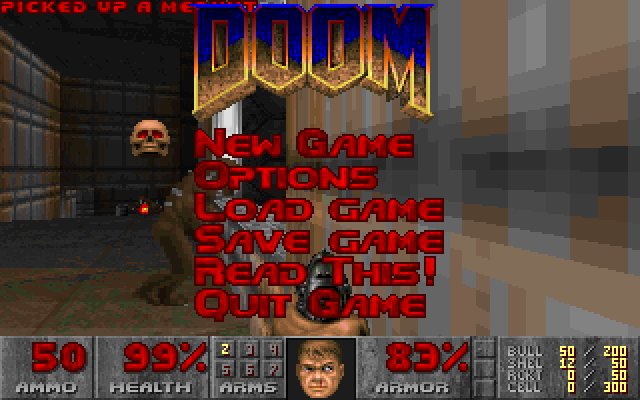
3. Doom (1993) — still the reference point for “instantly playable”
The shareware episode (nine levels of Knee-Deep in the Dead) needs no pitch three decades later; it remains the version most emulator bundles and source ports default to, and for good reason — it’s a complete arc with its own boss fight. Full writeup: Doom (1993).
4. Heretic (1994) — Doom’s engine with a fantasy coat of paint, and it earns it
Raven Software’s reworking of the id Tech 1 engine added inventory items, vertical aiming, and a genuinely different tone. The shareware episode is a fair sample of what makes it more than a reskin — the Tome of Power alone changes how you’d approach a Doom-style fight.
5. Dangerous Dave (1990) — freeware from day one, and a real piece of id prehistory
This one was never shareware at all. John Romero built and released it as freeware through Softdisk before id Software existed as a company, and it stayed that way. It’s rougher than anything else on this list, but it’s a direct look at the side-scrolling platformer instincts that later became Commander Keen.
6. Jill of the Jungle (1992) — Epic MegaGames before Epic Games, one free episode deep
The first episode is a complete, colorful platformer with a mechanically interesting swimming and vine-climbing system for its era, and it’s the game that gave Epic the revenue to later fund Jazz Jackrabbit and, eventually, Unreal. Worth playing as the root of that lineage, not just as a curiosity.
7. Duke Nukem (1991) — the platformer, not the shooter, and worth separating from the reputation
Before the one-liners and the strip clubs, Duke Nukem was Apogee’s answer to Mega Man: a tight run-and-gun platformer. The shareware episode holds up as pure level design, no franchise baggage required.
8. Hocus Pocus (1994) — Moonlite Software’s underrated answer to the genre
A lesser-known Apogee-published platformer starring a young wizard, built on solid jump-and-shoot fundamentals with secret-hunting that rewards actually exploring each stage rather than sprinting through it.
9. Epic Pinball (1993) — proof shareware wasn’t only shooters and platformers
Epic MegaGames’ pinball engine was legitimately ahead of a lot of console pinball games at the time, with tables that had actual multi-stage objectives instead of just flat scoring. The shareware table is a complete table, not a stripped demo.
10. The Elder Scrolls II: Daggerfall (1996) — freeware, and the biggest thing on this entire list by a wide margin
Bethesda made the full commercial release free in 2009 for the series’ 15th anniversary, with no episode restrictions at all — you get the entire sprawling world, guild politics included. It’s a different category of “free” from everything else here: a complete AAA-scale release from its era, not a shareware sampler. Full writeup: The Elder Scrolls II: Daggerfall (1996).
| Game | Free Because | Genre | Best For |
|---|---|---|---|
| Rise of the Triad | Shareware episode | FPS | Players tired of po-faced shooters |
| Wolfenstein 3D | Shareware episode | FPS | Understanding where the genre started |
| Doom | Shareware episode | FPS | A short, complete arc |
| Heretic | Shareware episode | Fantasy FPS | Doom fans wanting a twist |
| Dangerous Dave | Freeware from release | Platformer | id Software prehistory |
| Jill of the Jungle | Shareware episode | Platformer | Early Epic MegaGames history |
| Duke Nukem (1991) | Shareware episode | Platformer | Pure level-design fans |
| Hocus Pocus | Shareware episode | Platformer | Explorers, secret-hunters |
| Epic Pinball | Shareware episode | Pinball | A change of pace |
| Daggerfall | Full freeware release | RPG | Long-haul players wanting scale |
Setting Up DOSBox for a Decade of Shareware Titles
Most of these games predate the CPU-speed assumptions baked into modern hardware, so DOSBox’s default cycles=auto setting is usually fine, but a few — Rise of the Triad especially — benefit from a fixed cycle count (roughly 15,000–20,000) rather than letting DOSBox scale automatically, since auto-detection can occasionally misjudge a shareware-era engine’s timing loop and cause stuttering. For sound, stick to DOSBox’s default Sound Blaster settings (Address 220, IRQ 7, DMA 1) unless a game’s own setup utility asks for something else — nearly all of these titles were built against that exact configuration since it was the market standard by the early ’90s. If a game launches into a setup screen first (Duke Nukem, Hocus Pocus, and Jill of the Jungle all do), run that setup executable once before the main game and choose Sound Blaster or Adlib depending on what you’d rather hear — the difference in the pinball table specifically is worth trying both.
Beyond Episode One: Tips for Squeezing More Out of a Shareware Release
- Treat the shareware episode as the whole game, not a preview — most of these were paced to have a real ending, so rushing through to “see what’s locked” misses the point.
- In the platformers (Dangerous Dave, Jill of the Jungle, Duke Nukem, Hocus Pocus), backtrack before finishing a level — secret areas rarely block your forward path, so a first playthrough that beelines the exit will miss most of the content.
- In Rise of the Triad, actually pick up the power-up items instead of avoiding them out of caution — several change your capabilities enough (temporary invincibility, bouncing movement) that skipping them changes how a level is meant to be approached.
- In Daggerfall, build a custom class at creation rather than picking a preset — the freeware release still uses the full GURPS-influenced system, and a preset class wastes the game’s deepest customization layer.
- Save often in anything with permadeath-adjacent design (Rise of the Triad’s harder difficulties, Daggerfall’s early dungeon crawling) — these engines weren’t built with generous checkpoints in mind.
Questions Worth Sorting Out Before You Download Anything
Are these actually legal to download in 2026?
Yes — every game on this list is either freeware by the rights holder’s own decision or a shareware episode that was explicitly built for free redistribution. None of it depends on abandonware’s legal gray area.
Do I need anything besides DOSBox to run these?
No. DOSBox (or DOSBox-X) handles all ten. A few of the platformers benefit from mapping a modern gamepad to arrow keys plus Ctrl/Alt if keyboard-only controls feel stiff, but that’s a comfort choice, not a requirement.
Which one should I start with if I’ve never touched a DOS game before?
Doom’s shareware episode remains the friendliest on-ramp — it’s short, well-paced, and doesn’t require reading a manual to understand what you’re doing.
Is Daggerfall really the whole game for free, not just part of it?
Correct — Bethesda’s 2009 release removed all commercial restrictions from the full 1996 release. There’s no equivalent “episode 2” you’re missing.
Why isn’t Quake or Duke Nukem 3D on this list?
Both have legitimate free shareware components too, but we kept this particular ten to games whose free portion is either fully self-contained or represents the majority of the intended experience, to avoid stretching the definition of “worth playing” for a fragment.
Why the Shareware Model Still Matters
It’s easy to read the shareware era as a quaint distribution quirk, but it was the reason small teams could compete with boxed retail releases at all. Apogee, id, and Epic MegaGames didn’t have shelf space or a marketing budget — they had disks that people were willing to copy and pass along for free, because the free part was genuinely good. That’s arguably the direct ancestor of the free-to-play and demo models still used today, and it’s why so many of the biggest PC franchises of the 1990s started as a company mailing floppy disks out of a house in Texas or Maryland rather than a publisher deal.