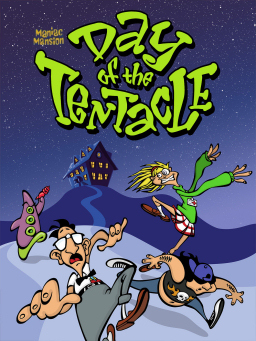
Some puzzle games ask you to find a key. Day of the Tentacle asks you to leave an item in 1776, then travel to 1993 to see what two hundred years of history did to it. That single idea, executed with more cleverness than almost any adventure game before or since, is why LucasArts’ 1993 classic still gets mentioned in the same breath as the genre’s very best three decades later.
A Maniac Mansion Sequel That Outgrew Its Predecessor
Day of the Tentacle is a point-and-click adventure from LucasArts, co-designed by Tim Schafer and Dave Grossman. It’s the sequel to Maniac Mansion, and while it inherited that game’s cast and mansion setting, it’s widely regarded as having surpassed the original in almost every respect — writing, puzzle design, and presentation all took a substantial leap forward.
Three Friends, One Mutant Tentacle, Three Centuries
The story follows three friends — Bernard, Hoagie, and Laverne — who travel through time to stop the mutated Purple Tentacle from taking over the world. Its time-travel mechanic, where actions in one era affect the world in another, is used to brilliant comedic and puzzle effect throughout, and the cartoon art style, outstanding writing, and voice acting make the whole thing feel remarkably timeless.
Nine Verbs and a Split Screen
Day of the Tentacle uses the SCUMM engine with nine action verbs and a split-screen interface showing all three characters simultaneously, often in three different centuries at once. That simultaneous view isn’t just a visual gimmick — you’re frequently solving one puzzle by coordinating actions across all three screens at the same time, which is a structural trick few other adventure games have attempted since.
Puzzles Built Out of Cause and Effect
Puzzles involve sending items between time periods — something left in 1776 might appear in 1993, changed by the passage of history, and the solutions are consistently clever and satisfying rather than obtuse for its own sake. A couple of tips if you’re going in fresh: pay close attention to what each of the three characters can see and interact with on their own screen, since a solution in one era is often triggered by an action you take in another; and don’t assume an item is useless just because none of your three characters has an obvious use for it yet — Day of the Tentacle loves paying off inventory items several puzzles later.
How the Comedy Still Lands
The comedy is front and center throughout. Historical figures like Thomas Jefferson and Benjamin Franklin appear as characters, and the game gleefully pokes fun at American history without ever feeling mean-spirited about it. It strikes a genuinely rare balance between brain-teasing puzzle logic and laugh-out-loud humor, and unlike a lot of comedy games from this era, the jokes mostly still land.
Part of what keeps the humor working is restraint — the game never lingers on a gag long enough to wear it out, and the three-way split screen means a joke can land visually in one time period while a completely different conversation is happening in another, which rewards players who actually watch all three panels instead of tunnel-visioning on whichever character they’re currently controlling.
A Note on Where to Actually Get It
One honest note: Day of the Tentacle is a commercial LucasArts title, not shareware or freeware. If you don’t already own a legal copy, look for the official Day of the Tentacle Remastered re-release on GOG or Steam, which is the easiest legal way to play it today, DOS version included as an extra in some editions.
Setting Up DOSBox for Tentacle
Once you have the game files from a legitimate copy, extract them and open DOSBox. Use mount c [folder] then c: to switch drives, and run TENTACLE.EXE to launch. Our DOSBox setup guide covers sound and control configuration if anything doesn’t work out of the box.
Why I’d Put This on Any All-Time List
Day of the Tentacle is the rare game that gets everything right at once: the writing, the puzzles, the art, the music, the performances. Its time-travel puzzle design remains unmatched — no adventure game before or since has used a single mechanic so creatively across an entire campaign. If there’s a criticism to make, it’s that a couple of late-game puzzles rely on trial-and-error logic that can send you combing three separate time periods for a solution you’ll only recognize after the fact. That’s a minor gripe against a game that belongs on any shortlist of the greatest games ever made, regardless of genre or era. If you’ve never played it, you’re in for a treat. If you have, it’s worth revisiting. Every time I go back to it I notice a small sight gag or line delivery I’d forgotten, which is a rarer quality in a thirty-year-old comedy game than you’d expect. Most comedy ages the way milk does; this one has aged more like a good joke book, still funny on a reread because the craft underneath the jokes was always the real point, and craft, unlike a topical reference, doesn’t have an expiration date. Compare that to plenty of 1990s comedy that leaned on pop-culture references now nobody under thirty would recognize, and Day of the Tentacle’s staying power looks even more deliberate in hindsight, a product of writers who trusted character and structure over passing references.
Watch Gameplay
You might also like: