Before the IBM PC was taken seriously as a games machine
It’s easy to forget now, but there was a stretch in the early 80s when nobody was quite sure the IBM PC could handle real-time action games at all. Sopwith, written by David L. Clark and published in 1984 by BMB Compuscience, was one of the titles that helped answer that question. It’s a side-scrolling biplane combat game, and it’s also one of the earliest action games written specifically for IBM PC compatibles, predating most of the shareware action titles people associate with early DOS gaming by several years.
What makes Sopwith’s story even more interesting is what happened after release. Rather than staying locked behind a commercial license, Clark eventually made the game freely available, and later released its source code as well. That decision turned Sopwith into one of the earliest and most durable examples of community-preserved PC software – you’re not playing a cracked copy or a fan reconstruction, you’re playing the real thing, exactly as it ran on the first IBM PCs, distributed the way its author intended.
Momentum is the whole game
You fly a Sopwith Camel biplane left and right across a scrolling battlefield, strafing ground targets, dogfighting enemy planes, and trying not to get shot down yourself. The control scheme is bare bones by modern standards – thrust, pitch, fire – but the plane’s momentum-based flight model is the real challenge here. Sopwith doesn’t let you stop or turn on a dime; every maneuver has to be planned a few seconds ahead, and overcorrecting is the single most common way new players crash into the ground.
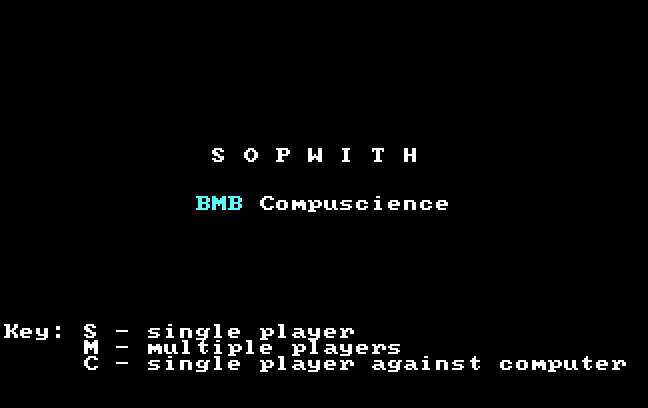
Ground targets like buildings and vehicles can be bombed or strafed for points, while enemy aircraft demand a completely different approach, forcing you to out-fly rather than out-shoot them. Sopwith also shipped with a two-player mode over a null-modem link, letting two players dogfight each other directly – an ambitious feature to include in a 1984 DOS title, and one that speaks to how seriously Clark took the multiplayer angle even this early on.
There’s very little presentation to speak of by later standards – CGA-era graphics, minimal sound, effectively no music to mention – but that austerity is honestly part of the charm now. Sopwith isn’t trying to impress you visually; it’s asking you to master a small, tight set of rules, and it trusts that the flight model alone is interesting enough to carry the whole game. For 1984, that was a reasonable bet, and it mostly still holds up.
Flying without crashing into your own runway
- Give yourself more runway than you think you need before attempting a landing; Sopwith’s momentum means you’ll drift further than instinct suggests.
- Practice pitch control in open air before engaging ground targets – strafing runs go wrong fast if you’re still fighting the controls while also dodging flak.
- Treat altitude as a resource. Diving builds speed you can’t easily shed, and climbing back up costs time you don’t always have mid-dogfight.
- In the two-player mode, fight over open terrain rather than near buildings; ground obstacles kill inexperienced pilots far more often than the other player does.
How it compares to what came after
Sopwith predates the wave of shareware action titles that would define DOS gaming later in the decade, and it shows: there’s no story, no progression system, just a tight little arcade loop. Compared to later biplane and dogfighting games it looks almost primitive, but that simplicity is part of its appeal. It’s closer in spirit to an arcade cabinet than to the increasingly systems-heavy PC games that followed it, and there’s something refreshing about a game this direct.
I’ll be honest: the momentum-based controls take real getting used to, and if you go in expecting something as forgiving as a modern indie flight game you’ll bounce off it in the first five minutes. Stick with it past that initial frustration, though, and it turns into one of the more satisfying “one more round” games from this era of DOS gaming, especially with a second player on the other end of a null-modem cable, or a modern equivalent.
What still impresses me most, decades on, is how deliberately unforgiving the physics are. Nothing about Sopwith cheats or feels arbitrary once you understand it; every crash traces back to a real misjudgment of speed or altitude, which is exactly the kind of design that keeps players coming back to “just one more attempt” long after flashier, more forgiving games from the same era have been forgotten entirely.
Getting a copy
Sopwith is legitimately free, source code and all, so there’s no shareware time limit or nag screen to deal with here. New to running old DOS software at all? Our DOSBox setup guide will get you oriented before you dive in.
Setting up the flight model in DOSBox
Extract the archive into a folder such as C:\GAMES\SOPWITH, mount it in DOSBox with mount c C:\GAMES\SOPWITH, switch to the drive with c:, and launch the EXE. Because Sopwith was written for such early, slow hardware, you’ll almost certainly need to drop DOSBox’s cycle count well below its default to get flight speed and control response feeling right – running it at modern default cycles makes the plane borderline unflyable. Our DOSBox setup guide explains cycle tuning for exactly this kind of situation, and it’s worth doing before your first flight rather than after a dozen confusing crashes you assume are your own fault.
Sopwith in Motion
You might also like: