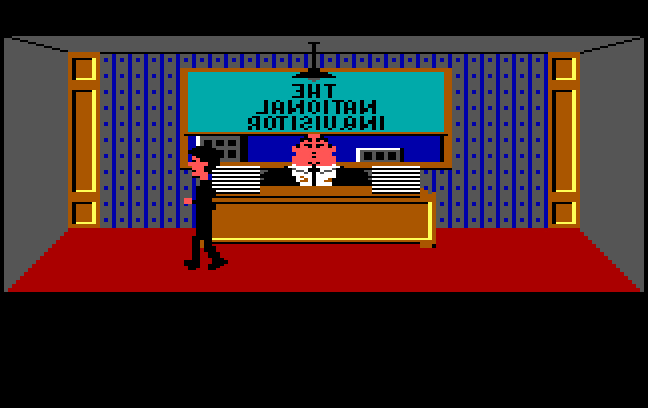
What does a tabloid reporter do when he stumbles onto proof that aliens are broadcasting a global “stupidity ray” to slowly dumb down humanity? If you’re Zak McKracken, you grab a photocopier, a Peruvian flute, and whatever else is lying around, and you start hopping continents to stop it. It’s a premise that sounds like it was written on a dare, and in a lot of ways it was — Lucasfilm Games in the late 80s was still figuring out how weird it could get.
SCUMM’s Second Outing
Zak McKracken and the Alien Mindbenders was the second Lucasfilm Games title built on the SCUMM engine, arriving in 1988 a year after Maniac Mansion proved the format could work. It’s a noticeably bigger swing than its predecessor: instead of one house, the game sends four playable characters across real-world cities and eventually off-planet, requiring you to coordinate between locations to make progress. For a studio that had just finished its first adventure game, that jump in scope was ambitious to the point of recklessness — and mostly, it pays off.
Splitting the Party Across the Planet
As the story unfolds, you recruit additional playable characters and switch between them to solve puzzles that require someone to be in one place while someone else is in another. The point-and-click verb interface will be familiar to anyone who’s played a SCUMM game, but the structure around it — mailing items between characters, coordinating long-distance travel, following a genuine “world tour” of locations — was unusually expansive for an adventure game of this era. Few games of 1988 asked you to think about logistics across four continents and a spaceship at the same time.
Where It Trips Up New Players
I’ll be upfront about this one: Zak McKracken has a reputation, deserved or not, for a few puzzles that lean harder on trial and error than modern adventure game design would ever allow. If you get stuck on something that seems to defy logic, you’re probably not missing something obvious — that’s just 1988 adventure game design showing its age. My advice: keep a written list of every unexplained item and location, because the solution to a puzzle in one city is very often sitting in your inventory from a completely different continent, and it’s easy to forget you’re carrying it.
How It Compares to Maniac Mansion
Where Maniac Mansion was a contained, almost sitcom-scale mystery inside a single haunted-adjacent house, Zak McKracken swings for something closer to a globe-trotting pulp adventure, closer in tone to a comic strip than a horror-comedy. The multiple-character mechanic carries over from Maniac Mansion, but here it’s stretched across a much larger map, which makes the character-switching feel more purposeful and less like a gimmick. If Maniac Mansion was Lucasfilm learning to walk with SCUMM, Zak McKracken is the studio testing how far it could run.
Getting It Running Today
The DOS version runs cleanly under DOSBox with no special tricks — mount the folder as a virtual drive, switch to it, and launch the game’s executable. If you’ve never configured DOSBox before, our complete setup guide walks through the basics of mounting drives and getting sound working correctly, which matters here since the game’s audio cues occasionally hint at solutions.
Why It’s Still Worth Your Time
Zak McKracken shows Lucasfilm Games pushing both the SCUMM engine and the adventure genre further just a year after Maniac Mansion, with a bigger world, more playable characters, and a considerably wilder science-fiction premise. It’s a key stepping stone between the studio’s earliest experiments and the celebrated adventures that followed later, and you can feel the confidence growing scene to scene. For players who enjoy globe-trotting mysteries with a strong sense of humor and don’t mind a puzzle or two that requires patience rather than logic, it remains an inventive, genuinely funny play, and one of the more interesting entries in Lucasfilm’s early catalog.
The Puzzle People Still Talk About
No discussion of Zak McKracken’s puzzle design is complete without mentioning the moment most veteran adventure gamers bring up unprompted: a sequence that requires exposing undeveloped photo film to a specific light source under conditions the game gives almost no direct hint toward. It’s become something of a cautionary tale in adventure game design circles, cited for decades afterward as an example of a puzzle that expects a leap of logic the player has no real way to arrive at on their own. If you hit a wall like that, know you’re not missing an obvious clue — you’ve just found one of the rougher edges of late-80s adventure design, and a walkthrough is a perfectly reasonable thing to reach for at that point.
A Character Roster With Real Range
Beyond Zak himself, the recruitable cast brings genuinely different skills to the puzzle-solving, which is part of why the character-switching never feels like padding. Each character’s unique access to certain locations or items means the game is quietly teaching you to think about four simultaneous storylines rather than one linear path, and piecing together how their journeys intersect is one of the most satisfying parts of watching the plot come together.
A Snapshot of Late-80s Lucasfilm
Playing Zak McKracken today is also a small window into how quickly Lucasfilm Games was iterating in its earliest years. Barely a year separates it from Maniac Mansion, yet the ambitions on display, four characters, multiple continents, an alien conspiracy spanning the globe and beyond, feel like the work of a much more experienced studio. That rapid growth in confidence is part of what makes the SCUMM-era Lucasfilm catalog such a rewarding thing to play through roughly in order, watching the format mature game by game.
You might also like: