Every LucasArts adventure game you’ve ever loved — Monkey Island, Day of the Tentacle, Sam & Max — owes its existence to a tool built for one specific game in 1987. That game was Maniac Mansion, and the tool was SCUMM.
Where SCUMM Began
Ron Gilbert and Gary Winnick designed Maniac Mansion for Lucasfilm Games, and in the process of building it they ran into a problem: the studio’s existing adventure tools weren’t flexible enough for what they wanted to do. Their solution was SCUMM — the Script Creation Utility for Maniac Mansion — a scripting system built specifically to let designers describe rooms, objects, and character behavior without hand-coding everything from scratch. It sounds like a small technical footnote, but SCUMM went on to power more than a decade of Lucasfilm and LucasArts adventures, from Zak McKracken through The Curse of Monkey Island. Maniac Mansion is where all of that started.
Dave, Sandy, and the Edison Family
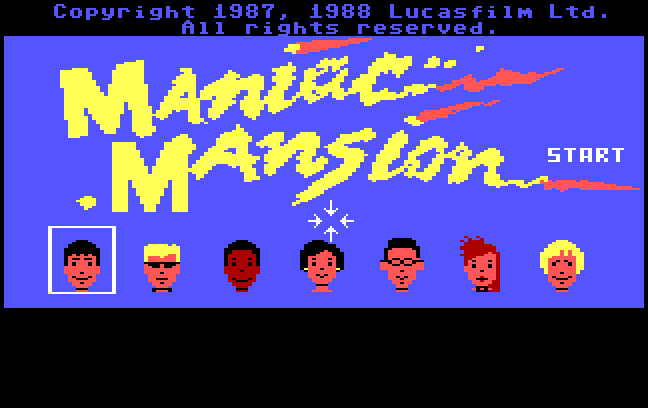
The plot is deliberately B-movie schlock: teenager Dave Miller’s girlfriend Sandy has been kidnapped by the mad scientist Dr. Fred Edison and dragged into his sprawling, booby-trapped mansion, which Dave sets out to infiltrate with two friends in tow. What made it unusual for 1987 was the roster system — you pick two companions from a group of teenagers at the start, each with a distinct skill (one might play music, another might be handy with electronics), and your choice actually changes which puzzles are solvable and how certain scenes unfold. The three characters can be split up and directed independently around the house at the same time, which was a genuinely novel way to structure an adventure game puzzle.
Getting the Most Out of Your Kids
- Pick companions with complementary skills rather than two characters who do similar things — the game is built around covering different puzzle types.
- Split the party deliberately. Sending all three characters to the same room wastes the time-based structure the game is built on; have one search while another distracts an Edison family member.
- Watch the family’s patrol routes. Nurse Edna, Dr. Fred, and the rest wander the house on their own schedules, and getting caught doesn’t always mean game over, but it’s rarely good news.
- Experiment with the verb interface freely — Maniac Mansion is generous about letting you try weird combinations, and a fair few of the game’s best jokes are hidden behind actions most players wouldn’t think to try.
- There are multiple endings depending on which characters survive and how you handle the back half of the mansion, so it rewards more than one playthrough.
From Mansion to Empire: What It Led To
Part of what made Maniac Mansion feel different from the Sierra and Infocom-style adventures of the mid-1980s was a growing frustration, shared across the small team, with puzzle design that could quietly doom a playthrough hours before the player noticed anything had gone wrong. The multiple-character system wasn’t just a gimmick for variety’s sake — it gave players more than one path through a given obstacle and more than one character whose particular skill might unlock a solution. That philosophy of fairness would harden into an explicit design rule at LucasArts within a few years, and it’s not hard to trace a line from Maniac Mansion’s rougher edges to the studio’s later, much stricter no-dead-ends policy that games like Monkey Island and Sam & Max would follow to the letter.
It’s easy to undersell how much followed from this one game. Beyond SCUMM itself, Maniac Mansion set a template LucasArts would refine for years: light horror or sci-fi trappings played mostly for comedy, multiple playable characters, and puzzles that are hard but almost never unfair. A stripped-down NES port introduced the game to a console audience, and a sequel — Day of the Tentacle — would go on to become one of the most beloved adventure games ever made, bringing back Dr. Fred, the mansion, and a returning cast of characters. Zak McKracken followed soon after on the same engine, cementing SCUMM as Lucasfilm’s house adventure tool for the next decade.
How It Holds Up
What surprises modern players most is how playable Maniac Mansion still is. It’s rougher than its SCUMM descendants — there are a handful of situations where you can lock yourself out of finishing the game, something LucasArts would later swear off entirely with its non-fatal, non-dead-end design philosophy — so it pays to save often. But the writing has aged well, the puzzle logic mostly makes sense once you understand the mansion’s rhythms, and the sheer novelty of directing three characters at once still feels fresh. My honest advice: keep multiple save slots and don’t be afraid to restart a scene if you sense you’ve missed a window, because a few of 1987’s design habits (timed events, occasional dead ends) haven’t entirely gone away.
Getting It Running
If you haven’t set up DOSBox before, walk through our DOSBox setup guide first — it covers mounting drives and getting sound working, which matters here since Maniac Mansion supports early PC sound hardware that needs to be configured correctly to hear the (admittedly sparse) music and effects. Once DOSBox is installed, mount the folder containing your copy with mount c [folder], switch to it with c:, and run the game’s executable to start it up.
Watch Gameplay
You might also like: