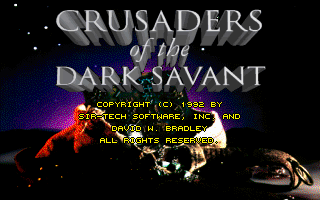
By 1992 the Wizardry series had been running for a decade, and Sir-Tech used that decade of experience to build something genuinely sprawling. Crusaders of the Dark Savant is the direct sequel to Wizardry VI: Bane of the Cosmic Forge, and it rewards players who still have their old party file: import your six adventurers, equipment and all, and pick up exactly where Bane of the Cosmic Forge left off.
The Cosmic Forge and the world of Guardia
The plot picks up after the Cosmic Forge, a reality-altering artifact, is stolen by a servant of the mysterious Cosmic Lords and carried off to the planet Guardia. Guardia isn’t an empty dungeon waiting to be looted; it’s a contested world. The militaristic Umpani Federation and the alien, spider-like T’Rang are both hunting for the pieces of the Astral Dominae, and so is the game’s namesake, the Dark Savant. Whoever assembles the Dominae first effectively controls the fate of the Forge, and the factions won’t wait politely for your party to catch up.
Building (and rebuilding) your party
Character creation is still the heart of Wizardry, and VII gives you fourteen professions and eleven races to combine, whether you’re importing veterans or rolling up a fresh crew. New skills — swimming, climbing, and diplomacy among them — reflect how much more the game wants you to talk your way through Guardia instead of just fighting through it, and a learnable mapping skill finally gives the series a proper in-game automap instead of graph paper. Magic is still split across four schools and six elements, and, true to the series, spells and weapon skills improve through use rather than being bought outright with experience points. Wizardry VII is also just physically bigger than its predecessor: instead of a single fortress-dungeon, you’re moving between full towns, open forest, and several connected dungeon complexes, with NPCs who pursue their own goals independent of the party.
Combat rewards planning your formation as much as your spell list. Melee professions belong up front soaking hits, while mages, priests, and bishops stay in the back row where enemies have a much harder time reaching them. Wizardry VII expects you to keep track of six distinct professions at once, each improving skills at its own pace through use, and getting the formation wrong is one of the fastest ways to lose a promising character to a single bad encounter early on.
Where the design gets ambitious
A few things I’d tell a first-time player: don’t ignore the diplomacy skill, since talking your way past a hostile encounter is often safer than a fight your party isn’t built for yet; put someone on mapping duty early, because Guardia’s dungeons are large enough that you’ll regret not having it; and treat faction quests as time-limited, since the Umpani and T’Rang are actively racing you for key items and will simply take them if you dawdle. That reactive world is what still makes Wizardry VII stand out next to contemporaries like the Might and Magic series or Ultima Underworld — those games gave you a rich space to explore, but Guardia is a rich space other people are also trying to win.
The series eventually closed out Guardia’s story arc nine years later in Wizardry 8, released in 2001 by much of the same core team, not long before Sir-Tech itself folded. It’s worth remembering, too, that Wizardry’s commercial life didn’t end with Sir-Tech’s American studio — the brand carried far more weight in Japan than it ever regained in North America, and licensed Japanese-developed sequels and spin-offs kept the name alive for years after Western fans had mostly moved on to other RPG series.
Getting it running in DOSBox
If DOSBox is new territory for you, our setup guide covers the basics end to end, and it’s worth a look before diving into something this dense. Once you have the files, mount the game’s folder as drive C, switch to it, and run the game’s EXE from the installation directory. Combat calculations in Wizardry VII can bog down at high cycle counts on modern hardware, so if fights feel oddly sluggish or too fast, that’s your cue to adjust DOSBox’s cycles setting rather than assume something’s broken. The GOG release is pre-packaged to run with minimal fuss if you’d rather skip the manual setup entirely, and it’s the version I’d point a first-time buyer toward, since matching period sound card settings by hand on original floppy or CD media is one of the more fiddly setup jobs in the whole Wizardry catalog.
Is it still worth the time investment?
Plenty of longtime RPG fans still call Crusaders of the Dark Savant the high point of classic Wizardry — there’s genuinely hundreds of hours here between the main quest, faction politics, and the sheer amount of optional territory to poke around in, plus the option to betray any faction you’ve allied with. My honest caveat: the interface is dense and text-heavy by modern standards, first-person tile-based movement takes some patience, and there’s very little hand-holding if you haven’t played Wizardry VI first. If you have, or if slow, methodical party-based RPGs are your thing, this is still an essential stop. Compared to modern RPGs that hold your hand through objective markers and quest arrows, Wizardry VII trusts you to take notes, get lost, and occasionally walk into a fight you had no business starting — that’s a real ask in 2026, but it’s also exactly what fans of the genre’s older, harder edge come looking for. Few RPGs since have matched the sheer density of systems Sir-Tech crammed into this one release.
Watch Gameplay
You might also like: