Ask where Epic Games really began and most people will point to Unreal or Gears of War. The honest answer is a text-mode dungeon crawler with a built-in level editor, made by a teenager who would go on to reshape the entire industry.
Tim Sweeney’s first game, and his most influential
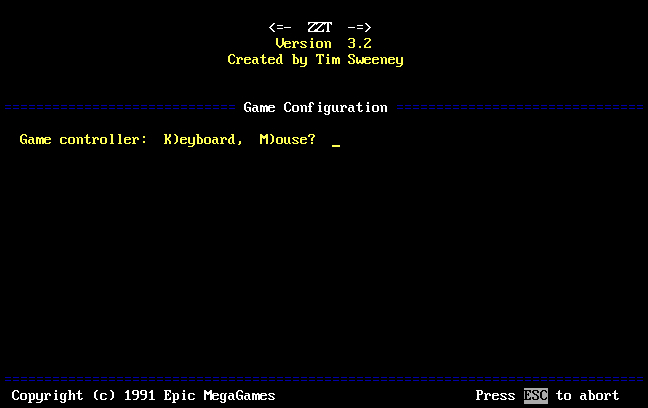
ZZT was created by Tim Sweeney in 1991, originally distributed through his own small company, Potomac Computer Systems, before Epic MegaGames took over publishing and gave it a much wider reach. Built entirely from ASCII and extended text-mode characters, it combines simple puzzle-adventure gameplay with something far more significant: an editor that let ordinary players build and share their own custom worlds without needing to know how to program.
That editor is the whole story. It turned ZZT into one of the earliest widely-used game creation tools for everyday PC users, spawning a sprawling community of amateur level designers throughout the 1990s. It also marked the true beginning of Sweeney’s career, the same person who would go on to found Epic Games and create the Unreal Engine that still powers major releases decades later.
It’s worth sitting with just how direct that line actually is. The company that eventually built Fortnite and licensed its engine to hundreds of other studios started with a text-mode dungeon crawler sold out of Sweeney’s home as a one-person shareware operation. Few franchises in gaming can trace so clean a thread from bedroom-coded shareware to industry-defining technology, and ZZT is the actual starting point of that thread, not a mythologized origin story.
Simple rules, a surprising amount of depth
In its included worlds, ZZT has players navigating text-mode mazes, solving puzzles, collecting gems and keys, and battling simple enemies represented as colored characters on a grid. Movement is tile-based, and much of the challenge comes from learning how each object and creature type behaves, since ZZT’s rules are consistent but occasionally unforgiving to players who haven’t figured out a particular enemy’s pattern yet.
What separates it from other text-mode games of its era is that same built-in editor, letting players design their own levels using the identical objects, enemies, and scripting logic found in the official worlds. The library of fan-made ZZT worlds created over the following decade remains one of gaming’s earliest and most enduring user-generated content scenes, predating mod culture as most players understand it today.
Those fan worlds ranged wildly in ambition, from simple puzzle rooms clearly made by a first-time creator to sprawling multi-part adventures that pushed ZZT’s scripting language far past what the official worlds ever attempted. Browsing that back catalog today is its own kind of history lesson in how quickly amateur creators outgrow the tools they’re handed.
Getting the most out of it
- Learn enemy movement patterns before engaging; several creature types have predictable but unforgiving behavior once you understand them.
- Collect keys even if you don’t see their matching door yet. ZZT worlds frequently backtrack you through earlier areas.
- If you’re curious about the editor, start by opening one of the included worlds in edit mode rather than building from scratch. Seeing how existing puzzles are scripted teaches the object logic faster than a blank canvas does.
- Don’t rush combat encounters. ZZT’s grid-based movement rewards patience over reflexes.
- Save progress at natural checkpoints within a world; not every ZZT world autosaves the way you’d expect from a modern game.
A legacy far bigger than its graphics suggest
ZZT holds a genuinely special place in gaming history as the starting point for Tim Sweeney’s career and one of the earliest examples of a commercially distributed game creation kit reaching everyday PC users, years before tools like RPG Maker or Klik & Play popularized the same idea. Its influence on user-generated content stretches far beyond its own modest text-mode graphics.
What’s also worth appreciating is how the ZZT community itself became a kind of informal training ground. A generation of people who later worked in game design and programming got their first real experience building interactive systems inside ZZT’s scripting language, long before “modding” was a word anyone used casually. It’s a legitimately overlooked chapter in the broader history of user-generated content in games.
Free download
New to DOSBox? Our complete setup guide walks through everything you need, and our free DOS games list is worth a look afterward for more of this era’s shareware standouts.
Setting up ZZT in DOSBox
Extract the files into their own folder, mount it with mount c [folder], switch over using c:, and launch the EXE. Once it’s running, you can play the included worlds or jump straight into the built-in editor to start building. See our DOSBox guide above if you hit any setup snags.
Why you should still play it
For retro fans, ZZT is worth experiencing both for its charmingly simple puzzle-adventure worlds and as history behind one of the industry’s most influential companies. With its creation tools included and the whole package free, it’s an unusually accessible piece of history to explore firsthand.
The official worlds alone are a little slight if judged purely as a game, and I won’t pretend they’re the main event. The real draw is opening the editor and seeing how much creative mileage Sweeney squeezed out of such a simple rule set, and that’s an experience that rewards curiosity far more than it rewards expecting a polished, lengthy campaign.
Watch Gameplay
You might also like: