If you’ve ever played Worms, or one of the hundred browser-based tank artillery clones that followed it, you’ve already played a distant descendant of Scorched Earth. The original still holds up, it costs nothing, and it will still eat an entire afternoon if you let it.
“The mother of all games,” by its own admission
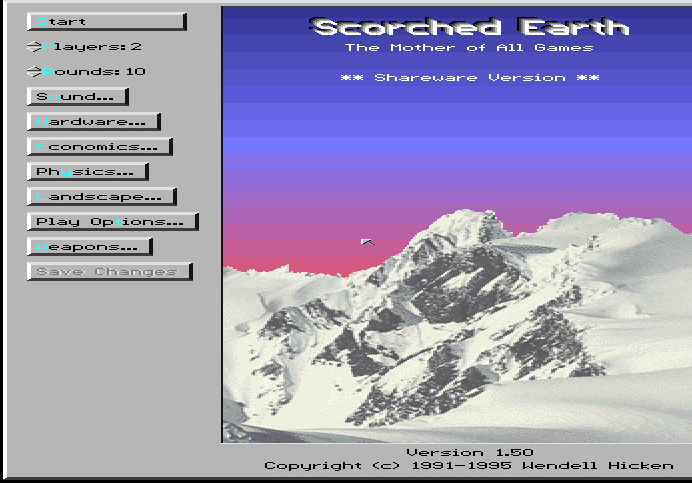
Scorched Earth was created by Wendell Hicken and released for MS-DOS in 1991, one of countless small shareware projects competing for attention that year. Its own splash screen nicknamed it “the mother of all games,” and while that’s obviously tongue-in-cheek, the claim has aged into something closer to accurate given how much later artillery gaming borrowed from its formula. The game tasks up to ten players with commanding tanks and blasting each other off a destructible, randomly generated landscape using an enormous arsenal of weapons.
Distributed as shareware, it spread through the early ’90s DOS scene about as widely as any game of its size could, thanks to a small download size, simple pick-up-and-play format, and no learning curve beyond angle and power.
Part of its reach came down to raw practicality: it was small, ran on nearly anything, and worked as hotseat multiplayer, which meant it spread through offices, schools, and dorm computer labs the way few other games of the period could. Scorched Earth is one of those titles that a huge number of people from this era have a specific memory of playing on a machine they weren’t supposed to be using for games at all.
Angle, power, and an escalating arms race
Each round has players taking turns adjusting a shot’s angle and power, then firing across the battlefield while accounting for wind, gravity, and terrain. Landscapes deform with every explosion, gradually reshaping the map and opening or closing lines of fire as a match progresses, which means no two games play out quite the same way even on identical terrain seeds.
Between rounds, players spend earned cash on an expanding arsenal, from simple shells to absurdly over-the-top options like the Death’s Head and MIRV warheads, plus shields, parachutes, and other survival tools. The combination of dead-simple controls, escalating weapon variety, and configurable weather and economy settings gives it real replay value whether you’re playing a quick match or a marathon session against friends.
The economy settings deserve special mention, since they let a group tune matches to their exact preference: fast, cash-rich rounds where everyone’s throwing around the ridiculous top-tier weapons within minutes, or slower, scarcity-driven matches that reward careful shot placement over brute force. Few games this simple offer that much control over their own pacing.
Getting good at it
- Learn wind indicators before worrying about exact angles; misjudging wind ruins more shots early on than bad math does.
- Don’t blow your whole budget on one big weapon. A mix of cheap shells and one or two situational specials outperforms an all-in purchase most rounds.
- Watch how the terrain deforms after each hit; craters change sightlines, and a shot that missed last round might have a clear path now.
- Save some cash for a shield or parachute rather than spending everything on offense. Survivability wins longer matches as often as firepower does.
- Agree on wind and terrain settings before a match starts if you’re playing with a group. Small rule tweaks change the game’s pace more than most players expect.
The lineage it started
Scorched Earth’s DNA is visible in decades of later games that borrowed its turn-based, terrain-destroying formula, most famously Worms, but also countless browser and mobile artillery clones that followed the same basic loop. Its concept also echoes earlier, more obscure BASIC tank games from the same period, though Scorched Earth is the one that actually stuck and spread.
What separates it from most of its imitators, even decades later, is how well the weapon economy holds up. The escalating arsenal gives even a losing player something to work toward between rounds, which is a subtler piece of design than the destructible terrain gimmick that usually gets all the credit. A lot of later artillery games copied the explosions and forgot to copy the economy that made repeated matches worth playing.
Downloading it
New to DOSBox? Our complete setup guide walks through everything you need to get multiplayer running properly.
Running it with DOSBox
Extract the files into their own folder, mount that folder with mount c [folder], switch to it using c:, and launch the EXE from the DOS prompt. The game runs comfortably on modest cycle settings, and hotseat multiplayer works fine on a single machine; check our DOSBox guide above if you need help configuring anything.
Still worth loading up today?
Absolutely. Whether you’re a Worms fan curious about the source, or just want a simple, endlessly replayable multiplayer game to fire up with friends, Scorched Earth remains one of the most enduring shareware releases of the entire DOS era, and it costs nothing to find out why.
The one real weakness is single-player: the CPU opponents get the job done but lack the personality and unpredictability of a human across the table, so if you’re only ever going to play solo, temper your expectations accordingly. Gather a couple of friends around one keyboard, though, and it’s still one of the most purely fun things you can load into DOSBox.
Watch Gameplay
You might also like: