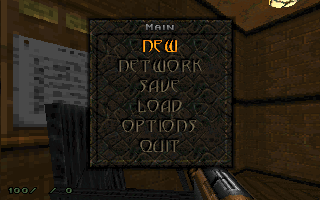
In 1997, most first-person shooters were still drawing their enemies as flat, billboard sprites — even Duke Nukem 3D and Blood, celebrated as they were. Chasm: The Rift, built by the Ukrainian studio Action Forms, took a different route: fully modeled, polygonal enemies you could hack apart limb by limb, years before that level of destructibility became a genre standard.
One of Eastern Europe’s First FPS Exports
Chasm: The Rift is notable simply for where it came from — it’s one of the earliest first-person shooters to emerge from Eastern European development at a time when the genre was overwhelmingly dominated by American studios. The premise sends you hopping between loosely connected time periods, from medieval castles to futuristic labs, fighting knights, robots, and monsters with a weapon roster that spans swords, firearms, and experimental tech.
What made it stand out technically wasn’t just the time-travel conceit but the engine underneath it. Building a custom engine capable of rendering full 3D enemy models rather than sprites was a serious undertaking for a small studio in 1997, and it let Action Forms show off features — limb-by-limb dismemberment, destructible scenery — that wouldn’t become common in the genre for years afterward.
Getting a game like this out of a small, independent Ukrainian studio and onto Western store shelves was itself a considerable achievement in the late 90s, when international publishing deals for Eastern European developers were still rare. That Action Forms managed it with a technically ambitious original engine, rather than licensing an established one, makes Chasm: The Rift’s existence almost as interesting as what’s actually on screen.
Building a custom engine rather than licensing Build or one of id Software’s technologies also meant Action Forms had to solve problems — true 3D collision, real-time model damage — without the benefit of an established codebase other studios were already troubleshooting collectively. That kind of from-scratch engineering was a much bigger gamble for a small studio than it would have been for an established Western publisher with deeper resources to fall back on.
Getting Through the Rift Without Getting Cornered
- Early levels favor melee weapons against knights and armored enemies; save firearms and ammo for the harder-hitting foes in the later, more futuristic stages.
- Use the destructible scenery deliberately — blowing holes in weak walls can open shortcuts or escape routes when a room gets overwhelming.
- Watch enemy behavior after a partial dismemberment. A creature missing a limb often changes its attack pattern rather than simply losing power, so don’t assume a wounded enemy fights the same way.
- Each time period has its own enemy roster and architecture, so don’t carry assumptions about hazards from one era into the next — a tactic that works against medieval knights won’t necessarily work against futuristic guards.
- Keep moving during larger fights rather than trading hits head-on; the 3D enemy models give combat a more physical, positional feel than sprite-based shooters, and standing still is punished harder here.
Destructible Environments as a Design Statement
It’s worth separating the shock value of dismemberment from the quieter, arguably more forward-looking feature sitting next to it: physics-driven, destructible environments. Blowing a hole through a wall to create a shortcut, or knocking down an obstacle to change the shape of a room mid-fight, gave levels an interactivity that almost nothing else on shelves in 1997 offered. Most contemporaries treated their levels as fixed geography; Chasm: The Rift treated them as something you could reshape under pressure.
That’s a genuinely different design philosophy from the memorize-the-level approach most FPS games of the era encouraged, and it rewards players who experiment with the environment rather than just running the intended route. It’s easy to overlook next to the more headline-grabbing dismemberment system, but it’s arguably the more influential idea buried in this game.
A Quiet Stepping Stone in FPS History
It’s easy to overstate Chasm: The Rift’s influence — it never reached the audience id Software or 3D Realms commanded, and most players in 1997 never heard of it. But held up against Quake, which was pushing the genre toward true 3D that same year, Chasm’s willingness to render its combatants as full models rather than sprites feels like a genuinely parallel experiment rather than an imitation. That ambition, largely unnoticed at the time, is exactly why FPS historians still bring it up today.
My honest read: the destructibility and dismemberment are still the highlight, but the time-hopping structure means the game never quite settles into one consistent identity, and some of the later futuristic levels lean on firepower over the more distinctive melee-vs-sword-and-crossbow combat of the earlier ones. It’s worth playing for the technical curiosity as much as for the moment-to-moment action.
The other honest note: enemy AI doesn’t always keep pace with the technical ambition on display elsewhere. Opponents can behave predictably once you’ve learned their patterns, which is a minor letdown given how much effort clearly went into the visual and physical side of combat. It doesn’t undercut the achievement, but it’s a reminder that Chasm: The Rift was still a small studio’s first major swing at the genre.
Tracking Down the Rift
If DOSBox is unfamiliar territory, our setup guide walks through the basics step by step.
Getting It Running in DOSBox
The GOG release ships a modernized version alongside the original, and its installer handles DOSBox setup automatically for the classic build. For an original DOS copy, mount the game’s folder as a virtual drive with mount c [folder], switch to it using c:, and launch the EXE from the DOSBox prompt — our guide above covers every step in detail.
The Rift in Motion
You might also like: