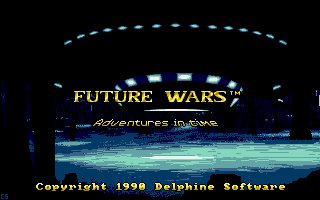
Delphine Software’s very first adventure
Future Wars: Adventures in Time was Delphine Software International’s debut in the adventure genre, created by programmer and writer Paul Cuisset and released in 1989, first for the Amiga and Atari ST before arriving on MS-DOS. It introduced the Cinematique Evenementielle interface, an icon-driven point-and-click system that would go on to define the studio’s next several games, with visuals from artist Eric Chahi, who would later create the landmark cinematic platformer Another World.
The story follows John Kraft, a window cleaner who stumbles into a time-travel plot involving an alien invasion. Chased across different historical eras, from prehistory to the far future, Kraft must gather clues and objects to prevent a machine invasion of Earth. The premise gave Delphine room to experiment with varied settings and tones across a single adventure, something few competitors were attempting at the time, and it set the template for the studio’s next decade of adventure design.
One right-click menu, four historical eras
Future Wars uses a streamlined verb interface: left-clicking moves the character, while right-clicking opens a small popup menu of context-sensitive actions such as Examine, Take, Operate, and Use. This kept the screen uncluttered compared to the sprawling verb lists common in adventures of the period, and it let the game focus attention on its environments and puzzles rather than on interface management.
Puzzles typically involve collecting items in one time period and using them in another, so you’re constantly moving back and forth between eras to unlock new areas and solutions. There’s no combat or real-time pressure, but a handful of sequences are unforgiving of missteps, in keeping with the design conventions of late-eighties adventure games. The shifting settings, from a medieval castle to a futuristic space station, keep the pacing varied throughout the runtime in a way a lot of single-setting adventures from the same period simply can’t match.
What’s easy to underrate on a first playthrough is how much visual variety Delphine packed into a single 1989 adventure game. Most contemporaries stuck to one consistent setting and tone for their entire runtime; Future Wars asks its artists to render a convincing prehistoric landscape, a medieval fortress, and a science-fiction space station all within the same game, and the fact that all three feel distinct rather than reused is a real achievement for the hardware of the time.
A few things to know before you start
- Carry items between eras liberally – an object picked up in one time period is very often the exact solution to a puzzle in a completely different one, and the game rarely tells you this outright.
- Examine everything with the right-click menu before moving on from a screen; Future Wars hides a fair number of interactive objects in otherwise unremarkable backgrounds.
- Save before entering a new historical era for the first time, since a few sequences can be missed or fumbled if you don’t already have the right item on hand.
- Don’t assume a locked door or blocked path is permanent; revisiting a location after solving a puzzle elsewhere often opens up new options.
The interface that launched a studio
Future Wars matters historically as the game that established Delphine’s signature interface and aesthetic, groundwork the studio would build on for Operation Stealth and Cruise for a Corpse. Its clean, low-friction control scheme was a genuine step forward for the genre and influenced how later point-and-click games streamlined their own interfaces, trimming down the unwieldy text-parser and giant verb-list designs that had dominated adventure gaming up to that point.
My honest opinion: it shows its age in places, particularly in a couple of trial-and-error sequences that feel more like a relic of the era than a deliberate design choice, but the time-travel structure and the sheer variety of settings keep it consistently interesting from start to finish. It’s a genuinely fun, tightly-paced adventure with a likeable everyman protagonist, and a great entry point for players curious about Delphine’s catalog before diving into the studio’s later, more polished efforts. John Kraft’s ordinariness is actually part of the charm; unlike the wizards and secret agents that populate most adventure games of the era, he reacts to the plot’s escalating absurdity roughly the way you’d expect a window cleaner to, which keeps the tone grounded even as the setting jumps from cavemen to spaceships. That grounded reaction is a big part of why the game still reads as charming rather than dated, more than three decades after its original release on Amiga and Atari ST, and long after most of its contemporaries have been forgotten outside of dedicated retro-gaming circles entirely. It’s a debut that a lot of established studios would be happy to claim decades into a career, let alone as their very first commercial release in the adventure genre as a whole.
Sourcing a copy
Never used DOSBox before? Our step-by-step DOSBox guide covers installation and configuration. More legally free classics live in our free DOS games roundup.
Future Wars is a commercial title and is not legally available as a free download. Look for official re-releases on GOG or Steam.
Setting it up
Mount the folder containing your game files with mount c [folder], switch to that drive with c:, and run the EXE. If you’d rather skip manual DOSBox configuration, Future Wars is also supported by ScummVM’s Cine engine, which was built specifically for this game and its Delphine stablemate Operation Stealth. See our DOSBox guide for full configuration details either way.
Time Travel in Motion
You might also like: