What do you do when an alien fast-food mogul decides Earth’s population is the secret ingredient in the galaxy’s most popular burger?
A Comedy Adventure Born From the CD-ROM Boom
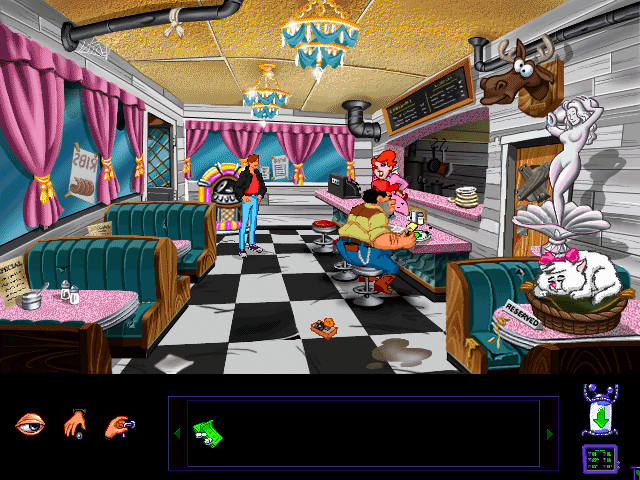
Sanctuary Woods developed Orion Burger and Eidos Interactive published it in 1996 for MS-DOS and Macintosh, right as CD-ROM adventure games were leaning hard into grim mysteries and celebrity-filled FMV. Orion Burger went the opposite direction, building its identity around cartoon visuals and a script that spoofs both fast-food culture and decades of alien-invasion movie cliches. The approachable difficulty and comfort with broad, family-friendly humor set it apart from the more cynical tone a lot of mid-90s CD-ROM adventures reached for in their pursuit of a mature, cinematic image.
Saving Earth, One Puzzle at a Time
You play an ordinary Earthling pulled into the scheme of Zlarg, an alien entrepreneur planning to turn the planet’s population into the secret ingredient of his burger chain. Gameplay follows standard point-and-click conventions — move, examine, collect, combine — across a series of brightly colored locations populated by an oddball supporting cast. The tone stays consistently light even as the stakes technically involve the end of humanity, which is really the whole joke: nobody in this world, including the villain, treats the apocalypse with the gravity you’d expect.
Tips for a Smooth Playthrough
- Don’t overthink the puzzles — Orion Burger favors logical, straightforward item combinations over the obscure leaps common in tougher 90s adventures.
- Talk through every dialogue option with each character before moving on; the comic writing is a bigger draw here than the puzzle difficulty.
- Keep every item you pick up. The game rarely punishes over-collecting, and hoarding beats guessing later.
- Because the pacing is forgiving, it’s a good pick if you want to introduce someone new to point-and-click adventures without frustrating them early.
- Enjoy the environments for their own sake — the game’s brightest, most colorful locations are worth exploring fully even after you’ve technically solved whatever puzzle brought you there.
A Lighter Alternative to Its Genre Peers
Set next to the gothic mysteries and cerebral science fiction that dominated mid-90s CD-ROM adventures — think Phantasmagoria or The Journeyman Project — Orion Burger’s refusal to take itself seriously is its whole appeal. It sits closer in spirit to Sam & Max Hit the Road or Toonstruck than to its more self-serious contemporaries, prioritizing gags and personality over atmosphere or dread. Where a lot of CD-ROM adventures of the period spent their storage budget on grainy full-motion video of live actors, Orion Burger spent it on more animation frames and bigger, more expressive cartoon sprites, which has honestly aged better than most of the FMV experiments from the same window of years.
Eidos Interactive’s role as publisher is also worth noting — this was still a few years before the company became synonymous with Tomb Raider and a very different kind of blockbuster action game, and Orion Burger is a reminder that Eidos’s early catalog was considerably more varied than its later reputation might suggest.
A Cult Favorite, Deservedly
It’s become something of a cult pick among adventure game collectors precisely because it never chased prestige. In a genre often remembered for its gothic mysteries, Orion Burger’s willingness to be genuinely silly gives it a personality that still stands out decades later. Zlarg himself is a genuinely memorable villain in a very specific, low-stakes way — less a menacing alien overlord than a slick corporate huckster who happens to be from outer space, which fits the game’s satirical target of consumer fast-food culture more precisely than a more traditional invasion plot would have.
Where to Legally Get a Copy
Orion Burger is a commercial release with no legitimate free download available, so keep an eye out for it on GOG or Steam if it resurfaces. Our complete DOSBox setup guide is the place to start if this is your first time configuring an old CD-ROM adventure.
Macintosh players had access to the same game in 1996, a reminder that cross-platform CD-ROM releases were increasingly common by the mid-90s as publishers looked to maximize the reach of increasingly expensive multimedia productions.
Setting Up the CD-ROM Release in DOSBox
Mount your game folder as C: and launch the EXE as usual, but since Orion Burger shipped on CD-ROM with digitized art and audio, you’ll also need to mount the CD image separately for everything to play correctly — our DOSBox guide covers that process along with sound card setup. If the digitized speech sounds garbled or cuts out, double-check that DOSBox’s sound card emulation is set to Sound Blaster 16 with the correct IRQ and DMA values rather than the default Adlib-only configuration, which won’t play digitized voice at all.
The Bottom Line
Orion Burger isn’t a technical showcase or a genre-defining classic, and it won’t take long before you notice how simple its puzzle logic really is. But as an afternoon of gentle, well-written comedy from a genre that too often took itself deadly seriously, it’s still a charming way to spend a couple of hours, and a reminder that not every 90s adventure needed a body count. If your usual complaint about CD-ROM-era adventures is that they’re too grim or too slow, this is one of the friendlier detours the genre has to offer. It’s also a genuinely good pick for playing alongside a kid or a curious non-gamer, since neither the puzzles nor the tone ask much prior genre knowledge to enjoy.
Watch the Full Orion Burger Playthrough
You might also like: