Not every literary adaptation tries to compress an entire fantasy series into a single game. Death Gate had the advantage — and the challenge — of adapting a novel cycle that was still actively being written.
A Faithful Trip Through the Death Gate Cycle
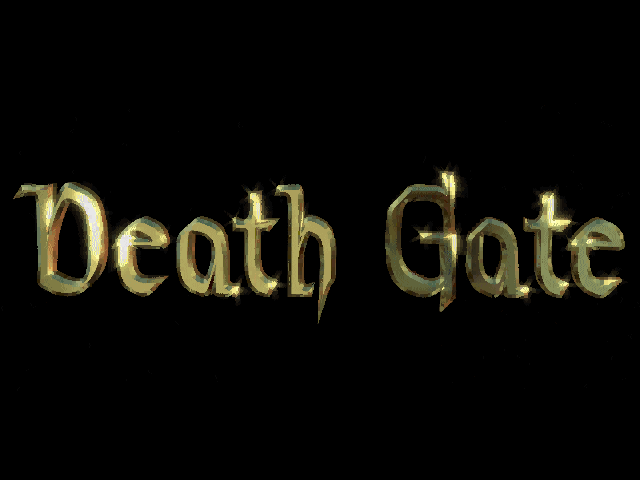
Death Gate is a fantasy adventure developed and published by Legend Entertainment in 1994, loosely based on Margaret Weis and Tracy Hickman’s Death Gate Cycle novel series. Designed by Glen R. Dahlgren, it follows a young hero from a race unjustly banished from the five realms by the technologically advanced Sartan, who must journey across all five realms to gather the seal pieces needed to restore his people’s place in the world. It continued Legend’s tradition of blending rich text-based interaction with detailed fantasy artwork, following the studio’s earlier literary adaptations, and its atmospheric presentation and mature fantasy tone made it well regarded among adventure fans of the mid-90s.
Adapting a story mid-publication also meant Legend couldn’t simply lean on readers already knowing how everything resolves, which forced the game’s writers to build a genuinely self-contained arc that respects the Death Gate Cycle’s tone without requiring players to have caught up on every published novel first.
Haplo’s Magic as a Puzzle Tool
The whole game is played from a first-person perspective, combining detailed static illustrations of each realm with substantial text description and dialogue. You interact through selectable verb commands, examining objects, talking to characters, and solving puzzles that span the game’s five distinct fantasy realms. The standout system is protagonist Haplo’s ability to cast magic spells, which becomes essential to solving many of the game’s puzzles and navigating obstacles unique to each realm — this isn’t flavor magic, it’s a genuine mechanical toolkit you’re expected to use creatively as you move between worlds.
Tips for Surviving the Five Realms
- Learn Haplo’s spells as soon as they’re available and experiment with them against realm-specific obstacles rather than saving them only for obvious “magic puzzle” moments the game flags explicitly.
- Read the game’s text descriptions in full. Because Death Gate leans harder on prose than most Legend titles, skimming costs you real information you’ll need later in a different realm entirely.
- Keep track of items and clues by realm — the five-realm structure means backtracking across worlds is common, and it’s easy to forget what you found where without your own notes.
- Don’t assume a puzzle is purely mechanical. Given the game’s roots in Weis and Hickman’s dense worldbuilding, some solutions hinge on understanding the Sartan/banished-race conflict rather than just combining items in your inventory.
Death Gate Compared to Legend’s Other Fantasy Titles
Next to Companions of Xanth’s lighter, pun-driven tone, Death Gate is a much heavier, more atmospheric game, closer in spirit to a proper fantasy epic than a comedic romp. Compared to Shannara, which adds an explicit battle system, Death Gate keeps its challenge purely in exploration, dialogue, and Haplo’s spellcasting rather than combat — which makes it feel more like Legend’s earlier text-heavy interactive fiction than its later, more graphically driven work. Of the three, it’s the one most likely to reward players who genuinely love reading over players who just want to click through a story.
Legacy: Adapting a Series Still Being Written
That’s the kind of creative risk publishers rarely take on licensed properties today, which makes Death Gate an interesting relic of a period when game studios had more room to experiment with unfinished source material.
What makes Death Gate unusual among licensed adaptations is timing — Weis and Hickman were still writing new entries in the Death Gate Cycle when this game came out, which meant Legend was adapting an unfinished story rather than a settled, complete work. That’s a genuinely harder task than adapting a finished series, and it’s part of why the game leans on original puzzle and exploration structure rather than trying to faithfully retell specific novel scenes beat for beat. Decades later, it’s remembered as one of the more ambitious literary game tie-ins of its era specifically because of that gap between game and source material, not despite it.
DOSBox Configuration Notes
Death Gate is a commercial release without a legitimate free-download option, so look for it through official re-releases where available. Copy the installed game to a folder, then in DOSBox use mount c [folder] followed by c: to access it, and run the executable to start. Our DOSBox guide covers memory and sound setup tips that help with Legend Entertainment’s adventure titles from this era, which can need specific extended-memory configuration to run smoothly.
Final Verdict
Death Gate is a standout example of Legend Entertainment’s ambition to merge interactive fiction’s depth with graphical adventure accessibility. The five-realm structure and Haplo’s spellcasting give it a scope and mechanical variety that many adventure games of the period didn’t attempt, and its ties to Weis and Hickman’s novels add fantasy world-building rarely seen in games of the time. The density that makes it rewarding also makes it demanding — this is not a game to breeze through in an afternoon, and players who prefer lighter, faster-paced adventures may find the sheer volume of text a slog rather than a pleasure.
If you’re willing to read carefully and experiment with Haplo’s magic, though, it’s one of Legend’s most rewarding fantasy titles. My honest take: it asks more patience of you than Companions of Xanth or Shannara, but it pays that patience back with a genuinely mature, atmospheric fantasy story that few other adventure games from 1994 even attempted.
Watch Gameplay
You might also like: