From Haunted Castle to Cursed Film Studio
Two years after the original Elvira, Horror Soft and Accolade returned with a sequel that swapped the gothic castle for a genuinely stranger location: a horror movie studio built on cursed ground, where the props and sets have come to life as real monsters. This time you’re not working for Elvira — you’re playing her boyfriend, setting out to rescue her after she’s captured by the demon Cerberus, who wants to harness her magical power for his own ends. It’s a bigger, weirder canvas than the first game, and Horror Soft uses it to cram in everything from mummies to slasher-movie stalkers.
Accolade clearly saw an opportunity to double down on what worked in the original rather than mess with the formula too aggressively, and the choice to swap the villain from a generic dungeon threat to Cerberus himself gave Horror Soft’s writers a much bigger mythological canvas to riff on, even while keeping Elvira’s own voice front and center throughout the story.
What’s New in the Sequel
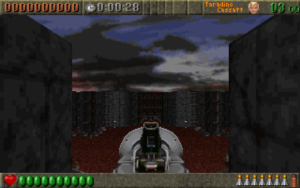
Elvira II keeps the first game’s formula intact: first-person, grid-based dungeon exploration, real-time combat, and item-based puzzle solving. What changes is scale. The spell list is broader, the enemy roster is more varied, and the sound stages and backlots you explore are large enough that careful mapping matters even more than it did in the original castle. Elvira’s commentary is still a constant presence, and the writing leans harder into horror-movie parody now that the setting itself is a fake movie set turned real nightmare.
Tips Before You Start Exploring the Backlot
- Invest in your spell list early rather than relying purely on melee — the broader magic system here is a genuine upgrade over the first game and makes some of the tougher encounters far more manageable once you’ve got a few useful spells learned.
- Map as you go, room by room. The backlot’s sprawl is easy to underestimate, and getting turned around costs you food and light, both of which run out in real time and don’t regenerate on their own.
- Keep a mental, or literal, list of studio sets you’ve cleared versus ones you haven’t. It’s easy to assume an area is done and skip an item you needed, especially once several sound stages start to blur together.
- Don’t ignore weaker-looking enemies. Some of the studio’s smaller threats hit harder than their appearance suggests, especially in groups, and getting swarmed is a faster way to die than any single boss encounter.
Elvira II vs. the Original
Where the first Elvira feels like a compact, contained haunted house, Elvira II is closer to a full-blown dungeon-crawling RPG with a horror-comedy skin. The expanded spellcasting and enemy variety give it more mechanical depth, but that comes at the cost of some of the original’s tight pacing — this is a longer, denser game, and it asks more patience of the player in exchange for a bigger world to explore. If the first game was Horror Soft testing the format, this one is the studio fully committing to it.
Legacy: The Peak of the Elvira Format
Longtime fans still argue over whether the original or the sequel represents the series at its best, and that debate itself is a decent measure of how well Elvira II holds up on its own terms rather than simply riding the first game’s coattails.
Elvira II is generally remembered as the mechanical high point of Horror Soft’s Elvira-era output — bigger, meaner, and more confident than the original, even if some fans prefer the tighter pacing of the first game or the atmosphere of Waxworks. It’s also a useful snapshot of Accolade’s willingness to keep funding a licensed horror-comedy RPG hybrid at a time when the genre was drifting toward either straight dungeon crawlers or straight point-and-click adventures, rarely both at once. The studio’s confidence here paved the way for Waxworks to drop the license entirely and stand on its own, which in hindsight reads as Horror Soft realizing it didn’t need Elvira’s name to make this formula work.
Running It Today
Setup is standard DOSBox procedure: mount c [folder], switch to the drive with c:, and launch the executable. Because the real-time combat and movement are sensitive to emulation speed, keep an eye on your cycles setting if fights feel too fast or too sluggish — details are in our DOSBox setup guide, which also covers sound card configuration if you want Elvira’s commentary to come through clearly.
Should You Play This One First?
I wouldn’t recommend jumping straight into Elvira II without the original — a lot of the returning-character dynamic and tonal callbacks land better if you’ve met Elvira in her own game first. On its own merits, though, this is a genuine refinement of the format: more spells, more monsters, more places to get delightfully lost. The trade-off is that the sheer size of the movie-studio setting can wear thin in the middle stretch, where backtracking through half-explored sets starts to feel like busywork rather than discovery, and a couple of the sound stages are large enough that getting lost stops being fun and starts being a genuine chore.
Even with that caveat, it’s a strong pick for anyone who wants more of Horror Soft’s particular blend of horror, humor, and old-school RPG combat, and it’s a clear step on the road to the studio’s later reinvention as Adventure Soft. My honest advice: keep graph paper or a note-taking app open, because the game genuinely does not do that work for you.
Watch Gameplay
You might also like: