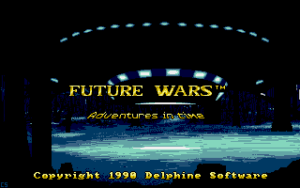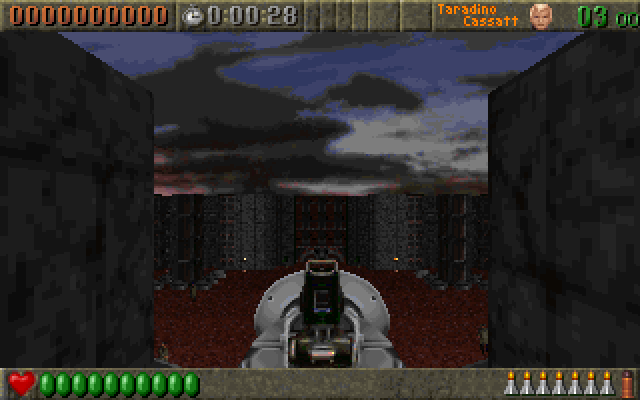
For about four months in 1993, Rise of the Triad wasn’t its own game at all — it was going to be Wolfenstein: Rise of the Triad, a licensed sequel to id Software’s breakout hit, built around what happened after Hitler’s demise in the original storyline. Then John Romero made a phone call, the license fell through, and a small Apogee team was left holding a pile of Nazi-occupation level design with nowhere to put it. What they built instead, in the scramble that followed, turned into one of the most deliberately unhinged shooters of the shareware era — a game that seems to actively resent how seriously its genre was starting to take itself.
A Sequel That Refused to Stay a Sequel
The project’s creative lead was Tom Hall, who had co-founded id Software and, by his own account, been let go by John Carmack in August 1993 over creative disagreements. He landed at Apogee almost immediately and had a full design document written by November of that year — fast, even by early-’90s shareware standards. Apogee licensed the Wolfenstein 3D engine specifically so Hall’s team could build a follow-up, and the game carried the Wolfenstein premise for roughly four to five months of development before Romero’s call ended that arrangement and forced a pivot to an original property.
What survived the pivot was the team’s momentum, not the setting. Hall’s group — who nicknamed themselves the “Developers of Incredible Power” — kept building on the same licensed engine, adding jumping, gibbing, distance-based lighting, and parallax-scrolling sky backgrounds that Wolfenstein 3D never had. Hall later said staying on that engine rather than switching to the Build engine — the one being developed down the hall for Duke Nukem 3D — was a mistake he regretted, since it capped how far the game’s level geometry could evolve. The shareware episode shipped December 21, 1994, with the full three-episode, 32-level version following in February 1995.
Five Agents, One Engine, and a Team That Kept Adding Rules
Rise of the Triad puts you in the boots of one of five H.U.N.T. (High-risk United Nations Task-force) agents, each with different balances of hit points, speed, and accuracy — Taradino Cassatt sits at the statistical middle and is, notably, the only one of the five available in the shareware release; the other four unlock only in the registered version. Across the 13 weapons, split into bullet, missile, and magic categories, the game leans hard into absurdity: the Drunk Missile staggers across the screen and disorients enemies caught near it, the Excalibat trades ranged combat for a glowing baseball bat, and pickups like God Mode (temporary invincibility plus homing energy blasts), Elasto Mode (frictionless, wall-bouncing movement), and Shrooms Mode (a deliberately nauseating color-and-perspective distortion) turn ordinary combat encounters into something closer to a fever dream.
Level design pushes just as hard on verticality as the weapon list does on chaos — jump pads fling you across chasms, moving platforms demand timing, and trap rooms punish players who rush forward without checking the floor. Enemy variety includes soldiers who can be talked into surrendering, berserk troops who charge on sight, and robed monks who require specific tactics to put down safely. None of this reads as subtle, and it isn’t meant to — Rise of the Triad’s whole identity is a shooter that keeps interrupting its own tension with a joke.
The shareware episode alone spans the game’s first episode in full, which is enough to see how deliberately the pacing swings between tones — a corridor of straightforward soldier fights will dump you into a room built entirely around chaining jump pads over a bottomless pit, then follow that with a trap corridor where the puzzle is figuring out which floor tile is safe to stand on. That whiplash is intentional; interviews and retrospectives on the design team consistently describe the goal as never letting a play session settle into a predictable rhythm, which is also why the weapon roster mixes grounded firearms with something as deliberately silly as a swing-for-distance baseball bat.
Keeping the Jump Pads and Elevators on Beat in DOSBox
The shareware episode runs cleanly under DOSBox with a fixed cycle count around 20,000 — leaving cycles on auto can cause the game’s timing-sensitive elevators and jump pads to behave inconsistently on modern hardware. Sound defaults to Sound Blaster settings (Address 220, IRQ 7, DMA 1), which match DOSBox’s out-of-the-box configuration, so most players won’t need to touch the audio setup at all. If you’re running the source-port revival built from the 2002 GPL release instead of the original DOS binary, none of this applies — that version runs natively and skips DOSBox entirely, though the original shareware release is still worth experiencing for the authentic feel of the 1994 engine.
Early Tips for the H.U.N.T.
- Learn to recognize the Drunk Missile’s telltale wobble before you’re standing near where it lands — the screen-sway effect it causes makes it easy to walk into a second hit while still recovering from the first.
- Don’t hoard the Excalibat as a backup weapon — its swing arc and damage make it genuinely useful for clearing single enemies without wasting ammunition you’ll want for tougher rooms.
- Watch for surrendering soldiers and let them be — killing a surrendering enemy in some level configurations triggers reinforcements, so it’s often faster to just move past them.
- Treat every unexplained gap in a floor as a jump pad launch point rather than a dead end — several of the shareware episode’s secret areas are only reachable by trusting a pad you haven’t used yet.
- Pick up Shrooms Mode when you find it even though the visual distortion is disorienting — enemies are affected by the same warped perception rules, and experienced players use the chaos to slip past groups rather than fight through them.
- Save your Firebomb and Split Missile charges for monk enemies specifically — their armor and behavior make conventional bullet weapons noticeably less efficient against them.
Where It Sits Next to Doom and Wolfenstein
Critics at the time were mixed, generally landing on Rise of the Triad as “an entertaining but ultimately undistinguished Doom replica” — a fair read if you were judging it purely on shooter fundamentals against 1994’s best. Scott Miller later put shareware sales at roughly 110,000 copies, respectable but well behind Apogee’s biggest hits. What’s aged better than the contemporary reviews is the game’s structural experimentation: its capture-the-flag multiplayer mode arrived in the same general window as Doom’s deathmatch, and its emphasis on vertical, arena-style level layouts anticipated design language that wouldn’t get formally labeled “arena shooter” until years later.
| Wolfenstein 3D (1992) | Rise of the Triad (1994) | Doom (1993) | |
|---|---|---|---|
| Engine origin | Original id Tech 0 | Licensed Wolf3D engine, heavily modified | id Tech 1 |
| Verticality | None (flat plane movement) | Jump pads, moving platforms | Limited (stairs, lifts) |
| Tone | Grim, straightforward | Deliberately absurd | Grim, atmospheric |
| Multiplayer | None | 9 modes including capture-the-flag | Deathmatch |
The game’s full source code went public under the GPL in December 2002, which is why community ports and modernized rereleases have kept it playable well outside DOSBox — but the original shareware release, jankiness and all, is still the most direct way to feel what Tom Hall’s team was actually building in 1994. That source release also matters historically beyond Rise of the Triad itself: it arrived a few years after id Software had already open-sourced Doom and Quake, and it gave hobbyist programmers a comparatively rare look at a Wolfenstein-derived engine that had been stretched to do things — jumping, lighting, sky parallax — it was never originally built for.
It’s worth sitting with how much of Rise of the Triad’s DNA shows up, unacknowledged, in later shooters. The jump pad as a core traversal tool, the idea of a power-up that actively distorts your control scheme rather than just buffing a stat, and vertical arena combat as a deliberate design goal rather than an accident of level geometry — all of these get treated as innovations of the mid-2000s arena shooter boom, when Apogee’s team was already building full levels around them a decade earlier under a much smaller budget and a much tighter deadline.
What New Recruits to the H.U.N.T. Ask First
Was Rise of the Triad originally a Wolfenstein 3D sequel?
Yes, for roughly its first four to five months. It was in active development as a licensed Wolfenstein sequel before the deal fell through and the team pivoted to an original setting while keeping the engine and much of the level work already completed.
Can I play as any of the five characters in the shareware episode?
No — only Taradino Cassatt is available in the free shareware release. The other four H.U.N.T. agents unlock in the registered full version.
What DOSBox cycle setting works best?
A fixed value around 20,000 is the commonly recommended starting point; leaving cycles on auto can cause inconsistent behavior with the game’s jump pads and timed elevators.
Is there a legal way to play Rise of the Triad today?
Yes. The shareware episode was built for free redistribution from the start, and the full game’s source code has been open under the GPL since December 2002, which has kept community source ports actively maintained.
How does it compare to Doom in difficulty?
It’s generally considered less mechanically demanding than Doom but more chaotic moment-to-moment, thanks to power-ups like Shrooms Mode and Elasto Mode that actively work against precise play rather than rewarding it.
You might also like: