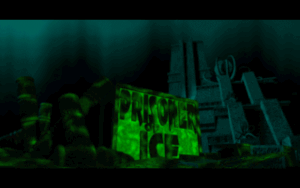
Conrad B. Hart survived Flashback’s 2D platforming only to wake up in a fully three-dimensional world that barely knew how to handle him.
Delphine’s Ambitious Sequel to Flashback
Fade to Black was developed by Delphine Software International and published by Electronic Arts in 1995 for MS-DOS, serving as the direct sequel to Delphine’s celebrated 1992 title Flashback. Conrad wakes from cryogenic sleep to discover that his old enemies, the shape-shifting Morphs, have tracked him down determined to finish what they started, and his search for answers carries him from the wreckage of Earth to the alien ring-world of Ka’Zar and the secrets of an ancient civilization called the Ancients.
A Genuine Leap Into Full 3D
Where Flashback told its story through cinematic 2D platforming, Fade to Black made a dramatic jump into full three-dimensional space, arriving alongside the earliest wave of true 3D action games. The game unfolds from a third-person perspective, with Conrad exploring fully 3D, Gouraud-shaded environments built on Delphine’s own in-house engine, with movement, camera, and combat handled independently of one another — an ambitious approach for 1995 that could feel unwieldy compared to the flatter, more forgiving levels players were used to.
Conrad’s cryogenic sleep as a plot device also does useful narrative work beyond just waking him up for a sequel — it lets the writers plausibly explain why the world around him has changed so drastically since Flashback, giving Fade to Black’s ruined-Earth opening a coherent in-universe reason to look so different from anything in the original game.
Surviving the Growing Pains of Early 3D
- Move deliberately across catwalks, shafts, and industrial corridors — a careless step off a ledge is often just as dangerous as an enemy ambush.
- Prioritize finding keycards and switches over rushing ahead; progress is gated behind them, and skipping past an area without fully searching it usually means backtracking later.
- Balance gunfights against Morph soldiers with careful platforming rather than treating either half of the game as the “main” challenge — Fade to Black asks for both skill sets in roughly equal measure.
- Expect the camera to fight you occasionally in tight spaces; when it does, stop and reorient rather than pushing forward blind.
How It Compares to Flashback and Its Peers
Set against Flashback’s tighter, more controlled 2D puzzle-platforming, Fade to Black feels looser and more experimental, closer in spirit to early 3D action titles like Tomb Raider, which arrived the following year with a similar third-person, platforming-heavy structure, than to its own more disciplined predecessor. It’s a slower, more deliberate action-adventure than most, closer to Flashback’s puzzle-platform roots than to the run-and-gun titles of the era.
Delphine’s own earlier work also casts a long shadow here. Another World had already proven the studio could tell an atmospheric, largely wordless story through pure environmental staging, and Fade to Black inherits that same instinct for bleak, alien architecture doing a lot of the narrative heavy lifting, even as the jump to full 3D asked the team to relearn how to stage that atmosphere in a completely different technical space.
The Ka’Zar ring-world setting also lets the game escape Earth’s ruins entirely for its back half, opening up brighter, more alien environments that contrast sharply with the grim industrial tone of the opening levels and give the back half of the game a very different visual identity.
A Fascinating, Awkward Milestone
Fade to Black occupies a strange place in gaming history: a beloved 2D franchise reinvented in full 3D at a moment when almost nobody had worked out how to make that transition feel comfortable. It’s by turns awkward and genuinely impressive, a snapshot of a studio unafraid to gamble on new technology after already proving its creative chops with Flashback and Another World.
Electronic Arts’ backing as publisher also mattered for a project this technically ambitious. Building a bespoke 3D engine in-house, rather than licensing one, was a significant investment for a mid-90s European studio, and it’s a decision that speaks to how seriously both Delphine and EA were taking the industry’s broader shift toward real-time 3D during this period, even in a market still dominated by 2D and pre-rendered titles.
A Note on Buying It Today
There’s no legitimate free version of Fade to Black floating around — it’s a commercial release, so an official Everything from installing DOSBox to tuning cycles is covered in our setup guide. And if you want more games like this, our free DOS games list is the place to browse.
Tuning DOSBox Cycles for 3D Rendering
If you own a legitimate copy, mount the folder containing your installed files as drive C, switch to that drive, and launch the game’s EXE from the DOSBox prompt. Because Fade to Black leans heavily on real-time 3D rendering, you’ll likely need to push DOSBox’s CPU cycles well above the default to keep movement smooth — check our DOSBox setup guide for notes on tuning cycle counts for demanding titles like this one.
Closing Thoughts on Fade to Black
Its slower, more deliberate pace rewards careful players, and its bleak, alien architecture still carries a distinct, memorable mood nearly three decades on. Just don’t go in expecting the polish of Flashback — the camera and control scheme need real patience before they click, and some players never quite make peace with them. Approach it as a piece of gaming history rather than a game that needs to compete with modern 3D action, and there’s real substance underneath the rough edges.
Watch Gameplay Footage
You might also like: