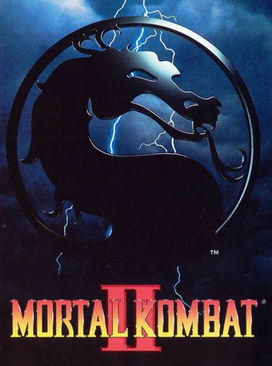
Twelve fighters, three ways to end a match, and a sequel that fixed nearly everything players complained about in the original. Mortal Kombat II, developed by Midway for arcades in 1994 and ported to DOS by Acclaim, took the notorious fighting game that sparked congressional hearings and made it deeper, funnier, and considerably more polished.
From Arcade Cabinet to Home PC
The roster doubled from the first game’s seven to twelve: series mainstays Liu Kang and Scorpion return alongside newcomers Kung Lao, Kitana, Mileena, Jax, Baraka, Reptile, and Shang Tsung, now playable in his own right. Midway also expanded the settings well beyond the original’s tournament island, adding stages like the Pit II and the Kombat Tomb that gave the sequel a much stronger sense of place. On DOS, the game runs through DOSBox faithfully enough to capture what made the arcade version a phenomenon, though it’s worth knowing up front that keyboard controls will never quite replicate an arcade joystick.
The presentation grew right alongside the roster. Backgrounds became full scenes rather than static backdrops — the Pit II adds a visible drop below the platform, the Kombat Tomb layers torches and stonework into the arena itself — and that extra visual detail did a lot to sell the sense that Outworld was a genuinely different place from Earthrealm, not just a reskinned fighting stage.
Punches, Kicks, and Learning the Cast
Combat still runs on the five-button layout — high punch, low punch, high kick, low kick, block — and every character has special moves built from specific directional and button combinations. The fun of MKII is memorizing enough of that cast to have an answer for whatever the AI throws at you, whether that’s Sub-Zero’s freeze, Scorpion’s spear pull, or Kung Lao’s spinning hat.
Mileena and Kitana in particular show how much thought went into differentiating characters that share a similar body type — on the surface they look like palette-swapped twins, but Mileena’s speed and Kitana’s range give them completely different matchup profiles once you actually play them. That level of care extended across nearly the whole roster, and it’s a big part of why so many MKII characters, not just Sub-Zero and Scorpion, still have dedicated followings decades later among players who never touched the arcade cabinet.
Fatalities Aren’t the Only Way to Finish a Fight
- Both Babalities (turning your opponent into a crying baby) and Friendships (a comedic non-violent finisher) require winning the final round without blocking, then entering the specific input instead of a Fatality.
- Learn one reliable combo per character you play often — even a simple uppercut into a follow-up hit will win more matches than relying purely on special moves.
- Blocking matters more here than the original game; the AI is aggressive, and mashing buttons without ever guarding will get you punished quickly.
- Discovering a character’s Fatality for the first time is still one of the most satisfying moments in the game — resist looking them all up and let a few surprise you.
- Distance control matters as much as offense. Characters with strong projectiles, like Kitana’s fan toss or Kung Lao’s hat throw, can win a round just by controlling space rather than trading hits up close.
- Practice against the computer on an easier difficulty before jumping into harder fights. The input timing for specials is unforgiving enough on a keyboard that muscle memory matters more here than in most fighters.
Keyboard vs Joystick: Getting It Running in DOSBox
New to DOSBox? Our setup guide covers the basics, and it’s worth reading before jumping into a game that leans this heavily on precise inputs. Extract the files from a legitimate copy, mount the folder, switch drives, and run MK2.EXE; if you have an old gamepad lying around, mapping it in DOSBox will get you noticeably closer to the arcade feel than a keyboard ever will.
How MKII Improved on the Original
Everything that made the first Mortal Kombat notorious is refined here: the roster is far more varied, the digitized-actor presentation pushes further into the Outworld aesthetic, and the combat feels noticeably more balanced round to round. Where Street Fighter II, the era’s biggest fighting-game rival, built its identity on tight combo systems and colorful cartoon sprites, MKII doubled down on realism and spectacle instead — two very different ideas of what a fighting game should feel like, both valid, both hugely influential. It’s also a noticeably bigger, more varied game than its own predecessor — more stages, more finishers, more characters with genuinely distinct identities rather than reskins of the same handful of archetypes.
Where It Lands for Me
MKII is one of the best 2D fighters of the decade, and I still think its Fatality variety alone gives it more replay value than most fighting games from this era. The honest downside on PC specifically is control: this is a game designed for an arcade stick, and keyboard inputs for special moves take real practice to land consistently. If you can hook up a gamepad, do it — the game underneath is worth the extra setup, and once the inputs stop being the bottleneck, this is one of the most purely entertaining fighters DOS ever got. Even against the tougher modern competition of remasters and re-releases, there’s a rawness to booting up the DOS original specifically that a shinier port doesn’t quite replicate, controls and all.
Watch Gameplay
You might also like: