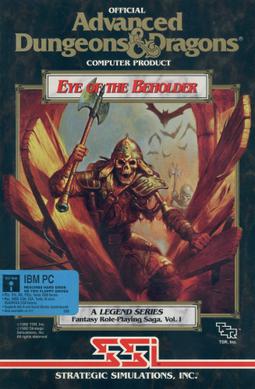
Strategic Simulations Inc. had spent most of the 1980s building its reputation on the Gold Box series — careful, turn-based Dungeons & Dragons adaptations where every fight paused for you to think. In 1991, the studio handed the Forgotten Realms license to a young external developer and got back something that moved in real time, punished hesitation, and effectively ended the Gold Box era on the spot.
Westwood’s License to Break the Formula
Eye of the Beholder was developed by Westwood Associates and published by SSI in 1991, years before the same studio became a household name for Command & Conquer. It used Advanced Dungeons & Dragons 2nd Edition rules and the Forgotten Realms setting, but structurally it owed far more to FTL’s Dungeon Master — a grid-based, first-person dungeon crawler where movement happens in real-time steps rather than SSI’s established turn-based Gold Box combat. SSI’s decision to license the Forgotten Realms setting to an outside team building a fundamentally different kind of game, rather than extending the Gold Box engine again, was a direct response to how much commercial ground Dungeon Master had taken from turn-based dungeon crawlers industry-wide. It worked: Eye of the Beholder became SSI’s answer to that shift, and it effectively closed out the Gold Box era rather than sitting alongside it. Westwood developed this game and its sequel before departing the series; a third installment came from a different studio on different technology.
What the Gold Box Games Weren’t Doing
To understand why Eye of the Beholder felt like such a departure at the time, it helps to be specific about what the Gold Box games actually were. Titles like Pool of Radiance and its sequels presented combat as a tactical, turn-based exercise on a grid — closer in spirit to a tabletop D&D session translated faithfully to screen, with initiative order, discrete rounds, and time to weigh every action before committing to it. That fidelity to the tabletop experience was the Gold Box series’ whole appeal, and SSI had built a loyal audience around exactly that pacing through the late 1980s. Dungeon Master’s success proved a meaningfully large audience wanted something else entirely: a dungeon crawler where danger arrived in real time, where hesitation had a cost measured in seconds rather than in a turn you could always undo by simply not confirming it. Eye of the Beholder is SSI’s answer to that audience, built by an outside studio rather than the internal team that had spent years perfecting the turn-based approach — itself a sign of how seriously the company took the threat Dungeon Master represented to its existing formula.
Beneath Waterdeep, in Real Time
The setup is simple — the city Watch sends a party of up to four adventurers, plus hired mercenaries along the way, into the sewers beneath Waterdeep to investigate corruption traced back to the beholder Xanathar. What makes it play differently from a Gold Box game is that combat and movement both happen in real time rather than pausing for turn-based decisions. You move through the twelve-level dungeon in discrete steps rather than smooth scrolling, and when something attacks, you’re reacting immediately rather than queuing up a planned turn. That single structural change reshapes almost everything about how the game feels compared to SSI’s earlier D&D titles — there’s markedly less room to sit back and plan a fight in detail, and markedly more tension in every corridor, because you genuinely don’t get a pause button once something’s coming at you.
A DOS and Amiga Release, Not Quite the Same Game
Eye of the Beholder shipped on DOS and, almost simultaneously, on the Commodore Amiga, with later ports to PC-98, SNES, and Sega CD following. The two 1991 releases aren’t pixel-identical. The most frequently cited difference is the ending: the original DOS version resolves with a small, static text window and no animation, which players and reviewers alike have long called an anticlimactic way to close out a twelve-level dungeon crawl. The Amiga port replaced that same moment with a short animated sequence instead — a small change, but a telling one about how differently the two platforms’ audiences and technical capabilities were treated even for what was otherwise the same game built in the same year.
Keeping a Party Alive Underground
Party composition matters more here than in a lot of contemporary dungeon crawlers, precisely because real-time combat gives you less room to course-correct mid-fight. A dedicated cleric for healing isn’t optional in any practical sense — losing your only source of in-combat recovery in a real-time fight is a fast way to end a run. Beyond that:
- Draw your own map as you go. The game doesn’t hold your hand with automapping, and Eye of the Beholder’s dungeon layouts are dense enough with secrets that an unmapped level becomes disorienting fast.
- Test suspicious walls deliberately, not just when you happen to notice something odd. Secret doors and hidden passages are a core part of how the dungeon is built, not an occasional bonus.
- Clear and secure a room fully before resting in it — monsters can and do wander into a rest in progress, and resting mid-fight is not a recoverable mistake.
- Balance your party across fighters, a cleric, and arcane spellcasters rather than leaning heavily into one archetype; the real-time combat model punishes narrow builds harder than a turn-based Gold Box game would.
- Manage light sources and consumables conservatively in the early levels — running out of light with several dungeon levels still ahead of you is a much bigger problem here than in a game where you can retreat and regroup at leisure.
- Retreat deliberately rather than reflexively when a fight goes badly. Backing your whole party into a corridor bottleneck so only one enemy can reach you at a time is often the difference between a survivable fight and a wipe, since the real-time system means multiple attackers landing hits simultaneously adds up fast.
None of this is meant to make the game sound punishing for its own sake. The difficulty is a direct consequence of the design choice to run everything in real time rather than a tacked-on challenge layer, and once a party’s roles are settled and the player has internalized that there’s no pause-and-plan safety net, most of the friction described above becomes second nature within the first two or three dungeon levels.
Tuning Cycle Speed So Real-Time Combat Doesn’t Feel Broken
Eye of the Beholder’s real-time movement can feel too fast or too sluggish depending on emulated CPU speed, so it’s worth tuning DOSBox’s cycle count directly rather than leaving it on an auto or max setting — start conservative and adjust up only if movement feels sluggish. If you haven’t configured DOSBox before, our DOSBox setup guide walks through drive mounting, cycle settings, and sound configuration from a blank install. Sound Blaster and AdLib support are both present in the original release and worth confirming are correctly detected, since the dungeon’s ambient audio does real work in building tension that the visuals alone don’t carry. Movement is deliberately stiff and step-based rather than smoothly scrolling — a grid-step model shared with Dungeon Master — and it’s worth confirming the game itself is behaving correctly, not just the emulator, since a mistuned cycle count can make already-deliberate combat feel outright broken.
What It’s Actually Like to Play Now
Modern players coming to Eye of the Beholder for the first time should recalibrate expectations before starting. Manual mapping is a real, sustained requirement rather than a nostalgic flourish — there’s no in-game automap to fall back on if you decide halfway through that drawing your own is too much effort. Compared to Might and Magic IV: Clouds of Xeen, released roughly a year later and considerably friendlier about tracking your own progress, Eye of the Beholder demands more from the player up front. That demand is also exactly why it’s remembered as a genre high-water mark rather than just another D&D license: the tension of real-time combat with no pause button, combined with a dungeon genuinely worth mapping by hand, produced something the Gold Box games — for all their mechanical depth — never quite managed to replicate. The comparison to Dungeon Master is worth making explicit here too: Westwood built on that game’s real-time, grid-based dungeon-crawling formula directly, then layered a full AD&D 2nd Edition ruleset and the Forgotten Realms setting on top of a fantasy world Dungeon Master never had.
Legacy: What Beholder Did to SSI’s Own Formula
Eye of the Beholder’s commercial and critical success directly shaped SSI’s product strategy for the rest of the AD&D license, pulling the company’s dungeon-crawling output toward real-time, Dungeon Master-influenced design and away from the Gold Box formula that had defined it through the late 1980s. Westwood built one direct sequel on the same technology before moving off the series entirely, redirecting the studio’s energy toward the real-time strategy games — beginning with Dune II the following year — that would eventually make Command & Conquer the thing Westwood is remembered for by most players today. Later Forgotten Realms-adjacent RPGs, including the far more expansive The Elder Scrolls: Daggerfall, took dungeon design in different directions entirely, but the specific tension Eye of the Beholder built out of real-time combat and mandatory manual mapping remains a distinct, rarely-repeated approach even by the genre’s later standards.
You might also like: