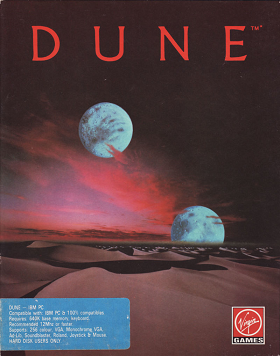
Mention “Dune” to most PC gamers from this era and they’ll think of Westwood’s real-time strategy game. That’s a shame, because Cryo Interactive’s Dune, released the same year, is arguably the better tribute to Frank Herbert’s novel.
Adapting Frank Herbert Instead of Just Licensing Him
Dune, developed by Cryo Interactive and published by Virgin Games in 1992, is an adventure-strategy hybrid based directly on Herbert’s novel rather than the Lynch film or any other adaptation. You play as Paul Atreides, working to unite the Fremen tribes of Arrakis, build up spice production, and ultimately drive the Harkonnen from the planet. Cryo’s team leaned into the book’s political and ecological themes rather than treating the license as an excuse for another battle game, and it shows in nearly every design decision — the haunting ambient soundtrack by Stéphane Picq, later released as a standalone album, sets a tone that owes far more to the novel’s mysticism than to space opera. The interface itself reinforces that mood: rather than a conventional menu-driven adventure, Cryo built a stylized cockpit-and-map view that keeps you anchored to Paul’s perspective as he learns Fremen customs and the ecology of the desert, and the pacing of information — who you can trust, which sietch will support you next — is doled out with a patience that feels closer to reading a chapter of the novel than clicking through a typical point-and-click puzzle chain.
Diplomacy First, War Second
You navigate the desert planet by riding sandworms between locations, meeting Fremen leaders, discovering caves, and negotiating allegiances. As trust grows, tribes contribute soldiers and gradually shift their labor from harvesting spice to training troops for the eventual confrontation with Harkonnen forces. The game is paced more like a novel than a typical strategy title — you spend real time building relationships before a single battle happens, and the shift from diplomatic exploration to military conflict mirrors Paul’s arc in Herbert’s story closely. An ecology system, where planting vegetation gradually and permanently changes Arrakis’s climate, adds a layer of long-term strategic depth that few games of the period attempted. It’s a slow-burn mechanic — you won’t see dramatic results from a single planting session — but committing to it over the course of a full playthrough visibly reshapes the world map, and it ties directly into the novel’s own themes about Arrakis’s ecological transformation being a generational project rather than a quick fix.
Tips for Uniting the Fremen Faster
- Prioritize visiting sietches early — the sooner you establish trust with a tribe, the sooner it starts contributing troops and spice.
- Don’t neglect the ecology system; planting too late in the game wastes turns you can’t get back before the endgame confrontation.
- Pay attention to sandworm behavior when traveling — reckless riding attracts unwanted attention and can cost you time and resources.
- Talk to the same characters more than once as the story develops; several give updated information that isn’t available on a first visit.
- Take notes on which sietches have already pledged support — the game doesn’t always make your overall progress toward uniting the Fremen obvious at a glance.
If you played Cryo’s game back in the 90s and are coming back to it now, know that it rewards patience more than quick reflexes; there’s no fail state tied to combat skill the way there is in most action-strategy hybrids, so slowing down and reading the room is almost always the right call.
Dune (1992) vs. Westwood’s Dune II
These two games are frequently confused, and it’s worth being clear about the difference. Westwood’s Dune II, released later the same year, is a real-time strategy game widely credited with defining the genre’s conventions — base building, resource harvesting, unit production. Cryo’s Dune is something else entirely: a slower, conversation-and-exploration-driven hybrid that spends far more time on Arrakis’s politics and ecology than on unit combat. If you’re looking for the game that invented modern RTS, that’s Dune II. If you want something closer to reading the novel with your hands on the keyboard, this is the one. It’s a genuine curiosity of gaming history that both were published in the same year under the same license, developed independently by two separate studios with almost entirely different visions of what “a Dune game” should even be — and both ended up influential in their own, very different lanes. Cryo Interactive would go on to build a broader reputation for narrative-driven adventure titles through the 1990s, but this remains the game most often cited as its most faithful and atmospheric use of a licensed property. For anyone who’s only experienced Arrakis through Westwood’s strategy game or the various film adaptations, this version offers a genuinely different lens on the same material, and it’s aged into something closer to a cult classic than the more commercially dominant Dune II ever needed to become.
Playing Dune in DOSBox Today
Once you have the game files from a legitimate copy, extract them, mount the folder as drive C, switch to it, and run DUNE.EXE. The game’s install routine handles sound card detection during setup — Sound Blaster at the standard settings works cleanly with DOSBox’s defaults and preserves Picq’s soundtrack properly, which honestly might be the single best reason to get this one running correctly. Our DOSBox setup guide covers configuration in more depth if you hit any snags, and our list of the best free DOS games has more where this came from.
Dune is a commercial title. Look for official re-releases on GOG or Steam.
You might also like: