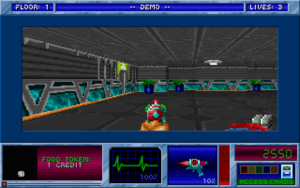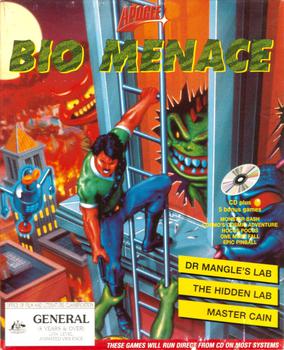
Snake Logan doesn’t get a good day. He crash-lands over a city full of mutants, and Apogee gives him nothing but a machine gun and three episodes’ worth of trouble.
Snake Logan’s very 90s B-movie premise
Bio Menace was developed by Jim Norwood and published by Apogee Software in 1993. Snake Logan, a gruff CIA agent, gets shot down over Metro City and must fight his way out across three episodes filled with mutant creatures. The framing barely matters beyond justifying the action, which is exactly the point — plenty of Apogee’s action platformers from this stretch of the early 90s treated plot as a launchpad rather than a destination, and Bio Menace commits to that fully. Apogee later released all three episodes as freeware, making the complete game freely available, and it uses a modified Commander Keen engine, giving it smooth side-scrolling physics. That engine choice puts Bio Menace in an interesting position within Apogee’s catalog: it moves and controls like a Keen game, but the tone couldn’t be more different, trading Keen’s cheerful sci-fi whimsy for something closer to a self-aware creature feature, with mutants that look like they wandered in from a cheap VHS horror tape.
Run-and-gun mechanics on the Keen engine
Bio Menace is a run-and-gun platformer. Snake Logan moves through large, scrolling levels shooting mutants, collecting weapon upgrades, and rescuing hostages. The weapon selection evolves from a basic machine gun to grenades, flamethrowers, and more, and enemies range from shambling zombies and giant bugs to armored soldiers and massive boss creatures. Levels are noticeably larger and more maze-like than a typical Commander Keen stage too, with more emphasis on backtracking through areas you’ve already partially explored once you’ve picked up a key or a stronger weapon. Snake Logan himself controls with the same tight, responsive jumping the Keen engine was built around, which is a big part of why the run-and-gun combat here feels so much snappier than most other Apogee action games from the same couple of years.
Hostages, secrets, and other things new players miss
Rescuing hostages earns points and occasionally unlocks bonuses, so it’s worth backtracking a screen if you spot one rather than beelining for the exit. The level design hides secret areas and item caches off the main path, and Bio Menace rewards poking at suspicious-looking walls and gaps. Save the stronger weapon upgrades for the enemies that actually need them — the base machine gun handles early mutants fine, so don’t burn limited grenade or flamethrower ammo on weak enemies. Multiple paths exist through several stages, so if one route feels impossibly hard, back out and look for an alternate way around. It’s also worth pacing your progress through each of the three episodes rather than marathoning them in one sitting — the difficulty and enemy variety both ramp up steadily, and going in fresh for each episode makes the escalation feel earned rather than exhausting. Because the underlying engine descends from Commander Keen, jump arcs and enemy collision behave in ways longtime Keen players will find instantly familiar, which makes Bio Menace easy to pick up quickly even though the horror-tinged combat is a sharp tonal departure from anything Keen ever attempted.
Setting up Bio Menace in DOSBox
Not familiar with DOSBox? Our complete setup guide covers everything you need. Follow it, then mount the folder with mount c C:\Games\BioMenace, switch with c:, and run BIO.EXE.
Where it fits among Apogee’s action platformers
Bio Menace occupies a sweet spot between accessible and challenging. The action is immediate — there’s always something shooting at you — but the game gives you enough tools to handle it, and the monster designs are creative and grotesque in a pleasingly low-budget horror-film way. It sits comfortably alongside Apogee’s other action platformers, faster and more aggressive than the Commander Keen games it borrows its engine from, and a bit more forgiving than the studio’s later Duke Nukem. My honest criticism: the Contra-style intensity means deaths can feel cheap in crowded rooms until you’ve learned enemy spawn patterns, so expect some early frustration. It’s still one of the better examples of Apogee’s shareware model at work — the free first episode is genuinely complete and satisfying, and unlike some of the company’s slighter releases it never feels like a demo cut short specifically to sell you the rest. Jim Norwood’s work on the character and enemy designs also holds up better than the game’s budget origins might suggest — Snake Logan has a clear, readable silhouette even at the small sprite sizes DOS platformers were stuck with, and that clarity does a lot of quiet work keeping fast-paced fights easy to parse on screen. It’s a small craft detail, but it’s the kind of thing that separates a genuinely well-made shareware game from one that’s merely functional. Bio Menace earns its place in the same conversation as Apogee’s better-remembered releases, even if it rarely gets invited to that conversation. It’s a genuinely fun couple of hours, free episode and all, and worth far more attention than it usually receives.
Watch Gameplay
You might also like: