Somewhere on a hard drive today, a piece of software built by the same person who wrote Jill of the Jungle’s scrolling and collision code is powering games worth billions of dollars. That’s not an exaggeration for effect — it’s the literal throughline from a bedroom programmer in Potomac, Maryland to Unreal Engine and Fortnite. Jill of the Jungle isn’t remembered as a landmark platformer on its own merits so much as it’s remembered as the moment a teenage shareware publisher renamed itself something grandiose enough to grow into, and then actually grew into it. Understanding this jungle-warrior platformer means understanding the company that made it, because the two origin stories are inseparable.
From a Bedroom Business to “Epic”
Tim Sweeney founded a company called Potomac Computer Systems in 1991, operating it out of his parents’ house in Potomac, Maryland while he was still a student. Its first release, a scriptable action-puzzle game called ZZT, spread through bulletin board systems and mail order and became successful enough on its own to fund what came next — by Sweeney’s own later account, ZZT alone was generating roughly a hundred dollars a day, real income for a one-person operation. In early 1992, Sweeney renamed the company Epic MegaGames, a name he later admitted was chosen partly to make a company with no employees and no office sound bigger than it was. Jill of the Jungle, released later that same year, was among the first titles to carry the new Epic MegaGames name, and its commercial success helped establish the studio’s identity as a serious shareware publisher rather than a one-hit bedroom outfit. It’s worth being precise here: Jill wasn’t Sweeney’s first game — ZZT came first — but it was the release that proved the rebrand worked, and the platformer genre it launched Epic into (alongside titles like Epic Pinball and later Jazz Jackrabbit) is what most people associate with the studio’s shareware years before it pivoted toward engine licensing.
The Apogee Playbook, Applied by a Competitor
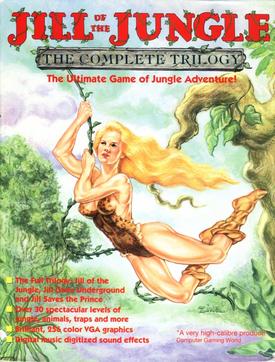
Jill of the Jungle’s business model wasn’t invented by Epic — it was borrowed directly from Apogee Software, the studio whose “give away episode one, sell the rest by mail order” formula had already made shareware a viable alternative to retail publishing. Epic built Jill explicitly to compete in that same space, releasing it as a trilogy: Jill of the Jungle, Jill Goes Underground, and Jill Saves the Prince, with the first episode distributed free to build demand for the two paid sequels. All three were later packaged together as Jill of the Jungle: The Complete Trilogy in 1993, and eventually the entire series was released as freeware, making the full game accessible without the original episodic purchase structure. The choice to compete directly against Apogee and id Software’s platformer catalog rather than try something entirely different says something about how confident Epic already was in its own technical footing barely a year after Sweeney’s bedroom-coded debut.
The Technical Groundwork for Everything That Followed
What makes Jill historically interesting isn’t its story — a jungle warrior fighting to save a kidnapped prince — but the engineering underneath it. Sweeney’s smooth-scrolling engine and tile-based collision system for Jill predate his work on the Unreal Engine by several years, and the design instincts visible here (responsive movement, tightly-tuned platforming physics, levels built around vertical exploration) are recognizably the same instincts that would later define Epic’s approach to 3D engine design. It’s a useful reminder that “engine programmer” wasn’t a specialized role yet in the shareware era — Sweeney was writing the tools and the game simultaneously, and the discipline that shows up in Jill’s tight platforming is the same discipline that would eventually get formalized into licensable middleware. None of this required a large team or a long production cycle; it’s the kind of foundational systems work that’s easy to take for granted once it becomes standard practice across an entire industry, and Jill is one of the earlier places you can watch it happening firsthand.
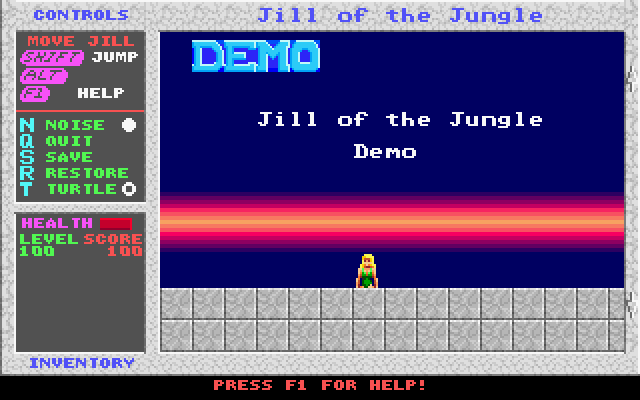
Mounting the Complete Trilogy’s Three Separate Episode Files
Jill of the Jungle runs comfortably on modest DOSBox settings — a cycles value in the 2000–4000 range is generally enough for smooth scrolling and animation without introducing input lag, since the game targeted mid-range 386/486 hardware rather than pushing the technical ceiling the way contemporaries like Doom would a year later. Sound Blaster emulation should be enabled for the game’s music and effects; without it, the game falls back to PC speaker beeps that undersell the soundtrack considerably. If running the freeware Complete Trilogy release rather than an individual shareware episode, double-check that the correct episode files are mounted, since the trilogy package bundles all three games’ data separately rather than merging them into one executable. Getting this step wrong is the most common source of confusion for players coming to the trilogy release for the first time — the installer doesn’t always make clear that each episode is really its own self-contained program sharing a common engine, not three levels of a single game.
Gameplay: Transformation as the Core Hook
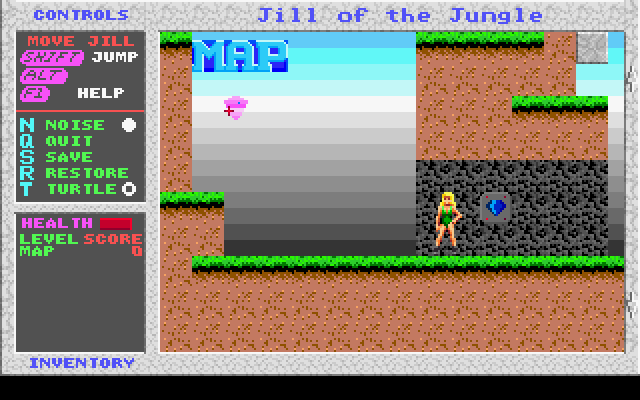
Jill herself runs, jumps, and fights using a rotating arsenal of weapons picked up through each level — a throwing knife, an axe, a spinning discus-like blade, and a whip, each suited to different enemy placements and ranges. What distinguished the game from other early-’90s shareware platformers was its transformation mechanic: specific level sections let Jill shift into a flying phoenix-bird form for aerial traversal, a fish form for underwater swimming sections, and a frog form built around unusually long jumps. Rather than being a gimmick bolted onto standard platforming, these forms gate entire sections of levels, meaning the game’s difficulty curve is as much about recognizing when to transform as it is about combat reflexes. Levels lean into vertical space more aggressively than most contemporaries, rewarding exploration over straight-line rushing to the exit.
The enemy roster and level dressing change noticeably across the trilogy’s three episodes rather than repeating the same handful of sprites. The first game leans on relatively simple threats — snails, frogs, and oversized ants that tower over Jill — set against jungle, castle, and open plateau backdrops, with fire-breathing hazards and spike traps as the main environmental dangers. Jill Goes Underground expands the enemy variety considerably, introducing caterpillars, jumping ants, demons, bats, and crocodiles to match its darker, more claustrophobic level design. Progress through each stage is gated by keys that have to be located before certain doors or paths open, which pushes exploration beyond simple left-to-right traversal even in levels without a transformation section.
This escalation across the trilogy — simpler jungle hazards in the first episode, tougher and more varied threats underground in the second — is a small but telling piece of design craft for a shareware studio barely a year into its rebrand. It suggests Epic was thinking about the trilogy as a single difficulty arc rather than three disconnected episodes stitched together to hit a release schedule.
Five Tips for Swinging Through the Jungle
- Learn each level’s transformation gates before rushing forward. Sections requiring the bird, fish, or frog form are usually visually distinct (water, wide gaps, tall walls) — recognizing the cue early saves backtracking.
- Match your weapon to the enemy, not just the situation. The spinning discus and whip have different effective ranges than the knife and axe; switching deliberately beats spamming one weapon throughout.
- Explore vertically, not just forward. Levels frequently hide items and shortcuts above the obvious path — treat ceilings and upper platforms as seriously as the main route.
- Start with the free first episode before buying into the trilogy mentally. Jill of the Jungle alone is a complete, satisfying arc; Jill Goes Underground and Jill Saves the Prince raise the difficulty meaningfully.
- Save often if playing a version with save states. The original shareware releases used limited in-game saves typical of the era, so plan attempts around checkpoint availability rather than assuming frequent free saves.
Legacy: The Quiet Start of a Gaming Giant
It would be easy to overstate Jill of the Jungle’s direct influence on platform game design — it’s a solid, well-built entry in a crowded early-’90s shareware genre, not a genre-defining outlier the way Doom or Wolfenstein 3D were for shooters. Its real significance is retrospective: it’s the game that helped fund and validate the newly-renamed Epic MegaGames as it built out the catalog — Epic Pinball, One Must Fall: 2097, Tyrian — that eventually gave Sweeney the resources and credibility to pivot the company toward licensable 3D engine technology later in the decade, culminating in the Unreal Engine and, decades later, Fortnite. Players interested in the wider shareware-platformer landscape Jill competed directly against should look at the games it was explicitly built to rival, including Apogee and id Software’s own catalog entries like Dangerous Dave and the horror-tinged Hocus Pocus, both representative of the same free-episode-plus-paid-sequels formula that Epic adopted for Jill.
You might also like: