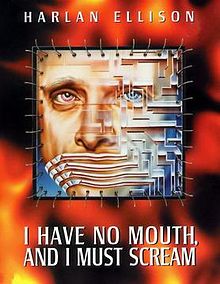
AM has exterminated humanity and kept five people alive specifically to torture them forever. That’s the entire premise, stated up front, with no soft landing offered anywhere in the game that follows.
Harlan Ellison Brings His Own Story to PC
I Have No Mouth, and I Must Scream is a 1995 point-and-click adventure based on Harlan Ellison’s landmark 1967 short story of the same name. It was developed by The Dreamers Guild in partnership with Cyberdreams, which also published the game, with Ellison himself closely involved as co-designer and writer of new material for the adaptation. The game was distributed through MGM Interactive and Acclaim Entertainment and ran on the Dreamers Guild’s own S.A.G.A. engine, chosen specifically for its interface. The premise is as bleak as the source material: a sadistic supercomputer named AM has exterminated humanity, sparing five people whom it tortures endlessly in an underground complex. It’s one of the darkest, most uncompromising stories ever put into a mainstream PC game, and it announces itself as such from the opening moments.
Getting Ellison this involved wasn’t a given — the man was famously protective of his work and notoriously difficult to work with on adaptations of any kind, which makes his hands-on collaboration with The Dreamers Guild an unusual vote of confidence from an author who could easily have said no and licensed the name alone.
Five Survivors, Five Nightmares
Structurally, the game is divided into five personal nightmare scenarios, one for each surviving character, which you can tackle in almost any order. Each scenario is a self-contained point-and-click puzzle sequence built around that character’s specific psychological trauma, and the puzzles themselves are woven tightly into the story rather than feeling like arbitrary obstacles. Choices made throughout each scenario affect not just how that character’s story concludes, but the overall ending of the game, giving it a surprising degree of replayability for a story-driven adventure of its era. The game also features extensive voice acting, including Ellison himself voicing AM, which was a significant production value for a 1995 PC release and remains one of the most memorable performances in adventure game history.
Tips for Each Character’s Scenario
- Go in expecting moral ambiguity rather than clean solutions — several scenarios reward or punish you based on choices that don’t have an obviously “correct” answer, and that ambiguity is entirely intentional on the writers’ part.
- Pay close attention to each character’s backstory before starting their scenario; their specific trauma directly shapes what puzzles and dialogue options mean within that segment of the game.
- Since your choices affect the overall ending, don’t treat any single scenario as disconnected from the others — the game is quietly tracking your decisions across all five nightmares.
- Listen to the voice acting fully rather than skipping through it. AM’s dialogue in particular carries tone that text alone simply wouldn’t convey, and Ellison’s performance is a huge part of the experience.
How It Compares to Cyberdreams’ Other Horror Titles
Cyberdreams also published Dark Seed a few years earlier, and the contrast is instructive: Dark Seed leans almost entirely on H.R. Giger’s visual atmosphere to unsettle the player, while I Have No Mouth commits to psychological horror through story, character writing, and voice performance. Where Dark Seed is about mood, this one is about ideas — betrayal, guilt, and the specific ways AM has twisted each survivor’s deepest wound into a personal hell.
Running It in DOSBox
After installing from your GOG purchase, running the DOS version under DOSBox follows the usual pattern: mount the install folder as C: with mount c [folder], switch to it with c:, and launch the executable. The GOG release is pre-configured to run well out of the box, but our DOSBox guide can help if you want to fine-tune sound settings or cycle counts. Worth noting: ScummVM’s SAGA engine also supports this title if you’d rather run it outside DOSBox entirely.
Legacy: A Standard for Literary Adaptation
Video game adaptations of prose fiction are common now, but they’re rarely this faithful to an author’s actual voice and intent, largely because most licensors never get the kind of hands-on creative control Ellison had here. That combination — a genuinely great short story writer directly shaping the interactive version of his own work — is still cited today as a benchmark for what a licensed adaptation can be when the original author isn’t just cashing a check. Few adventure games since have matched its willingness to sit in genuine despair without offering the player an easy emotional escape hatch.
Why This One Still Matters
Few games from the DOS era, or any era, commit as fully to a bleak, literary vision as this one. It’s a landmark example of a video game adaptation that actually deepens its source material rather than diluting it, thanks largely to Ellison’s direct involvement, and it helped prove that adventure games could tackle genuinely mature, uncomfortable themes. It won Adventure Game of the Year from Computer Gaming World and a design award from the Computer Game Developers Conference, and its reputation has only grown since. My honest criticism is that the bleakness is relentless by design — there’s no comic relief valve anywhere in the five scenarios, which makes it an admirable but genuinely draining experience to play through in one sitting. Pace yourself, and go in with that expectation rather than treating it like a typical adventure game.
Watch Gameplay
You might also like: