An $8 Million Bet on Christopher Lloyd
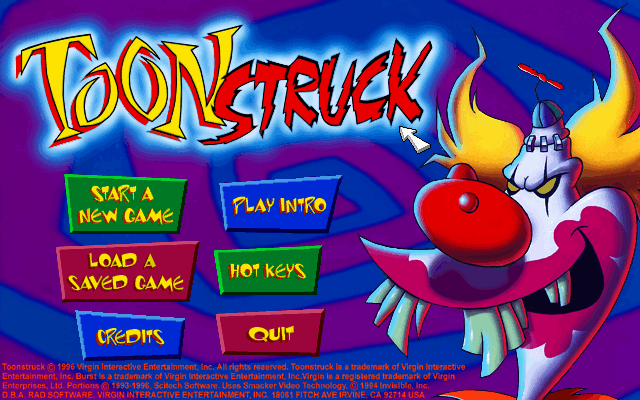
Toonstruck is a 1996 graphic adventure developed by Burst Studios and published by Virgin Interactive Entertainment. Burst was formed in October 1993 specifically to make this game, led by Chris Yates, a veteran of Westwood Studios, and Neil Young, formerly of Probe. Virgin invested heavily in the project — reportedly more than eight million dollars — making it one of the most expensive adventure games of its era. The game stars Christopher Lloyd as Drew Blanc, a cartoon animator who gets sucked through his television into the cartoon world he’s spent his career designing. Lloyd was filmed in live-action against blue screen, then composited into hand-drawn, animated environments, giving Toonstruck a distinctive Who Framed Roger Rabbit-style look where a real actor interacts directly with a fully cartoon world — a huge technical and artistic undertaking for a mid-90s PC release.
Virgin’s willingness to bankroll a brand-new studio, built from scratch around a single unproven concept, at this budget level says a lot about how confident publishers were in multimedia adventure games during the mid-90s — confidence that, in hindsight, the rest of the market didn’t fully share once Toonstruck actually hit shelves.
Cutopia, the Malevolands, and the Invention System
Toonstruck plays as a classic point-and-click adventure, with Drew exploring a cartoon world divided between the whimsical, colorful Cutopia and the darker, twisted Malevolands. You solve puzzles by collecting items, combining them, and using a signature invention system where Drew mixes body parts and objects into bizarre custom cartoon creatures to solve specific problems. The game leans heavily on humor and personality, with a large cast of animated characters voiced by a strong roster of actors, and its puzzle design generally received praise for being clever without being obtuse. The scale of the production is evident throughout, from the density of animated detail in each scene to the sheer number of unique character interactions on offer.
Tips for Toonstruck’s Puzzles
- Experiment freely with the invention system rather than assuming there’s only one “correct” creature for a given problem — Burst built a lot of flexibility into how you combine parts to reach a working result.
- Explore both Cutopia and the Malevolands thoroughly before assuming a puzzle is solved with items from just one region; solutions frequently cross between the two very different halves of the world.
- Talk to background characters, not just quest-critical ones. A lot of the humor, and the occasional useful hint, is buried in dialogue that isn’t strictly required to progress.
- Don’t rush past the animated cutscenes — given the scale of the production, skipping them means missing story beats that matter to puzzles later in the game.
Toonstruck vs. Other Roger Rabbit-Style Hybrids
Live-action-meets-animation was a novelty gimmick in most of the media that attempted it, but Toonstruck commits harder than almost any adventure game before or since, sustaining the blue-screen-and-cartoon illusion across the entire runtime rather than a handful of set-piece scenes. That level of commitment is exactly what made it so expensive, and it’s a big part of why nothing else in the genre quite looks like it, even decades later.
Legacy: A Cautionary Tale Worth Celebrating
Toonstruck’s underperformance at retail is frequently cited in discussions of why the mid-90s multimedia adventure boom eventually collapsed under its own budgets — games this expensive needed to sell in numbers the genre simply couldn’t reliably deliver. Burst Studios didn’t survive long after this release, which only adds to the game’s reputation as a beautiful, unsustainable one-off. That said, its cult following has only grown over the decades, with fans regularly petitioning for a sequel or remaster, and it’s frequently held up alongside other ambitious mid-90s adventures as proof of what the genre was capable of right before the CD-ROM era priced itself out of existence.
DOSBox Notes for a CD-Heavy Game
Once installed from GOG, Toonstruck runs well under DOSBox using the standard process: mount your install folder as C: with mount c [folder], switch to it with c:, and start the executable. Because the game relies heavily on full-motion video and animation, our DOSBox guide’s notes on cycle settings and sound configuration are worth checking if you run into playback issues.
The Verdict on Virgin’s Gamble
Toonstruck represents one of the most ambitious production efforts ever put into a PC adventure game, and despite being a financial disappointment for Virgin on release, it has earned lasting respect for its animation quality, humor, and Christopher Lloyd’s committed performance. It’s frequently cited as a cautionary tale about the unsustainable budgets of mid-90s multimedia adventure games, and honestly, that context is hard to separate from the experience of playing it — you can feel the money on screen, and you can also feel why it wasn’t a sustainable way to make games. The story does thin out a bit in the back half, as if the production schedule caught up with the writing team before every idea got the same polish as the opening hours.
That said, for fans of character-driven comedy adventures, or anyone curious about just how far studios pushed live-action/animation hybrids before the genre’s decline, it remains one of the era’s most memorable and rewatchable titles. Lloyd alone is worth the price of admission — few actors have committed this hard to reacting against a screen full of imaginary cartoon characters.
Watch Gameplay
You might also like: