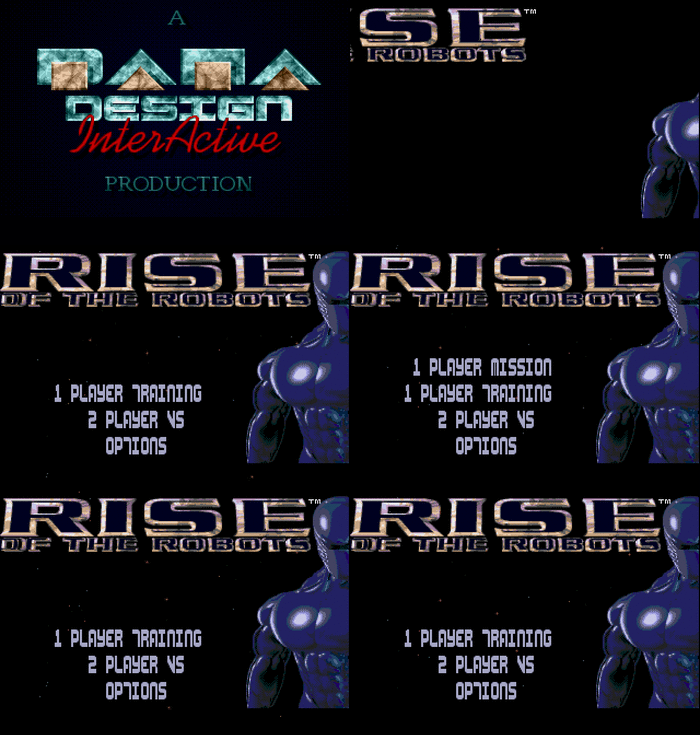
Few games in the mid-90s were hyped as hard as Rise of the Robots. Acclaim’s marketing push around its pre-rendered 3D visuals made it one of the most anticipated PC releases of 1994, and it’s still the game people picture when they think of “the fighter that looked incredible and played… less incredible.”
A Marketing Campaign Built on Graphics
Developed by Mirage and published by Acclaim, Rise of the Robots casts you as one of the last human-built combat robots standing against a rogue artificial intelligence called Supervisor and its army of increasingly advanced machines. What sold the game wasn’t the premise, though — it was the claim that it used pre-rendered 3D graphics for its character sprites, giving every robot a glossy, metallic look nothing else on shelves could match at the time. Attack routines were even choreographed with input from a martial arts consultant to give the mechanical movements a deliberate, weighty feel.
That visual ambition genuinely paid off in terms of first impressions. Grinding gears, sparking joints, and detailed background art gave Rise of the Robots a presentation that outclassed almost every other fighting game on PC shelves that year.
It’s worth remembering how much marketing weight publishers put behind visual technology in the mid-90s specifically. This was a period where “pre-rendered 3D” alone could sell a game before anyone had actually played it, and Acclaim leaned into that hard with Rise of the Robots — magazine covers, television spots, and demo booths built entirely around the robots’ look rather than around any specific gameplay hook.
Playing Past the Presentation
- Lean on spacing and pattern recognition rather than trying to build deep combo strings — the combat system rewards careful positioning far more than it rewards technical execution.
- Study each opponent’s attack pattern before pushing aggressively; the single-player gauntlet ramps up difficulty by testing whether you’ve learned an enemy’s rhythm, not by giving you new tools.
- A joystick or gamepad mapped through DOSBox helps with precise attack timing more than it would in a combo-heavy fighter, since single hits matter more here.
- Don’t expect Street Fighter II-style depth — going in with different expectations makes the limited move variety far less frustrating.
- Treat each match against a new robot type as a short puzzle rather than a test of reflexes; recognizing the pattern is usually more valuable than reacting quickly to it.
What the Visuals Actually Delivered
Give credit where it’s due: the pre-rendered 3D pipeline really was a step ahead of what most competing fighters were doing with hand-drawn or digitized sprites. Backgrounds carry a level of mechanical detail — gears, pistons, sparking joints — that few 1994 releases attempted, and the robots’ silhouettes read clearly even in fast-moving fights, which isn’t a given with this style of animation.
Where the visual ambition runs into trouble is in how it was marketed relative to what it could deliver on gameplay. Pre-rendering every frame of animation is expensive and time-consuming, and that production reality likely ate into the time available for tuning the actual fighting system. The result is a game where the tech demo impresses immediately and the fighting game underneath it reveals its limits within an hour or two.
The Honest Verdict
Here’s the criticism that follows Rise of the Robots to this day, and it’s a fair one: the gameplay never matched the hype the visuals generated. Combat is comparatively shallow, the single-player mode is short, and once the novelty of the pre-rendered graphics wears off, there isn’t a deep fighting system underneath to keep you coming back the way Street Fighter II or Mortal Kombat could.
What I’d push back on is dismissing it entirely because of that gap. As a snapshot of how far visual presentation alone could carry a game’s reputation in 1994 — before players had many other pre-rendered 3D fighters to compare it against — it’s a genuinely important artifact. It’s worth playing once for the history, even if it won’t hold your attention as a competitive fighter the way its contemporaries did.
There’s also a useful lesson in here about how quickly visual technology alone stops being enough to sustain a game’s reputation. Within just a couple of years, pre-rendered 3D graphics stopped being a novelty on their own, and games that leaned purely on the technique without matching gameplay depth aged fast. Rise of the Robots is arguably the clearest example of that specific pattern from the mid-90s.
If you do go in, temper your expectations around the single-player length specifically. It’s a short gauntlet by design, meant to showcase the robots and their environments rather than provide dozens of hours of fighting depth, and knowing that going in makes the whole experience land a lot better than expecting a Street Fighter II-length commitment.
Approach it the way you’d approach a tech demo with a fighting game bolted on, and an hour or two spent working through the gauntlet against Supervisor’s growing army is a genuinely enjoyable way to see mid-90s visual ambition at its most unfiltered.
Finding a Copy
Rise of the Robots is a commercial release without a legal free download option, so check GOG or Steam for official re-releases. If you’re new to DOSBox, our setup guide covers the basics from scratch.
Setting Up DOSBox
Mount the game’s folder as a virtual drive with mount c [folder], switch to that drive using c:, and launch the EXE from the DOSBox prompt. The game benefits from a joystick or gamepad mapped through DOSBox for more precise attack timing — our DOSBox guide has the full walkthrough.
See the Robots Fight
You might also like: