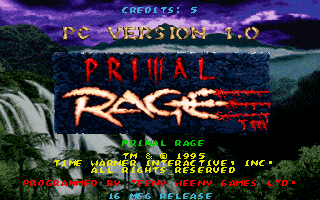
1995 was crowded with fighting games chasing the Street Fighter II and Mortal Kombat formula with yet another cast of martial artists and soldiers. Primal Rage looked at that trend and went the opposite direction entirely: giant prehistoric monsters, rendered in stop-motion claymation, smashing a ruined city to pieces.
Monster Gods Instead of Martial Artists
The premise drops you into a post-apocalyptic world where ancient beasts — dinosaurs, primates, monster gods each tied to primal forces like fire and ice — have returned to rule over what’s left of human civilization. The claymation-style animation gave the towering combatants a tactile, physical presence that stood apart from the pixel art and digitized sprites most fighters of the era relied on, and it’s still the thing most people remember about the game decades later.
Brought to MS-DOS and home systems as part of the mid-90s arcade-to-home conversion wave, the DOS port carried that presentation over to PC owners at a time when the genre was almost entirely populated by human and humanoid casts. Just on shelf presence alone, Primal Rage stood out.
The monster-movie framing runs deeper than just the visual design, too. Giving each creature an elemental identity — fire, ice, and similar primal forces — ties the roster together thematically in a way that feels more like a pantheon of gods than a random assortment of fighters, and that mythological angle gives Primal Rage a narrative hook most contemporary fighting games didn’t bother building.
Fighting as a Kaiju
- Don’t ignore the feeding mechanic — devouring the tiny humans fleeing in the arena’s background restores health mid-match, and skipping it means giving up free recovery.
- Each monster’s finishing moves are as important to learn as its regular special attacks; the fatality-style finishers hit noticeably harder and can end a close round outright.
- Elemental special moves (fire, ice, and similar) tend to have longer recovery windows than a basic claw swipe or bite — don’t throw them out carelessly at close range.
- A joystick or gamepad mapped through DOSBox makes executing special moves considerably easier than the keyboard alone, especially for combo strings.
- Pay attention to arena hazards and background details; the destructible, monster-movie city backdrop occasionally affects positioning in ways a human-scale fighting arena never would.
Claymation as a Technical Achievement
It’s worth pausing on just how labor-intensive stop-motion claymation animation actually is compared to the pixel art or digitized human-actor sprites competing fighting games relied on. Every frame of every monster’s attack had to be physically sculpted, posed, and photographed, then cleaned up for the game — a fundamentally different production pipeline than drawing sprites or filming a martial artist against a green screen.
That process gives the monsters a weight and physicality that’s genuinely hard to fake through other animation methods, which is exactly why the look has stuck in people’s memory even when the underlying fighting system hasn’t. It’s a case where the technical cost of the art direction is inseparable from why the game is remembered fondly at all.
It also meant the DOS port had a harder job than most home conversions: reproducing that same tactile claymation look on period PC hardware, at lower resolutions and with a fraction of the arcade cabinet’s processing power, without the animation losing its charm in the translation. That the DOS version still reads clearly as claymation, rather than turning into mush at lower resolution, is a real technical credit to the porting work.
A Genre Full of Human Fighters, Minus One
Set next to Street Fighter II and Mortal Kombat, Primal Rage’s structure is nearly identical — special moves, combo strings, brutal finishers — but the cast swap changes everything about how the game feels. There’s a monster-movie theatricality here that human-fighter rosters simply can’t replicate, and the feeding mechanic in particular reinforces that tone in a way no contemporary fighting game attempted.
My honest take: the spectacle carries the game further than the underlying mechanics do. It’s a fun, memorable detour rather than a technically deep fighter, and if you come in expecting Street Fighter II’s precision, you’ll likely be a little disappointed. Judge it as a monster-movie novelty first and a competitive fighting game second, and it’s a lot more fun.
The other honest criticism: hit detection on some of the larger special moves can feel inconsistent, particularly when two of the towering character models overlap heavily on screen. It’s a minor frustration rather than a dealbreaker, but competitive players looking for tournament-tight mechanics will find Primal Rage a rougher fit than the genre’s more precisely tuned entries.
None of that stops it from being one of the more purely fun fighting games of its year to just sit down and play casually with a friend. Precision tournament play was never really the point, and judged as an over-the-top couch experience, it delivers exactly what its monster-movie premise promises.
Finding a Legit Copy
Primal Rage is a commercial release, not available as a legal free download, so official GOG or Steam re-releases are your best bet. New to DOSBox? Our complete setup guide walks through everything you need, and our list of free DOS games has plenty to fill the gap while you look.
Configuring DOSBox
Mount the game’s folder as a virtual drive using mount c [folder], switch to it with c:, and start the EXE from the DOSBox prompt. As noted above, a joystick or gamepad will make executing special moves noticeably easier than keyboard controls — see our DOSBox guide for full instructions.
Watch the Monsters Fight
You might also like: