The early ’90s fighting game boom was overwhelmingly a Japanese and American conversation. Sango Fighter is a reminder that other regions were building their own answers to Street Fighter II, with their own history, their own audience, and their own idea of what a tournament roster should look like in mind.
The Three Kingdoms, reimagined as a tournament
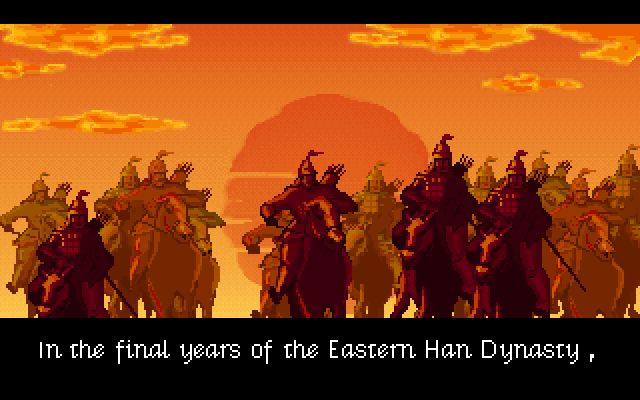
Sango Fighter was released for MS-DOS in 1993 by Taiwanese developer Panda Entertainment, at a moment when the fighting genre was exploding in popularity worldwide. It’s set during the tumultuous end of the Eastern Han Dynasty, when Emperor Ling’s court fell under the control of corrupt officials, and it reimagines figures from that turbulent period of Chinese history as combatants in a Street Fighter-style tournament. It’s a genuinely unusual pairing of setting and genre, one that PC fighting games rarely attempted at the time.
Arriving while the PC fighting game genre was still finding its footing against console rivals, Sango Fighter stood out simply for bringing a distinctly Chinese historical framework to a genre otherwise dominated by Japanese and American aesthetics. It was distributed as shareware, letting players sample the roster before committing to the full release.
The Three Kingdoms period it draws from is one of the most frequently adapted eras in Chinese storytelling, the same historical backdrop behind countless novels, films, and later, an entire strategy game genre through titles like Koei’s Romance of the Three Kingdoms series. Seeing that setting filtered through a Street Fighter II-style combat lens, rather than strategy or drama, is part of what makes Sango Fighter feel genuinely unusual even now.
A traditional fighter with a surprisingly rich soundtrack
Sango Fighter plays as a standard two-player fighting game, with each character controlled through a punch button, a kick button, and directional inputs for movement, jumping, and blocking. The per-character moveset is smaller than genre leaders like Street Fighter II, but the game supports AdLib and Sound Blaster audio alongside MT-32 and General MIDI, giving it noticeably richer music than most PC fighters managed at the time.
Special moves are tied to specific input combinations, though landing them consistently takes practice given animation that’s stiffer than its console contemporaries. The game is really built for head-to-head play against a second person; the historical roster and their distinct fighting styles give each match-up a different feel that’s harder to appreciate against the CPU alone.
Sound configuration options matter more here than in most fighters of the era. Between AdLib, Sound Blaster, and MT-32/General MIDI support, the game genuinely sounds different depending on what hardware you tell it to target, and spending a few minutes getting that setup right pays off more than it does in most shareware titles from the same year.
Tips for your first matches
- Practice special move inputs in a quiet moment rather than mid-match; the input windows are less forgiving than console fighters of the same era.
- Configure your sound card correctly before playing. The MT-32/General MIDI option is a genuinely different (and better) experience than default AdLib if your setup supports it.
- Play against a human opponent when you can. The CPU doesn’t showcase the character variety the way local two-player does.
- Learn blocking timing early; the stiffer animation means reacting late costs you more than it would in a smoother-animated fighter.
- Experiment with each character before settling on a main. The historical roster’s differences show up more in playstyle than in surface-level stats.
Its place in the genre
Compared with Street Fighter II or the console-first fighters that defined the genre, Sango Fighter is rougher around the edges technically, but it’s an interesting window into how developers outside Japan and the US approached the fighting game boom, and its historical setting remains genuinely uncommon even decades later.
Taiwan’s PC development scene in the early ’90s rarely got the same international attention as Japan’s console output or America’s shareware boom, which makes surviving, playable examples like this one unusually valuable for understanding how the fighting game craze actually played out across different regional markets rather than just the two or three usually covered in genre histories.
Grabbing a copy
New to DOSBox? Our complete setup guide walks through everything you need, including sound card configuration for older titles like this one.
Running it with DOSBox
Extract the files into their own folder, mount that folder using mount c [folder], switch to it with c:, and run the EXE from the DOS prompt. For sound, configure AdLib or Sound Blaster through the game’s own setup utility rather than relying on defaults; see our DOSBox guide above for more detail on getting audio right.
Worth tracking down?
For fans of retro fighting games looking for a change of pace, or anyone curious about early Taiwanese PC development, Sango Fighter is a worthwhile curiosity, especially played the way it was designed to be enjoyed: local, two-player, and free.
Playing it solo against the CPU is where it shows its age most; the AI is beatable in fairly repetitive ways once you learn its patterns, and the moveset just isn’t deep enough to carry a long single-player session on its own. With a second player and a bit of patience for the stiffer animation, though, the historical setting genuinely does make each fight feel a little different from the Street Fighter clones crowding the same shelf.
Watch Gameplay
You might also like: