Papyrus Design Group didn’t come out of nowhere with NASCAR Racing in 1994 — the studio, founded by David Kaemmer and Omar Khudari, had already made its intentions clear five years earlier with Indianapolis 500: The Simulation. NASCAR Racing is where that obsession with authentic racing physics found a much bigger audience than an open-wheel Indy sim ever could.
Simulation first, spectacle second
Where a lot of racing games in the early ’90s chased arcade thrills, Papyrus modeled stock car racing with a level of detail that was unusual for the genre at the time — car handling, draft mechanics, and oval-track strategy all mattered here in ways most competitors didn’t attempt. The game became a foundational release in the sim-racing space and set up the long-running NASCAR Racing series that Papyrus would keep building through the rest of the decade, eventually becoming one of the most respected names in racing simulation.
What separates a good lap from a great one
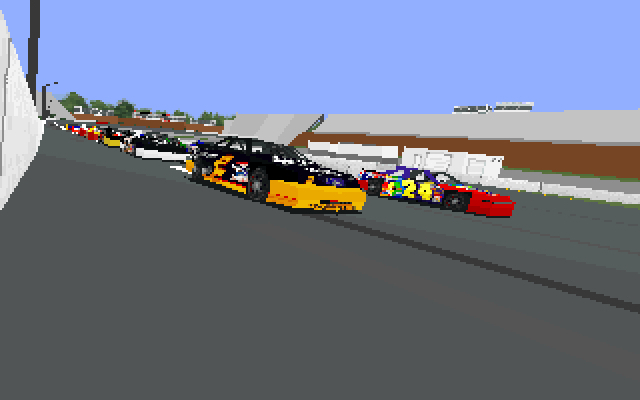
You race a stock car across a selection of oval tracks modeled on real NASCAR venues, either in single events or across a full championship season against AI opponents. Drafting is central to actually winning: tucking in behind another car cuts your air resistance and builds speed you can spend on a pass, and understanding when to draft versus when to pull out and go for it is most of the game’s real skill ceiling. Car setup options and a realistic damage model mean success comes from managing tires and aggression over a long race, not just flooring the accelerator from lap one and hoping for the best.
The setup screen alone is deep enough to intimidate newcomers, with gear ratios, tire compounds, and chassis adjustments all playing into how a car handles a specific track. It’s the kind of detail that rewarded players willing to treat each oval as its own puzzle rather than a generic loop.
Getting comfortable on the ovals
- Draft early and often on the longer ovals. Running solo out front burns fuel and tires faster than tucking into a pack and conserving your car.
- Watch your tire wear on setup screens before a race, not mid-race when it’s too late to adjust strategy for the laps ahead.
- Don’t force a pass in traffic on a tight oval; patience through the pack usually beats an aggressive move that ends in a wall.
- Use practice laps to actually learn the track’s groove rather than skipping straight to qualifying. Oval racing rewards knowing the exact line more than most genres.
- Adjust your car setup per track rather than reusing a default configuration; the difference between a short oval and a superspeedway setup is significant.
A landmark, not just a launch title
This is genuinely important stepping-stone territory for anyone tracing the history of racing simulations. Papyrus would go on to build an increasingly detailed motorsport sim reputation for years afterward, and NASCAR Racing is the release where that reputation started to solidify with a broad audience rather than just the Indy 500 crowd who already knew the studio’s name.
The honest take
If you came up on arcade racers, the learning curve here might frustrate you at first — this rewards patience and race-craft over reflexes, and that’s a deliberate choice, not a flaw, even if it makes the opening hour less immediately exciting than a game like Micro Machines. Once the draft mechanics click, though, the tension of a tight oval battle is hard to replicate in flashier racers. It’s aged into a slower, more deliberate kind of fun than most people expect from a “racing” game, and I still think that patience pays off for anyone who sticks with it.
Give it a full championship season before deciding whether it’s for you. A single race can feel repetitive on an oval track, but the cumulative strategy of managing a season — points, consistency, learning each venue in turn — is where the game actually earns the loyalty of the fans who still swear by it.
Racing against the field, not just the clock
One thing that separates NASCAR Racing from a pure time-trial racer is how much the AI field actually behaves like a field. Cars bunch up, fight for position, and react to your moves in ways that feel considered rather than scripted, which matters enormously in an oval-racing context where drafting and blocking are as much about reading other drivers as they are about your own lap time. Beating a strong AI opponent here feels earned in a way that isn’t always true of racing games from this period, where computer opponents often amount to little more than moving obstacles on rails.
That attention to opponent behavior is part of what made Papyrus’s reputation stick beyond just this one release. A convincing simulation needs more than accurate car physics; it needs an AI field that makes those physics matter, and NASCAR Racing got that balance right early enough to set the tone for everything the studio built afterward.
Running it in DOSBox
NASCAR Racing is a commercial title — check GOG or Steam for an official release.
Mount the folder containing your game files with mount c [folder], switch to the mounted drive using c:, and launch the EXE from there. Our complete DOSBox setup guide covers configuration details if the game needs extra tuning to run smoothly.
Watch Gameplay
You might also like: