
Ask two people who grew up gaming on DOS machines what a Wolfenstein 3D guard sounded like, and you can sometimes tell which sound card they owned by the answer. One remembers a warbling electronic bark. The other remembers a guard actually barking a German word. That split — one shared piece of software, two genuinely different sensory experiences depending on a $200 expansion card — is why the AdLib-versus-Sound-Blaster rivalry still gets argued about on forums and YouTube comparison videos more than three decades later. It wasn’t a spec sheet war. It was a fight over what “PC gaming” was even allowed to sound like, and for about five years, the outcome was not settled.
A Music Professor Starts a War
The company that kicked things off wasn’t based in Silicon Valley or Tokyo. Ad Lib, Inc. was founded in Quebec by Martin Prevel, a former music professor and vice-dean of the music department at Université Laval. In August 1987, Ad Lib released the AdLib Music Synthesizer Card, the first widely adopted add-on sound card for IBM PC compatibles. At its core sat a single Yamaha YM3812 chip, universally known by its internal designation, OPL2 — a nine-voice FM synthesis chip capable of two operators and four waveforms per channel.
Before this card, PC games made noise through the internal PC speaker: a single square-wave voice that could beep and approximate melody, but nothing resembling an instrument. The AdLib card changed that instantly. Sierra On-Line’s King’s Quest IV became the first major game to support it, and after a 1987 demonstration convinced reseller Rich Heimlich to push the card to his top customers, AdLib spent roughly three years as the de facto standard for PC sound with almost no serious competition.
A Repair Shop in Singapore Plays a Trojan Horse
Creative Technology’s origin has nothing to do with music. Sim Wong Hoo started the company in 1981 as a computer repair shop in Singapore, and by the mid-1980s it was building its own PC clones under the Cubic brand. Its first stab at PC audio, the Creative Music System, arrived in 1987 but never caught on. The card that actually mattered launched at Comdex in Las Vegas in November 1989: the Sound Blaster.
Creative’s decisive move wasn’t just adding new capability — it was refusing to abandon the old one. The original Sound Blaster included the exact same Yamaha YM3812 (OPL2) chip found in the AdLib card, wired for full register-level compatibility. Every existing AdLib-supported game ran on a Sound Blaster without modification. On top of that, Creative bolted its own “DSP” — Digital Sound Processor, an Intel MCS-51-family microcontroller — capable of recording and playing back 8-bit digitized audio at up to roughly 23kHz. A Sound Blaster, in other words, could do everything an AdLib card could do, plus something AdLib physically could not: play real recorded sound. That combination of full backward compatibility plus a genuinely new capability is what let Creative dethrone the incumbent. AdLib, unable to match digitized audio on its existing hardware, filed for bankruptcy in 1992.
What FM Synthesis vs. Digitized Sound Actually Meant to Your Ears
The technical difference between the two cards isn’t abstract — it changed what specific games sounded like in specific moments. The OPL2 chip at the heart of both AdLib and early Sound Blaster cards is a synthesizer, not a recorder. It generates tones algorithmically by combining sine-wave operators to approximate the timbre of a trumpet, a drum, or an explosion — the same basic principle as a Yamaha DX7 keyboard, shrunk onto one chip. It’s genuinely expressive for music, but it can only produce sounds its operators are capable of synthesizing.
Digitized audio, by contrast, is playback, not synthesis. A DAC (digital-to-analog converter) — the extra hardware Sound Blaster added — takes a recorded sample, a string of stored amplitude values, and reconstructs the original waveform. It can reproduce anything that was recorded: a gunshot, a scream, a spoken sentence, at whatever fidelity the sampling rate allows. The tradeoff is that digitized audio eats far more disk space per second than a few bytes of FM instrument parameters, which is why 1990-91 developers used it sparingly, for accents and short effects, rather than as a wholesale replacement for FM music.
Case Study: One Nazi Guard, Two Sound Cards
id Software’s Wolfenstein 3D (1992) is the clearest documented example of this split in action, because its sound configuration menu made the choice explicit. Composer Bobby Prince built the game’s audio using a 16-bit sampler and drew on his own time as a U.S. Army platoon soldier for realistic gunfire and Foley effects; id’s staff, along with producer Scott Miller, voiced the enemy soldiers, and at publisher FormGen’s request the team added German-language screams and shouted lines — “Mein Leben!” among them — to heighten the shock value.
Those spoken lines were stored as digitized PCM samples. On a system with only an AdLib card, there was no DAC to play them back — the OPL2 chip could synthesize gunfire-like tones and door creaks as FM approximations, but had no way to reproduce a recorded human voice. On a Sound Blaster (or a parallel-port digitizer like the Disney Sound Source, which the game also supported), those same moments played the genuine spoken line. Same shareware disk, same encounter with a guard around a corner — a fundamentally different, more visceral experience depending entirely on which card sat in the ISA slot. It’s a small technical footnote with an outsized effect on how frightening, or how cartoonish, the game actually felt.
AdLib vs. Sound Blaster vs. Sound Blaster Pro: A Side-by-Side
| Card | Sound Chip | Voices | Digitized Audio | Release | Launch Price (US) |
|---|---|---|---|---|---|
| AdLib Music Synthesizer Card | Yamaha YM3812 (OPL2) | 9-voice FM, mono | None | August 1987 | ~$195 |
| Sound Blaster 1.0 | YM3812 (OPL2) + Creative DSP | 11-voice FM, mono | 8-bit mono, up to ~23kHz | November 1989 | ~$239 |
| Sound Blaster Pro | Dual YM3812 (OPL2) | Up to 20-voice FM, stereo | 8-bit, stereo up to 22.05kHz | May 1991 | ~$249 |
Verified specs above are drawn from period-accurate hardware documentation; see the sources listed in this article’s metadata for citations.
Tuning dosbox.conf So You Actually Hear the Difference
Modern DOSBox setups can emulate any card in this lineage, but the defaults don’t always match what a given game expects, so it’s worth tuning your config rather than assuming it will “just work.” Full walkthroughs on general configuration live on our DOSBox setup guide; the sound settings below sit in the [sblaster] and [mixer] sections of dosbox.conf.
- Pick the right sbtype: Set
sbtype=sb1for a game from 1989-90 that expects an original Sound Blaster,sbtype=sbpro2for stereo-era titles, orsbtype=sb16for later games. Setting a card too advanced for the game can cause detection failures in the in-game setup utility. - Match hardware addresses: Default
sbbase=220,irq=7,dma=1,hdma=5match what most DOS-era games expect out of the box — the same values you’d type into a game’s own SET BLASTER-style setup screen, so keep them consistent. - Choose your OPL emulation:
oplmode=autolets DOSBox pick the right chip behavior based on sbtype; leave it alone unless a specific game document says otherwise. Foroplemu, the default setting is fine for most games, but switching tocompatcan smooth over minor inaccuracies in fast passages of FM music at a small performance cost. - No sound at all? Check that
sbtypeisn’t set tonone, and confirm the game’s own sound setup program (many DOS games have a separate SETSOUND.EXE or similar utility) has the matching port/IRQ/DMA values rather than assuming the game reads DOSBox’s config automatically. - Crackling or popping audio: This is usually a mixer rate mismatch or your host machine struggling with emulation cycles. Try raising
oplrateto49716for higher-quality FM output, and make sure your CPU cycles setting isn’t pegged so high that audio buffering starves.
Five Tips for Getting the Most Out of Both Cards
- Check the game’s setup utility first, not the manual. Most DOS games shipped a dedicated sound configuration program that auto-detected hardware; running it fresh after any DOSBox config change avoids stale settings.
- If a game offers both AdLib and Sound Blaster options, always pick Sound Blaster. Because Sound Blaster hardware was fully AdLib-compatible, choosing it never loses you anything — and it unlocks any digitized effects the game included.
- Listen for spoken dialogue or sampled voice to identify which mode you’re in. If a game’s enemies or narrator only make synthesized beeps and tones, you’re most likely hearing pure FM (AdLib) mode rather than the full Sound Blaster mix.
- Prioritize Sound Blaster mode for games built around voice or realism — id Software’s shooters lean on digitized effects far more than earlier Sierra adventure games, which were composed almost entirely for FM synthesizers.
- Don’t dismiss AdLib/FM-only mode as strictly worse. Composers including Bobby Prince wrote scores tuned specifically to OPL2’s timbre, and some collectors today deliberately choose pure FM playback for its period-accurate sound rather than treating it as a fallback.
Questions People Still Ask About the Sound Blaster Era
What’s the actual difference between AdLib and Sound Blaster?
AdLib cards used only FM synthesis (a Yamaha OPL2 chip) to generate music and sound effects algorithmically. Sound Blaster cards included the same OPL2 chip for full AdLib compatibility, plus an added digital-to-analog converter that could play back recorded, digitized audio — voice, real gunfire, sampled effects — which AdLib hardware could not do at all.
Why did AdLib go out of business if it invented the PC sound card market?
AdLib dominated from 1987 until Sound Blaster’s 1989 launch undercut it by matching AdLib’s own FM capability while adding digitized sound. AdLib struggled to respond competitively and filed for bankruptcy in 1992.
How do I know if a DOS game is using AdLib mode or Sound Blaster mode in DOSBox?
Check the game’s own sound setup utility for its selected device, and listen for any spoken or clearly “recorded” sound effects — pure FM/AdLib mode cannot produce those, so their presence confirms you’re hearing the Sound Blaster’s digitized channel.
Was the Gravis Ultrasound better than Sound Blaster?
Technically, its wavetable synthesis produced more realistic instrument sounds than FM synthesis for music. It never achieved Sound Blaster’s level of game-industry support, however, so despite the sound-quality advantage, it remained a secondary option for most DOS-era gamers rather than a true replacement.
Do I need special DOSBox settings to hear digitized sound effects properly?
You need sbtype set to a card that matches or exceeds what the game expects (never none), with the base address, IRQ, and DMA values matching the game’s own internal sound configuration screen.
What Came After the War
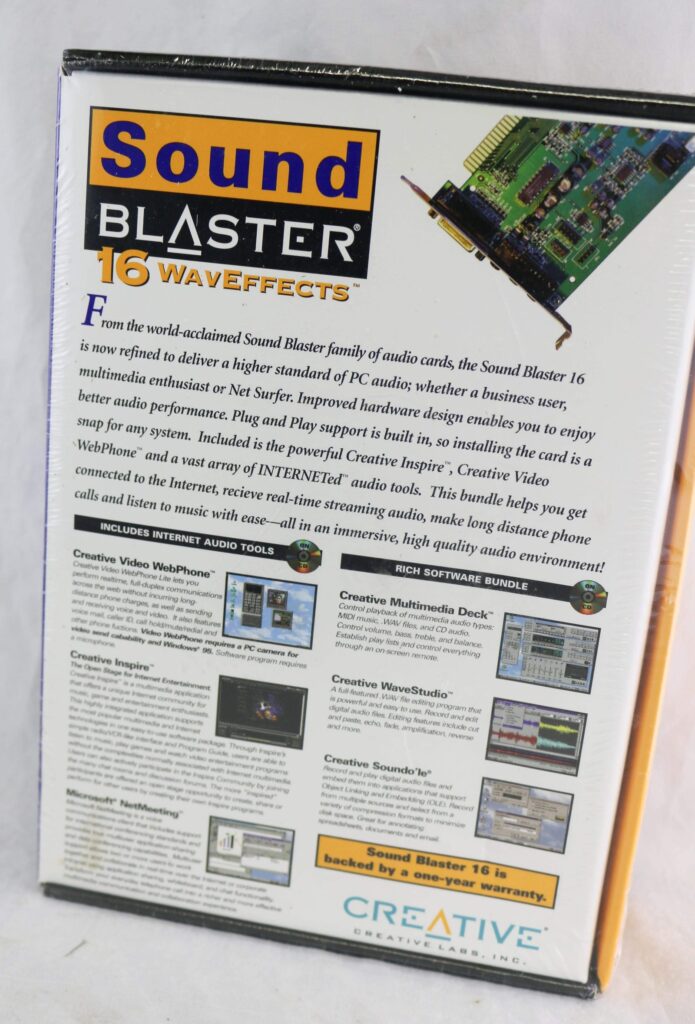
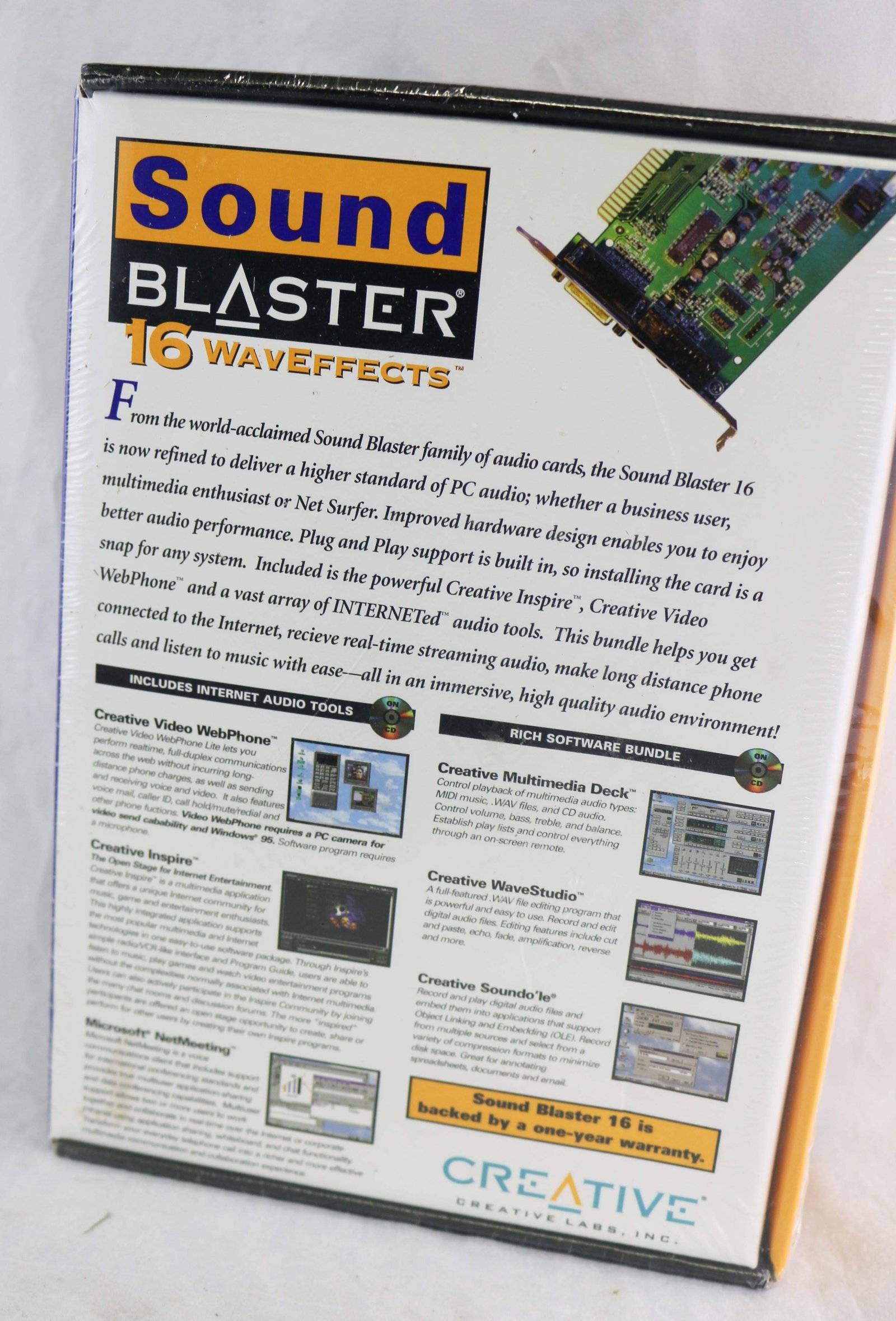
Creative didn’t stop at the original Sound Blaster. The Sound Blaster Pro arrived in May 1991 with dual OPL2 chips for stereo FM and stereo digitized audio up to 22.05kHz, and the Sound Blaster 16 followed in June 1992 with 16-bit sampling and CD-quality 44.1kHz stereo — a leap that pushed digitized speech and effects from novelty into expected baseline. Creative wasn’t unchallenged, either: Canada’s Advanced Gravis released the Gravis Ultrasound in summer 1992, built around a GF1 chip and genuine sample-based “wavetable” synthesis rather than FM, and it built a loyal demoscene following for its cleaner instrument reproduction, even though it never matched Sound Blaster’s install base. Creative’s later AWE32 line would eventually fold wavetable synthesis into the Sound Blaster family itself, right around the point where id Software’s Doom was setting the new baseline for what an SB16-equipped PC was expected to deliver.
Looking back now, what stands out isn’t just the leapfrogging specs — it’s that for a few years, “what a game sounds like” wasn’t a fixed property of the software at all. It was negotiated against whatever card happened to be sitting in your ISA slot. For a broader look at the hardware landscape this rivalry played out inside, our history of DOS-era PC gaming covers the graphics side of that same story.