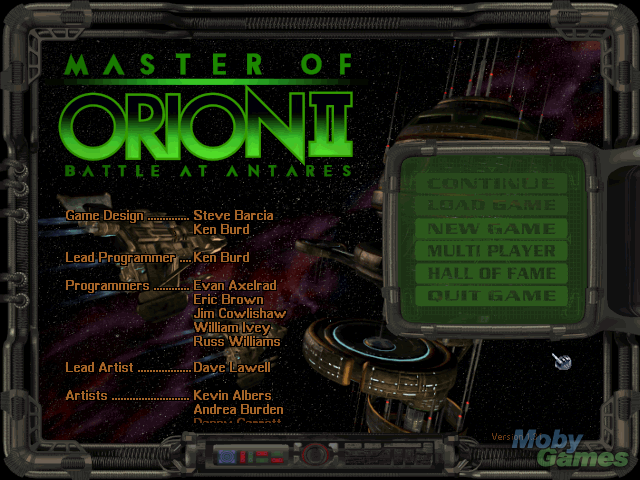
How do you follow up a game that’s frequently called one of the best strategy titles ever made? If you’re Simtex, you don’t play it safe, you rebuild almost everything and somehow come out with something even better. Master of Orion II: Battle at Antares, released in 1996, is that rare sequel that expanded on its predecessor in nearly every direction and still holds up as one of the deepest space strategy games ever put on a disc.
Simtex’s Follow-Up to a Beloved Original
Master of Orion II is the sequel to 1993’s Master of Orion, developed again by Simtex and published by MicroProse. Where the original established the exploration-expansion-exploitation-extermination formula that would come to define the 4X genre, the sequel doubled down on customization and combat depth in ways the first game never attempted. It was very well received on release and has held its reputation remarkably well since. It’s routinely cited decades later as one of the defining space strategy games, and its fingerprints are all over the genre that followed, right up through Stellaris and MicroProse’s own modern Master of Orion reboot.
Building an Empire From the Ground Up
You start by choosing, or building, a race to play. Rather than locking you into a handful of preset factions, Master of Orion II lets you assemble your species from a pool of traits: things like Creative, which grants access to every field of research instead of forcing you to specialize, or Tolerant, which makes colonizing a wider range of planet types much easier. That single system does more to give each campaign a distinct identity than almost anything else in the genre at the time, because the empire you’re managing is genuinely shaped by choices you made before the game even started. From there, it’s exploration, colonization, research, diplomacy, and eventually war, spread across a galaxy shared with several other empires all chasing the same goals you are.
Ship Design and Tactical Combat: The Heart of the Game
What really sets Master of Orion II apart, even now, is its ship design system. Rather than picking from a fixed roster of warships, you build your own, starting from a hull size ranging from small frigates up through the largest Titans and Doom Stars, and filling available slots with weapons, armor, shields, and special systems as your technology allows. When your fleets meet in combat, battles play out on a tactical grid where positioning and weapon range matter as much as raw firepower, which turns fights into genuine puzzles rather than simple stat comparisons. That combination, deep empire management paired with hands-on tactical combat, is something a lot of later 4X games have tried to replicate and few have matched.
Early Habits That Separate Winners From Losers
- Don’t neglect scouting. Sending ships out early to map nearby systems tells you which directions are safe to expand into and which ones are about to be contested by a rival empire.
- Match your research priorities to your race’s strengths. If you picked a Creative race, you can afford to spread investment across every field; if you didn’t, focus your research rather than trying to keep pace everywhere at once.
- Don’t over-colonize before you can support it. Founding more colonies than your empire can defend or manage economically leaves you thin everywhere, and a determined rival will find the weak point.
- Refresh your ship designs as soon as better hulls and technology come online, rather than sending outdated ships into battles they can’t win. A well-designed mid-tier fleet will usually beat a larger force of obsolete ones.
Where It Sits Among Space Strategy Games
Compared to the original Master of Orion, this is a substantially deeper game in almost every respect. The first title didn’t have ship design or tactical combat at all, running battles on abstracted odds instead. Against Civilization, the other major strategy franchise of the era, the comparison is more about focus than depth: Civilization spans all of human history on a single world, while Master of Orion II is entirely about space, with far more emphasis on combat and fleet design. It also shared the mid-90s spotlight with Stars!, a text-and-icon-heavy space 4X that traded Master of Orion II’s visual polish for even deeper strategic systems. Decades later, its influence is easy to spot in Stellaris, which borrows its empire-building structure while modernizing the interface and pace.
Running Battle at Antares in DOSBox Today
Installation and setup here are about as simple as DOSBox games get: mount the folder with your game files as a drive, switch to it, and launch the executable. As a turn-based strategy title, Master of Orion II is forgiving about cycle settings, you don’t need to chase a specific number to avoid slowdown the way you would with an action game, so getting sound configured correctly is really the only thing worth double-checking. If DOSBox is new to you, our setup guide covers the basics, and if you want more turn-based strategy after this one, our list of free DOS games has a few more worth digging into.
The Verdict After Three Decades
I still think Master of Orion II is one of the best strategy games DOS ever produced, and I don’t say that lightly. The combination of race customization, ship design, and tactical combat gives it a depth that most modern 4X games still measure themselves against, and the sheer number of viable strategies means very few playthroughs feel repetitive. My honest criticism: the interface is dense and unforgiving to a new player, with menus and screens that assume you already know what you’re looking for, and the late game can slow to a crawl once you’re managing a couple dozen systems at once. Push through that learning curve, though, and it’s one of the most rewarding strategy games of its era.
Watch Gameplay
You might also like: