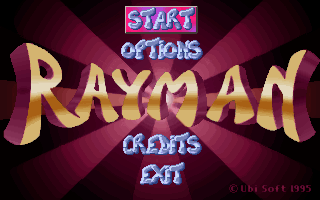
Rayman doesn’t have arms or legs, technically speaking — his gloves and boots just float near where limbs would normally be. It’s a strange design choice for a platformer hero, and it’s somehow the least strange thing about Michel Ancel’s 1995 debut for Ubisoft.
A hand-drawn world at the wrong moment, in the best way
Rayman arrived just as much of the industry was shifting its attention toward early 3D graphics, which makes its commitment to richly hand-drawn 2D art and animation feel almost defiant in hindsight. The story is simple platformer fare — the villainous Mr. Dark has stolen the Great Protoon and thrown the land’s harmony into chaos — but it’s really just scaffolding for some of the most detailed 2D character animation on DOS at the time. This was one of Ubisoft’s most ambitious releases of the mid-90s, and it shows in every frame, from Rayman’s own idle animations to the lush, layered backgrounds behind him.
Punching things you can’t reach
Rayman’s signature move is punching enemies and objects at range, which becomes the backbone of both combat and a fair amount of the platforming itself. Progress hinges on rescuing captured Electoons scattered through each stage, and new abilities like hovering unlock gradually as the adventure continues, opening up areas that were previously out of reach. Getting every Electoon in a level takes real dedication, and the game rewards that effort more than it punishes skipping it, though completionists should expect some genuinely demanding backtracking once new abilities are in hand.
What’s easy to underestimate on a first playthrough is how tightly the level design is built around that ranged punch. Plenty of platforms and hazards are placed specifically to test whether you can hit a distant switch or enemy before you’re forced to commit to a jump, which turns basic combat into a genuine platforming skill rather than an afterthought.
Surviving the difficulty spikes
- Learn enemy patterns before committing to a jump near them. Rayman’s platforming demands pixel-precise timing, and rushing a section you haven’t scouted rarely ends well.
- Don’t feel obligated to grab every Electoon on a first pass; some are genuinely difficult to reach and are better attempted once you’ve unlocked more abilities.
- Once hovering unlocks, revisit earlier levels. Several Electoons that seemed unreachable the first time through become accessible with the new move.
- Take boss patterns slow. The difficulty here comes from precision, not from surprises, so a careful first attempt usually teaches you what a rushed one won’t.
- Practice your ranged punch timing in safe areas before relying on it in a tricky platforming sequence; a missed hit at the wrong moment often means a fall.
Compared to the platformers around it
Set next to Earthworm Jim’s genre-hopping chaos or The Lion King’s film-faithful, more forgiving pacing, Rayman is the strictest of the three — less interested in variety than in pure platforming precision. It’s closer in spirit to a game like Prehistorik 2 in structure but nowhere near as forgiving in difficulty. Ancel would go on to direct Rayman 2 and later Beyond Good & Evil, and you can already see the studio’s design ambitions taking shape here, in a debut that never feels tentative.
The verdict
I still think this is one of the best-looking platformers of its decade, and the music and animation genuinely hold up against far newer games. But I won’t pretend the difficulty is for everyone — some stretches, particularly late in the game, ask for a level of precision that will frustrate players used to more modern, forgiving platformer design. If you can accept old-school difficulty as part of the deal, the payoff in style and craft is well worth it.
I’d rather a game be honestly, unapologetically hard than falsely easy, and Rayman never pretends to be anything other than what it is. That honesty is part of why it’s stayed respected rather than merely nostalgic among people who actually finished it.
A hero built around a technical constraint
There’s a persistent bit of design folklore around Rayman’s armless, legless design being a direct answer to the memory and animation constraints of the hardware Ubisoft was targeting, and while the exact production story has been told a few different ways over the years, the result speaks for itself regardless of the reasoning behind it. Floating limbs meant the animators could pull off more expressive, exaggerated poses without the overhead of animating a fully connected skeleton, and that constraint ended up becoming the character’s defining visual trait rather than a compromise anyone needed to apologize for.
It’s a good example of a limitation turning into a strength through sheer creative commitment. Plenty of games from this era show their technical seams; Rayman turned one of its into the single most recognizable thing about the whole project.
That same instinct shows up throughout the rest of the game’s art direction, too. Backgrounds that could have been simple scrolling wallpaper instead get their own small animated details, and enemy designs lean into exaggeration rather than realism in a way that fits the floating-limbs hero perfectly rather than clashing with it.
Setting it up
For an original DOS copy, mount your game folder with mount c [folder], switch to that drive using c:, and launch the EXE from the DOSBox prompt. Our complete DOSBox setup guide has additional tips if the game needs further configuration, and our free DOS games list is worth checking out for more classics like this.
Watch Gameplay
You might also like: