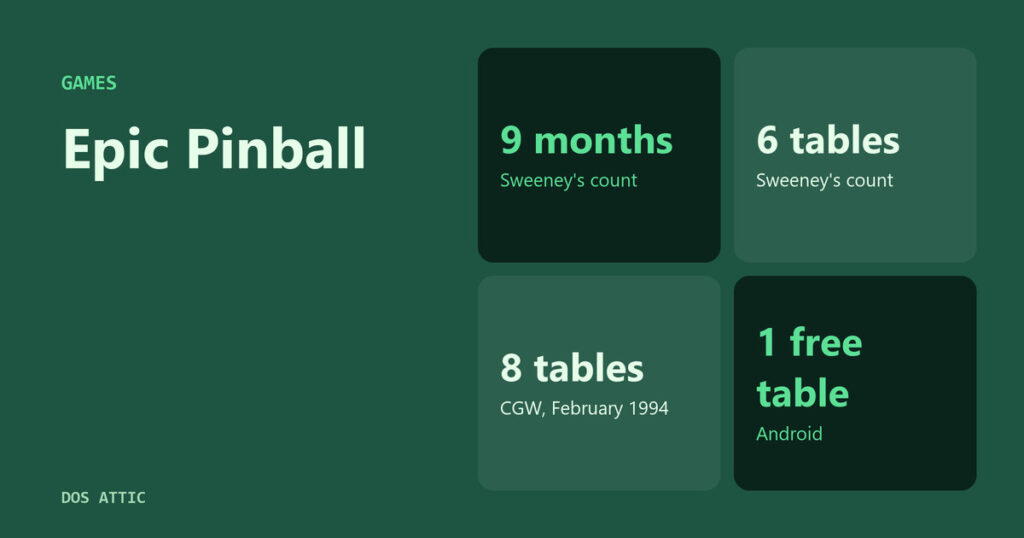
Tim Sweeney says the best-selling shareware game Epic ever put out was Epic Pinball, that its programmer built it in about nine months, and that it paid him more than a million dollars in royalties over the following year. Those figures are recollections from a 2009 interview with Sweeney, and each one deserves a second look. This article sets them against a studio history, two 1994 magazine pages and the store listing that sells the game today.
Epic Pinball is sold today as Epic Pinball: The Complete Collection on GOG. The page describes 12 tables, which it says are all three Epic Pinball sets plus a bonus table, and it states that the release is powered by DOSBox. The original DOS program is therefore part of what runs. No free official copy of any table was confirmed for this article, so none is pointed to. For titles whose rights holders do give copies away, the roundup of DOS titles that rights holders hand out at no cost is the place to look.
A Demo From Finland, Finished in Canada
Sweeney’s account begins somewhere other than the programmer’s desk. Epic had been courting Future Crew, a Finnish group known for early 3D demos, as a shareware developer, and Mark Rein travelled to Finland to recruit them. They declined, but Rein returned with an unfinished pinball game they had been building: vertically scrolling, with realistic physics. Epic begged them to finish it and they lacked the resources.
So Epic showed the demo to James Schmalz, who had made Solar Winds and lived in Canada. Sweeney describes him as someone who programmed entirely in assembly language and drew all the art for his own projects. Schmalz looked at the demo and said he could build a game like it.
Nine Months of Assembly and Art
Schmalz built the game from scratch while he was in college, by Sweeney’s telling, and designed the tables himself. Rein and Sweeney acted, in Sweeney’s phrase, as cheerleaders: they pointed out what needed work and handed him references on other pinball games and real pinball rules.
How Long It Took
The interview gives the schedule as something like nine months in total, hedged with “I think.” That is the only duration on record here, and it has no dated development log behind it, so nine months is best read as an approximate figure from the publisher’s side of the story.
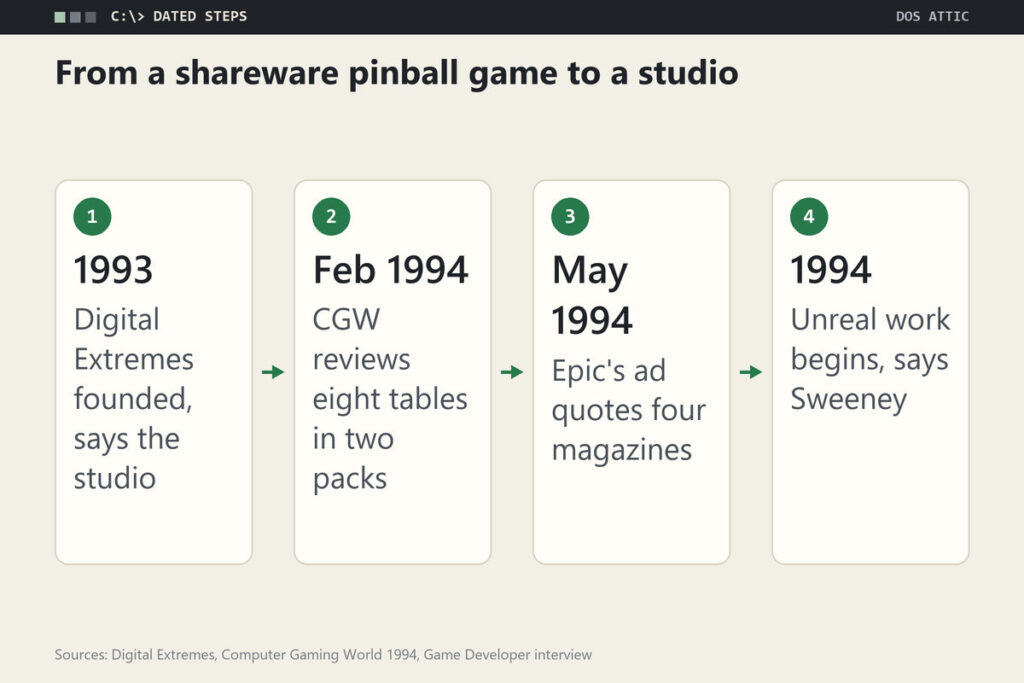
The trade press adds a wrinkle. Computer Gaming World’s February 1994 review says Epic Pinball was programmed by the same team as Silverball, an earlier commercial pinball package from MicroLeague Interactive, and judges the new collection better than that package. Sweeney’s interview describes Schmalz building the game from scratch and never mentions Silverball. The two records are not necessarily in conflict, since neither source says who worked on which release, but a team that had already shipped a pinball package is a different picture from a ground-up build in nine months.
Six Tables, Then Eight
Sweeney recalls Schmalz designing six tables for the game. By February 1994 Computer Gaming World was reviewing eight, in two packs of four. The two numbers are not necessarily in conflict, since tables could be added after the first release, but the sources do not say when. For anything specific about the first release, the safer statement is the magazine’s: eight tables, two packs.
Android Was the Free Table
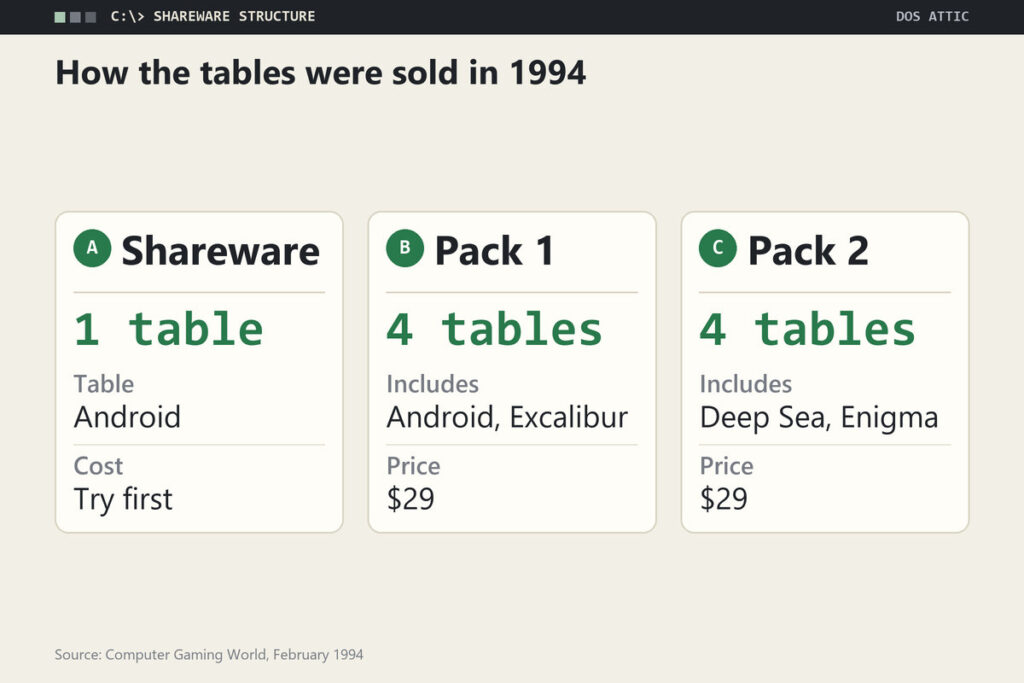
The shareware structure was the same one the genre used everywhere. Epic’s own May 1994 magazine advertisement, in Computer Gaming World, says the shareware version contains the Android table, while the registered versions are the Epic Pinball packs, each holding four tables. A bonus shareware game came with every order, and the ad pointed would-be players to CompuServe and a large bulletin board system for the free version.
Packs and Prices
The February 1994 review gives the prices: $29 for each pack of four or $45 for all eight boards. The first pack held Android, Pot of Gold, Excalibur and Crash and Burn. The second held Magic, Pinball Jungle, Deep Sea and Enigma, and Pinball Jungle was a table built around Epic’s own jungle heroine, a nod to the company’s earlier platformer starring Jill.
Why Android First
The reviewer describes Android as fast action in which the player works to activate a robot, and notes it is the only table playable in the shareware copy. A free table has to do two jobs at once, showing the whole game and being worth buying more of. That makes it the table to judge the physics on, and not the other seven.
Machine Requirements
The review lists the requirements plainly. The game uses VGA graphics, supports Sound Blaster, Sound Blaster Pro and Gravis Ultrasound boards, and needs a 386 or faster processor. Each table is about two screens high and scrolls smoothly. These are the specifications on paper for 1994, and the review never uses the term SVGA for the artwork.
Verdicts From Reviewers
The reviewer’s judgment is warm. The ball action is called realistic, the options allow the player to tune the game, and with so little to fault the verdict is that few commercial alternatives offer as much. Epic’s May 1994 ad collects four press verdicts of its own: Computer Gaming World says the game brings up a high score, PC Format rates it 91 percent, PC Power gives it five out of five, and PC Zone calls the shareware easily as good as commercial offerings.
The Sound Complaint
The one real fault the reviewer found was audio. Played through regular Sound Blaster emulation on a Sound Blaster 16, the digitized effects and music sounded a little muffled. Since that is a 1994 observation about a specific card configuration, it says nothing about how the game sounds today under a modern emulator.
Options the Printed Manual Explained
With registration, the review notes, players received printed documentation covering game options and a full explanation of each table, and each table also offered an on-screen synopsis of its rules. The player could choose three, five or six balls and set the table angle, and the keys mapped flippers, plunger and nudge.
From Pinball to Unreal
After Epic Pinball, Sweeney says, Schmalz was the first developer on Unreal and ended up co-developing it. Halfway through, Schmalz started Digital Extremes. The first two Unreal games were collaborations between Epic and the new studio, with about five employees at DE’s peak against 10 or 15 at Epic. After Unreal Tournament the two companies went their separate ways.
Sweeney places the start of Unreal in 1994 and remembers Schmalz writing a solo assembly-language 3D game, a dragon flying over a terrain, while Sweeney built the editor.
Two Dates for One Studio
Digital Extremes says on its own about page that it was founded by James Schmalz in 1993, and that it leapt from the shareware hit Epic Pinball to the Unreal series, co-created with Epic Games, and then to Warframe. Sweeney’s version says Schmalz started the studio halfway through the Unreal project, which he dates to 1994.
Those accounts can be reconciled if the company existed on paper in 1993 and became a real team later. They cannot be merged into a single date, so this article gives both and leans toward the studio’s own 1993 for the founding while treating Sweeney as the better guide to when the team grew.
How Far to Trust the Million-Dollar Story
The claim that Epic Pinball was Epic’s best seller and that it earned over a million dollars in royalties is the most quoted part of the story and the least documented. It comes from the head of the publishing company speaking fifteen years later, with no sales ledger attached. It is plausible, given the packs sold by mail at the prices above, but it should be repeated as Sweeney’s recollection. A rough check helps: at the 1994 prices, a million dollars equals about 34,500 packs at $29, or about 22,000 complete sets at $45, and royalties are only the author’s share of what customers paid, so gross sales would have to be larger still.
Editions, in the Order the Sources Show Them
- By February 1994: Epic Pinball is already on sale as shareware, and Computer Gaming World reviews it as eight tables in two packs of four, with Android as the shareware table. No source here gives the first release date.
- May 1994: Epic MegaGames advertises Epic Pinball by James Schmalz, quoting four magazines.
- Later, on a date no source here gives: a third set of tables and a bonus table bring the total to 12, as GOG’s description counts them.
- November 25, 2025: GOG’s changelog for the collection records a switch to DOSBox Staging, with adjusted settings and controller support.
- Now: the collection is listed for sale on GOG.