Corporate War, Now With Two Sides
Bullfrog Productions followed up 1993’s Syndicate with Syndicate Wars in 1996, widening the scope from a single dominant corporation’s expansion into an actual conflict between two rival factions, EuroCorp and the Church of the New Epoch, each with its own campaign and story. Set in a dystopian future ruled by megacorporations, it casts you as the commander of a squad of cybernetically augmented agents fighting for control of city after city.
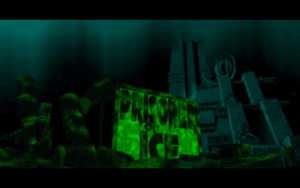
The game’s biggest technical leap was fully destructible, voxel-based city environments, letting you blow holes through buildings and collapse structures as a genuine tactical option – a striking upgrade over the original Syndicate’s static levels. That single change reshaped how missions could be approached, turning the environment itself into a tool rather than just scenery.
Persuasion, Sabotage, and Buildings You Can Blow Apart
You control a squad of agents from an isometric viewpoint, directing them through missions that mix combat, sabotage, and persuasion in equal measure. Agents can be equipped with an arsenal of futuristic weapons and cybernetic upgrades, and the signature persuadatron device lets you convert civilians and even enemy agents into loyal followers mid-mission.
The destructible environments change how you approach missions: rather than treating streets and doorways as fixed obstacles, you can level a building to open a new line of sight or bury enemies under rubble, and the ever-present threat of collateral damage among civilians keeps missions feeling chaotic and reactive. Vehicles add a further layer of mobility, letting you close distance or escape a losing fight in ways the original Syndicate’s slower, on-foot missions never allowed.
Tips for Your First Missions
- Use the persuadatron liberally on civilians early in a mission – converted followers can soak up damage and boost your effective squad size at no real cost.
- Don’t be afraid to demolish buildings for tactical advantage; a collapsed wall can open a flanking route that saves you from a head-on firefight.
- Watch your agents’ cybernetic energy and health closely, since Syndicate Wars is noticeably less forgiving than the original Syndicate about losing expensive, upgraded agents.
- Commandeer vehicles when available – they’re faster than moving on foot and can be used to run down enemies or make a quick escape.
Bullfrog’s Most Ambitious Technical Swing
Syndicate Wars pushed the boundaries of what a mid-90s DOS strategy game could depict, and it stands as one of Bullfrog’s most ambitious technical achievements, alongside Populous and Theme Park in the studio’s celebrated catalog. Its voxel-based destruction was ahead of its time, and while it didn’t spawn a long-running franchise the way some of Bullfrog’s other work did, it remains a distinctive high point for the cyberpunk strategy genre on DOS.
The two-faction campaign structure also gave it more replay value than the original Syndicate, since playing through as the Church of the New Epoch tells a meaningfully different story from the EuroCorp side rather than just flipping a difficulty slider.
Where It Sits Next to the Original Syndicate
If you’ve played the original Syndicate, the tonal shift here is worth knowing about going in: the first game leans into cold corporate efficiency, directing a single dominant force’s expansion, while Syndicate Wars is messier and more desperate, framing you as one side in an actual war rather than an unstoppable machine. Both approaches work, but they feel like genuinely different experiences rather than a simple numbers upgrade.
If you only have time for one, I’d point newcomers toward Syndicate Wars first for the more dynamic, destructible sandbox, then circle back to the original for a tighter, more focused campaign once you know you like the core idea.
Voxel Cities, Explained
Under the hood, the destructible environments run on a voxel rendering system rather than the polygonal engines that were starting to take over the industry by 1996, which gave Bullfrog a level of granular destruction that would have been much harder to pull off with contemporary 3D hardware. It’s part of why the game still looks distinctive today – the visual style is unmistakably its own thing rather than a generic mid-90s isometric strategy game.
That technical approach came with tradeoffs, though; voxel rendering is demanding, and the game pushed period hardware hard enough that some contemporary reviews flagged performance as an issue on lower-end machines, a problem modern emulation makes largely irrelevant. Running it under DOSBox today means you get to see the destruction system at full speed without any of the slowdown original owners sometimes had to contend with.
Getting a Copy
Never configured DOSBox before? Our setup guide covers the essentials, and our list of the best free DOS games is worth a look afterward if you’re hungry for more.
Keeping It Running Smoothly
Mount the folder containing your installed game as a virtual drive using mount c [folder], switch to it with c:, and start the EXE. Because the game relies on real-time rendering of destructible voxel terrain, performance can vary; our setup guide covers the cycle adjustments that help keep it running smoothly.
Watch the Mission in Action
You might also like: