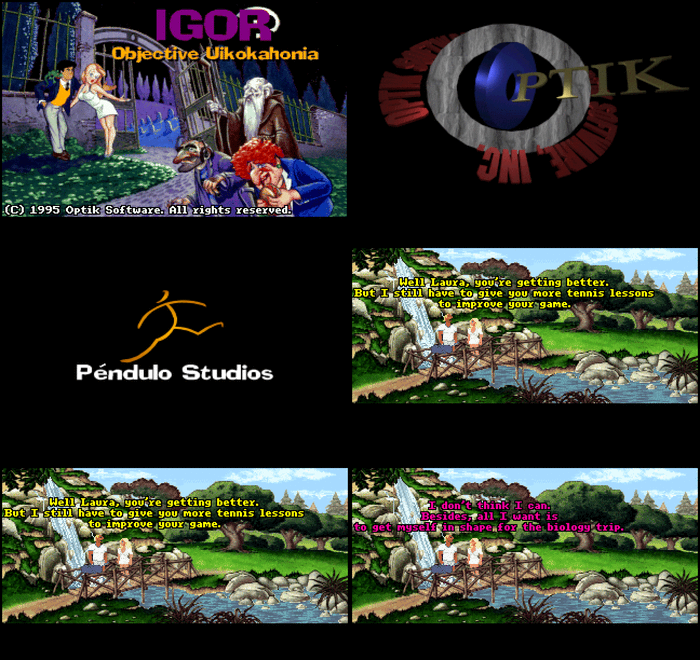
Every national games industry has a first graphic adventure, and Spain’s happens to be a slapstick comedy about a lovesick university student chasing a girl to a fake tropical island.
From a Group of Friends to a Commercial Release
Igor: Objective Uikokahonia began as a part-time project among four friends — Ramon Hernaez, Rafael Latiegui, Felipe Gomez Pinilla, and Miguel Angel Ramos — who would go on to found Pendulo Studios. DROsoft published the finished game in 1994, making it the first graphic adventure ever developed in Spain, and its modest commercial success helped convince other Spanish studios that the genre was worth pursuing.
Chasing Laura to Uikokahonia
The plot is deliberately silly: after spying on his classmate Laura Wright, Igor Parker learns she’s headed to the tropical paradise of Uikokahonia and launches into an escalating series of increasingly absurd schemes to follow her there. It’s a point-and-click adventure through campus and small-town locations, built around collecting items and combining them to solve puzzles as Igor claws his way toward his destination. The relatable, almost mundane starting premise — a lovestruck student improvising his way through an ordinary town — grounds the game before its plans escalate into far more ridiculous territory, which makes the growing absurdity land harder by contrast.
Puzzle Logic That Owes a Debt to LucasArts
The influence of Monkey Island-era LucasArts is obvious in the cartoonish, character-driven puzzle design, but filtered through a distinctly Spanish comic sensibility — broader physical gags, more absurdist non sequiturs, and a supporting cast that leans into caricature. A few things help going in:
- Talk to every side character more than once; a lot of the game’s personality, and its puzzle hints, live in dialogue you’d otherwise skip past.
- Expect cartoon logic over realism — if a solution feels too silly to be right, it’s probably exactly what the game wants.
- Backtrack often. Early scenes sometimes hold items or clues you won’t recognize as useful until much later in Igor’s journey.
Even the game’s inventory-combination puzzles carry a bit of that same regional flavor, with solutions occasionally built around small cultural details a purely international team might not have thought to include.
The Seed of Pendulo’s Later Work
As Pendulo Studios’ first release, Igor lacks the polish of the Runaway series the studio would become known for internationally, but the comic timing and character focus that made Runaway successful are already recognizably present here in rougher form. You can see the same instinct for oddball side characters who exist purely for a laugh, the same fondness for elaborate Rube Goldberg-style puzzle chains, and the same willingness to let a joke run a beat longer than strictly necessary because the writers clearly enjoyed it.
It’s also worth remembering just how small the Spanish games industry was in 1994 — there was essentially no domestic precedent for a graphic adventure of this scope, no established local publisher pipeline for the genre, and no guarantee DROsoft’s gamble would pay off. That Igor found any commercial success at all, let alone enough to help launch Pendulo as a lasting studio, makes it more of a foundational text for Spanish adventure gaming than its modest international profile might suggest.
DROsoft’s decision to publish an unproven, homegrown project like this one was itself a gamble worth appreciating. There was no established playbook in Spain for marketing or distributing a graphic adventure of this kind in 1994, which means every part of the game’s eventual commercial success had to be built essentially from scratch, without the safety net of an established local audience already primed to buy this type of game.
Where to Find a Copy
Igor: Objective Uikokahonia is a commercial release and was never distributed for free, so look for an official re-release on GOG or Steam rather than a random download. Our complete DOSBox setup guide covers the basics if this is your first old-school adventure game, and our best free DOS games roundup is a good place to browse while you wait on a sale.
It’s worth remembering, too, that Spanish-language adventure games barely existed as a commercial category before Igor, which means the English localization that eventually brought the game to a wider international audience was itself a meaningful step for a project that started as a hobbyist collaboration among friends.
Running Igor in DOSBox
With a legitimate copy installed, mount the game folder as C:, switch to it, and launch the EXE the standard way. If music or sound effects cut out, double-check your sound card emulation settings in DOSBox — Igor’s audio configuration can be picky depending on which release you own.
Even the game’s title mash-up of the protagonist’s name with an invented tropical destination sets the tone early — it’s a game that never takes its own premise too seriously, and that playfulness carries through from the opening scene to the credits.
Why It’s Worth Seeking Out
Historical significance aside, Igor holds up as a genuinely funny game in its own right, with the kind of committed, absurd comedic writing that made LucasArts-style adventures so beloved. Where it shows its age is in a handful of puzzles that rely on backtracking through nearly every location just to notice one new interactive detail — a rougher, first-game version of the pixel-hunting that better later adventures learned to smooth over. If you’ve played and enjoyed the Runaway games, going back to see where Pendulo started is a genuinely rewarding way to spend an afternoon, warts and all.
Watch an English Walkthrough
You might also like: