The trilogy’s biggest goodbye
Goblins Quest 3, released by Coktel Vision in 1993, closes out the original Gobliiins trilogy by introducing Blount, a lone goblin whose companions are turned to stone by a treacherous sorceress, sending him on a quest to free them with the help of a rotating cast of unusual sidekicks along the way.
Goblins Quest 3 builds on the structural shift begun in Gobliins 2, moving further toward traditional point-and-click adventure design while keeping the series’ offbeat charm and visual creativity intact. It expands the scope of the world Blount travels through considerably, adding more varied environments and a larger supporting cast than either earlier entry managed, making it the most ambitious game in the trilogy in terms of sheer scope.
Blount and his rotating cast of sidekicks
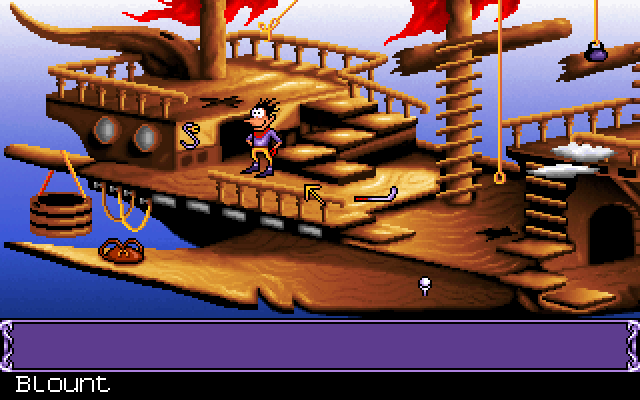
You control Blount as he explores multi-screen areas, collects items, and solves puzzles, occasionally teaming up with companions such as a parrot, a snake, and a magician, each contributing unique abilities to specific puzzles. This mix of solo exploration and situational teamwork gives the game more variety than the original Gobliiins, while never fully returning to that game’s simultaneous three-character control scheme.
The puzzle design keeps the series’ emphasis on experimentation and close observation, with solutions often tied to items and characters encountered earlier in the game. A built-in hint system offers some assistance, though it doesn’t cover every puzzle, and the game’s difficulty curve rewards players willing to explore thoroughly and think outside conventional adventure game logic rather than expecting a strictly linear solution path.
The larger cast of companions is really what sets Goblins Quest 3 apart visually and mechanically from its predecessors. Each sidekick has a distinct personality and animation style on top of their puzzle-relevant ability, giving Blount’s journey a stronger sense of a growing party than either earlier game managed, even without any of the actual party-management systems you’d find in a traditional RPG.
Tips for managing your companions
- Hold onto a companion even after their obvious usefulness seems to have passed – several of Goblins Quest 3’s puzzles call back to abilities from earlier in the game in ways that aren’t immediately telegraphed.
- Use the hint system sparingly and only as a last resort; it doesn’t cover every puzzle, and leaning on it too early can spoil solutions you would have found through the game’s intended experimentation.
- When a companion joins you, test their unique ability against the current room’s obstacles immediately rather than saving it for later – the game often expects that ability to be the current puzzle’s actual solution.
- Backtrack through earlier screens whenever you’re stuck. Goblins Quest 3’s larger world means solutions are more spread out across multiple screens than in the tighter, single-room puzzles of the original Gobliiins.
- Pay attention to how each companion reacts to different environments – their idle behavior and comments often hint at whether you’re in the right area to use their ability before you’ve even tried it.
The high point of Coktel’s puzzle-adventure formula
Many longtime fans consider Goblins Quest 3 the high point of the series, praising its expanded world, varied companion mechanics, and confident puzzle design that builds on everything the earlier games established. Set against its own predecessors, it keeps Gobliins 2’s more traditional adventure structure while reintroducing some of the original’s multi-character puzzle-solving spirit through its companion system, arguably landing closer to the best of both approaches than either earlier game managed alone.
My honest opinion: this is a legitimately satisfying way to close out the trilogy, and the companion system is a clever compromise between the original’s chaos and the second game’s more streamlined structure. My one real criticism is that the hint system’s inconsistent coverage means you can still get properly stuck without a walkthrough, which undercuts some of the accessibility gains the series had been building toward. Even so, it’s a fitting, ambitious conclusion for players who enjoyed either or both of the earlier games, and it closes out the original trilogy on the strongest possible note in terms of scope and polish, even if it’s not quite as tightly designed moment-to-moment as the best stretches of the first two games. Playing all three back to back, in release order, is genuinely one of the more satisfying ways to spend a long weekend with early-90s European adventure game design as a whole, start to finish, and it’s a good demonstration of how much a small studio’s formula can evolve meaningfully across just three releases without losing what made it distinctive in the first place, a genuinely rare feat for a trilogy built around such an unusual central gimmick from the very start. That consistency of vision across three games, released over the course of just three years, is something few adventure-game studios of the era managed to pull off.
Rounding up a copy
The GOG trilogy bundle is the simplest way to get all three games running on modern systems. New to DOSBox? Our complete DOSBox setup guide covers the basics before you start, and our free DOS games list is worth a look for more of the same era.
Getting it running today
Once installed, mount the game’s folder as your C drive in DOSBox, switch to that drive, and launch the EXE. As with the earlier two entries, ScummVM’s Gob engine supports Goblins Quest 3 as well, which is worth trying if you’d rather avoid tuning DOSBox settings by hand. Our DOSBox setup guide linked above has tips for getting older DOS adventure titles running with correct graphics and sound either way.
Blount’s Journey on Screen
You might also like: