From three goblins to one
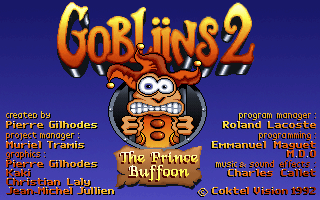
Gobliins 2: The Prince Buffoon, released by Coktel Vision in 1993, is a sequel that made a genuinely bold structural choice: it drops the original Gobliiins’ signature three-character puzzle format almost entirely. In its place, you get a single controllable goblin, Fingus, on a mission to cure a cursed prince who’s been transformed into a jester.
With this sequel, Coktel Vision shifted the series closer to a traditional point-and-click adventure while keeping its trademark visual creativity and offbeat humor intact. The change in structure gave the game a more conventional inventory system alongside the series’ signature environmental puzzles, broadening its appeal to players who’d bounced off the original’s stricter three-character logic, while still carrying forward enough of the family’s DNA to feel like a real sequel rather than a reinvention.
Fingus and the cursed prince
You control Fingus as he explores a series of increasingly strange locations, collecting and combining items in classic point-and-click fashion to solve environmental puzzles. Unlike the original Gobliiins, the sequel relies on a single controllable character supported by NPCs rather than switching between multiple playable goblins, which fundamentally changes the rhythm of how you approach each screen.
The game retains the series’ love of quirky, sometimes surreal puzzle logic, with solutions that reward experimentation and careful observation of the game’s colorful, cartoonish world. Its structure feels closer to a traditional adventure game than its predecessor, while still carrying forward the series’ distinctive tone and visual style – the puzzles are less about coordinating three abilities in sequence and more about the item-combination logic adventure fans of the era would recognize from other genres entirely.
The cursed prince premise also gives the game a slightly stronger narrative throughline than the original Gobliiins had. Where the first game was really just a sequence of self-contained puzzle rooms strung together, Gobliins 2 has an actual goal that develops as you play, with Fingus’s quest to break the curse giving the environments and characters you meet a bit more purpose beyond being the next obstacle in line.
Puzzle habits worth unlearning from the first game
- Stop thinking in terms of “which goblin has the right ability” – Fingus does everything himself here, so the puzzle logic is about item combinations and NPC interactions instead.
- Talk to every NPC you meet more than once; several characters offer new dialogue and hints as the plot progresses, and it’s easy to assume a conversation is exhausted when it isn’t.
- Examine background objects even when they look purely decorative – Coktel Vision carried its love of hidden interactive detail over from the first game, just in a more traditional inventory-driven form.
- Don’t rush past the game’s stranger dialogue options out of habit from more linear adventures; some of the best puzzle hints are delivered through the game’s absurdist humor rather than plain instructions.
A more traditional adventure, and what that costs
Gobliins 2 is often seen as a refinement of the series’ formula, trading the original’s chaotic multi-character puzzles for a more focused adventure structure without losing the series’ inventive charm. Set against contemporaries like Coktel Vision’s own later Goblins Quest 3, or other European point-and-click adventures of the period, it’s a noticeably gentler, more approachable game than the original Gobliiins, for better and worse.
My honest take: something is lost in trading away the three-goblin gimmick, since that structure is what made the original so memorable in the first place, and Gobliins 2 sometimes feels like a solid but slightly generic adventure game wearing the goblins’ skin. That said, the presentation, humor, and puzzle craft are all genuinely strong on their own terms, and it stands well even without having played the original. It’s a worthwhile stop for anyone exploring Coktel Vision’s catalog, just don’t expect the exact same experience that hooked you on the first game, and go in treating it as its own thing rather than a straight continuation of exactly what the first game was doing.
The world design deserves a mention too. Coktel Vision clearly used the extra scope this sequel afforded to build out more varied, distinct locations than the original’s tighter puzzle-room format allowed, and that variety keeps the pace moving even during the game’s more conventional item-hunting stretches. It’s a noticeably bigger game than its predecessor in terms of raw content, even if the puzzle format itself is less unusual on paper than what came before it in the original release. Players coming from the first game specifically for the three-goblin gimmick should adjust their expectations accordingly before starting, and judge Gobliins 2 on its own considerable merits instead of measuring it purely against the game that came before it. Taken purely as a point-and-click adventure, without the weight of the original’s reputation attached, it’s a genuinely well-crafted, funny, and inventive game in its own right.
Grabbing your own copy
New to emulating DOS? Spend five minutes with our DOSBox guide and come back.
Firing it up in DOSBox
Once installed, mount the game’s folder as your C drive in DOSBox, switch to that drive, and start the EXE. Like the original Gobliiins, this runs fine through ScummVM’s Gob engine too, if you’d rather skip manual DOSBox configuration entirely. Our DOSBox setup guide linked above covers the basics of getting early-90s DOS adventure games running smoothly either way.
Fingus in Motion
You might also like: