Leaving Barovia Behind
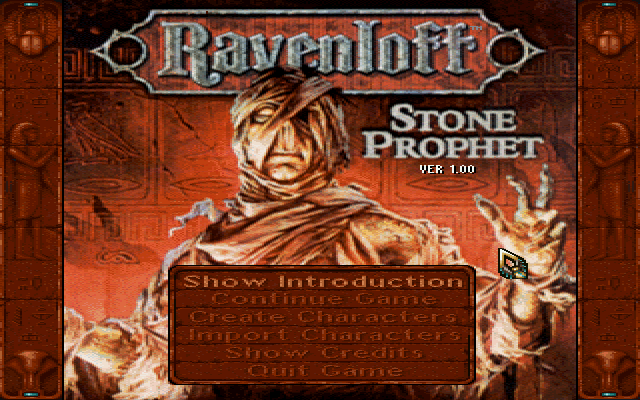
DreamForge Intertainment followed up Ravenloft: Strahd’s Possession with Stone Prophet in 1995, and the boldest decision the sequel makes is leaving Barovia’s gothic castles behind entirely. Instead of revisiting Count Strahd’s domain, it transports a new party to Har’Akir, a domain of dread modeled on ancient Egypt and ruled by a cursed, undead pharaoh.
It’s a strange pairing on paper – the Ravenloft campaign setting’s gothic horror tone against a sun-baked, tomb-raiding backdrop – but it works, giving Stone Prophet a visual and thematic identity distinct from both its predecessor and most other AD&D games of the period.
It also came at a point when DreamForge had a couple of these real-time AD&D titles under its belt already, and that experience shows in how confidently Stone Prophet commits to its setting instead of hedging with more generic dungeon design.
Tomb-Raiding Through Har’Akir
You lead a party through sand-choked ruins and cursed tombs in real time, fighting mummies and desert horrors while managing an AD&D-based spell and inventory system familiar from the first Ravenloft game. Exploration and environmental storytelling carry as much weight as combat, and the oppressive heat and curse mechanics keep the horror tone present even when nothing is actively trying to kill you.
Traps here lean more toward Egyptian-tomb tropes than gothic-castle ones – false floors, cursed sarcophagi, sealed chambers – which gives the puzzle design a different flavor from its predecessor even while the underlying engine stays the same. Combat can be paused to issue commands mid-fight, just as in the first Ravenloft game, which keeps fights from turning into button-mashing even when several mummies close in at once.
Tips for Surviving the Sands
- Watch your curse status closely – several traps and mummy attacks inflict lingering curses that get worse the longer you ignore them.
- Stock remove curse spells or scrolls before heading into any major tomb; running out mid-dungeon can turn a manageable fight into a death spiral.
- Map tombs carefully, since many secret passages and hidden loot rooms are tucked behind features that look purely decorative at a glance.
- Rest in cleared, safe areas rather than deep in active tomb complexes – wandering undead can and will interrupt a poorly timed rest.
- Vary your weapon loadout across the party rather than standardizing on one type; AD&D’s damage-type rules mean some undead shrug off certain attacks more easily than others.
Does It Hold Up?
Stone Prophet doesn’t always get the credit it deserves next to flashier RPGs of 1995, but I think the Egyptian horror setting alone earns it a spot on any classic RPG list. My one real complaint is pacing – some of the tomb complexes run longer than the content inside them justifies, and the game leans on backtracking more than it probably needed to.
Still, the atmosphere carries it through the slower stretches, and few games since have tried this particular combination of gothic horror mechanics with an Egyptian setting, which keeps it feeling distinctive even decades later.
The Sound of the Desert
One detail that doesn’t always get mentioned is how much the audio design contributes to the atmosphere here – wind, distant chanting, and sparse, tense music cues do a lot to sell Har’Akir as genuinely dangerous rather than just visually distinct from Barovia. It’s a reminder that SSI’s sound design on this engine was often stronger than the somewhat clunky UI around it.
A Setting That Still Feels Fresh
Decades on, the Egyptian-horror mashup at the center of Stone Prophet still feels underused by the wider RPG genre – plenty of games have done gothic castles, and plenty have done cursed tombs, but pairing Ravenloft’s specific brand of dread with a desert setting remains a genuinely uncommon combination. Har’Akir’s pharaoh-as-final-villain framing also gives the story a clearer through-line than some of SSI’s more meandering AD&D plots.
If you enjoyed the curse and status-effect systems in the first Ravenloft game, you’ll find them expanded here with a few Egyptian-specific twists, like mummy rot and tomb-specific afflictions that require different countermeasures than Strahd’s domain ever demanded.
The party-based structure also means you can lean into specialization more than a solo-adventurer game would allow – a dedicated cleric focused on curse removal pulls real weight here in a way that would feel like a luxury pick in a lot of other AD&D titles.
Fans of the Ravenloft campaign setting more broadly will also appreciate how faithfully Stone Prophet treats Har’Akir as its own domain of dread with its own rules, rather than just reskinning Barovia’s mechanics with sand textures.
Where to Buy It
If you haven’t set up DOSBox before, our step-by-step guide covers everything you need, and our list of the best free DOS games is a good place to look for more classics once you’re done here.
Getting the Settings Right
Mount the folder containing the game as your C drive (mount c c:\path\to\game), switch to it with c:, and launch the EXE. If real-time movement feels too fast or too sluggish for your taste, our setup guide explains how to tune DOSBox’s CPU cycles for a more period-accurate pace, which matters more here than in turn-based SSI titles since combat speed is directly tied to emulation speed.
A Look at the Game in Motion
You might also like: