Space Quest never took itself seriously, and that’s exactly why it’s lasted.
Two guys, one janitor, and a galaxy to save
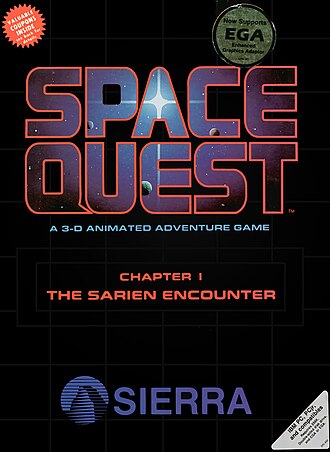
Space Quest I: The Sarien Encounter (1986), designed by Mark Crowe and Scott Murphy for Sierra On-Line, is a science fiction comedy adventure following Roger Wilco — a janitor on a spaceship who accidentally becomes the only person who can save the galaxy from an alien threat. The Two Guys from Andromeda, as Crowe and Murphy styled themselves, packed the game with satirical humor aimed squarely at Star Wars, Star Trek, and science fiction tropes in general. It spawned five sequels and became one of Sierra’s most beloved adventure series.
The setup is pure B-movie space opera: the Sariens attack Roger’s ship, the Arcada, steal its Star Generator prototype, and leave it for dead with Roger as the only surviving crew member. He escapes in an emergency pod and drifts to the nearby planetoid Kerona, and from there the game hands you the entire rest of the plot with barely a hint about where to start looking for help. It’s a setup that pokes fun at every “lone hero saves the galaxy” story while still delivering a genuine one, which is the balancing act Space Quest keeps pulling off across all six entries.
How Roger Wilco dies (a lot)
Space Quest I uses a text parser — you type commands like LOOK, TAKE, and USE to interact with the world. The puzzles range from logical to lateral, and the game’s universe is filled with details that reward careful exploration and creative thinking. Sierra never held your hand about which of those two categories a given puzzle fell into, so part of the game’s old-school charm is simply learning to think the way a mid-80s adventure designer thought. It’s also notable for its generous death count: Roger can die in dozens of inventive ways, each accompanied by a witty obituary. Save constantly, ideally before entering any new screen, since a few puzzles require items you’d only think to grab well before you actually need them — when you get stuck, backtrack and re-check your inventory before assuming the puzzle is the problem. Read item descriptions closely too; several of the jokes are hiding real clues underneath them. And don’t assume every location is meant to be visited in a fixed order — Kerona’s open early stretch is more forgiving about sequence than the tightly scripted areas that follow once you reach Ulence Flats.
Comedy adventure vs. its Sierra siblings
Next to Sierra’s other adventure lines, Space Quest occupies its own lane. King’s Quest leans into fairy-tale melodrama and Police Quest is dead serious about procedure, but Roger Wilco is a schlub who stumbles into heroism, and the humor is the whole point rather than a garnish. It’s also worth comparing the original 1986 EGA release to the 1991 VGA remake, which softened some of the deadliest early puzzle traps and made the game noticeably more forgiving for newcomers. That remake kept the script’s jokes largely intact while smoothing over some of the original parser’s rougher edges, which is a big part of why it’s the version most modern players are steered toward first.
Getting Space Quest running
New to DOSBox? Our complete setup guide walks through everything you need, and if you enjoy this one, our list of free DOS games has plenty more in the same spirit. Once you have the game files from a legitimate copy, extract them and open DOSBox. Use mount c [folder] then c: to switch drives, and run SQ1.EXE to launch. If you picked up the VGA remake instead of the original, the executable name and some of the mounting details will differ slightly, so it’s worth checking your specific release’s file listing before assuming the steps above apply exactly.
EGA original or VGA remake?
Space Quest captures a specific kind of nerdy humor that landed perfectly in 1986 and still holds up. Roger Wilco is a brilliantly conceived protagonist — not a hero by any measure, but a decent person in over his head — and the galaxy he inhabits is full of sharp comic invention. Every screen has at least one sight gag or throwaway parody worth reading twice, and the writing rarely goes for an easy laugh when a stranger one is available instead. My one real criticism of the EGA original: the parser can be genuinely unforgiving about exact verb phrasing, which will frustrate anyone used to modern point-and-click adventures where every reasonable action just works. Both versions are worth playing as foundational Sierra comedy adventures; the VGA remake is the easier recommendation for a first playthrough, while the EGA original is the one to return to once you already know Roger’s story and just want the rougher, funnier first draft of it. Given how influential the Two Guys’ sense of humor turned out to be for Sierra’s comedy output over the following decade, there’s real value in seeing where that voice actually started. Roger Wilco’s later, weirder adventures owe their existence to how well this scrappy first outing landed with players, and it’s still funny enough today to explain why they kept coming back for five more helpings of it. Not many 1986 adventure games can say the same. Even the game-over obituaries got a fanbase of their own over the years, which says something about how much personality Sierra managed to pack into what was, mechanically, still a fairly conventional text-parser adventure for its time.
Watch Gameplay
You might also like: