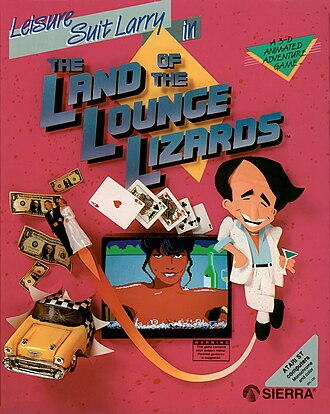
Before you meet Larry Laffer, you have to prove you were alive for the Carter administration. That opening trivia gauntlet — questions about Tiny Tim’s “Tiptoe Through the Tulips,” the “Where’s the Beef?” ad campaign, and who exactly lost a daughter but gained a “meathead” — is the first thing most players remember about Leisure Suit Larry, and it says more about the game’s design philosophy than any of the puzzles that follow. This is a comedy adventure built entirely around the gap between how Larry sees himself and how the world actually treats him, and understanding why it worked in 1987, and why Sierra rebuilt it almost from scratch four years later, means starting with that quiz.
A Remake of a Remake: From Softporn Adventure to Larry
Leisure Suit Larry in the Land of the Lounge Lizards wasn’t an original concept so much as a deliberate reinvention. Its structural backbone — the city map, the puzzle layout, the general shape of Larry’s night out — was lifted directly from Softporn Adventure, a 1981 text-only game by Chuck Benton that had circulated as an early example of adult-themed computer entertainment. Sierra designer Al Lowe, who pitched the idea of remaking it with the graphical tools Sierra had by the mid-1980s, kept Benton’s puzzle structure largely intact and is credited in the finished game’s manual for that reason, but wrote all new jokes and dialogue himself. Lowe was an unlikely author for the material: before joining Sierra he had been a high school teacher, and his early credits at the company were Disney-licensed children’s titles like Winnie the Pooh in the Hundred-Acre Wood and Donald Duck’s Playground. The tonal jump from educational Disney tie-ins to a comedy about a middle-aged loser trying to get a date is one of the stranger career pivots in 1980s game development, and it’s part of why Larry’s humor leans on awkwardness and self-deprecation rather than anything crude for its own sake.
The 1987 original ran on Sierra’s AGI (Adventure Game Interpreter) engine, the same technology behind the studio’s King’s Quest series, which meant EGA graphics limited to 16 simultaneous colors and a text-parser interface — players typed commands like “open door” or “talk to bartender” rather than clicking on anything. It also released on DOS and Apple II at launch, later reaching the Amiga, Atari ST, Apple IIGS, and even the TRS-80 Color Computer, a wider platform spread than most Sierra adventures of the period.
1987 vs. 1991: Two Versions of the Same Joke
In 1991, Sierra didn’t just patch the original — it rebuilt Leisure Suit Larry in the Land of the Lounge Lizards on the newer SCI (Sierra’s Creative Interpreter) engine, the same technology powering contemporary titles like King’s Quest V. The differences go well beyond a fresh coat of paint, and comparing the two side by side is one of the more instructive “same game, different era” case studies in Sierra’s catalog.
| Feature | 1987 Original | 1991 VGA Remake |
|---|---|---|
| Engine | AGI | SCI |
| Graphics | EGA, 16 colors | VGA, 256 colors |
| Interface | Text parser (typed commands) | Point-and-click, icon-driven |
| Music/Sound | PC speaker only | Expanded support for period sound cards |
| Topical jokes | Original 1987 references | Updated for 1991 (see below) |
The most interesting differences aren’t technical at all — they’re topical. The remake updated several jokes to match 1991’s headlines instead of 1987’s: Larry’s stack of credit cards, originally attributed to Libya in the joke text, was changed to Iraq to reflect the Gulf War, and a punchline after buying condoms was rewritten from “Thanks a lot, big mouth!” to “Thanks a lot, Saddam!” The core puzzles and plot beats are otherwise nearly identical between versions, which makes the remake less a reimagining and more a time capsule stacked on top of another time capsule — you can watch four years of American pop culture shift just by comparing punchlines.
The Quiz Itself: Copy Protection Dressed Up as Comedy
The age-verification quiz that opens the game deserves attention on its own, because it’s doing two jobs at once. On its face, it’s a comedic gate — a string of trivia questions about 1970s and ’80s American pop culture (Tiny Tim’s novelty hit, the “Where’s the Beef?” slogan, the Nehru jacket falling out of fashion, Bourbon Street’s location in New Orleans, Cesar Chavez’s grape boycott, James Brown’s “Godfather of Soul” nickname, and the identity of the TV character who called Archie Bunker “meathead”) meant to weed out anyone too young to plausibly remember them. But in the VGA remake specifically, several questions were retooled to double as functional copy protection: they referenced details printed only in the physical game manual, so a player working from a pirated copy without the manual would fail the quiz even if they were old enough to answer the pop-culture questions correctly. It’s a clever piece of design that folds anti-piracy measures directly into the joke rather than bolting on a separate serial-number check, and it’s a large part of why the quiz is remembered fondly today rather than as an annoying gate — it’s funny even when it’s also functional.
Playing Larry: A Comedy Built on Failure
Structurally, Leisure Suit Larry is a compact adventure — Larry’s entire story unfolds within one city, Lost Wages, which is small enough that players quickly learn its geography by heart rather than getting lost in sprawling world design. That compactness is deliberate: the game isn’t really about exploration, it’s about repetition and failure as comedy. Larry can die from choices that look completely harmless on the surface, and part of the design philosophy is that players are expected to learn the game’s dangers through trial and error rather than being warned in advance. What keeps this from feeling punishing rather than funny is Larry himself — a character the game clearly frames as sympathetic despite his flaws, a loser the player is meant to root for rather than laugh at cruelly. That balance, more than any individual joke, is why Al Lowe kept returning to the character for sequels across the following decade, each one refining the same joke-death formula while moving Larry to new settings.
Matching Cycle Counts to Whichever Engine You’re Running
Both versions run cleanly under DOSBox, but they need different handling. The original AGI-engine 1987 version is CPU-light by design and runs correctly at low cycle counts (around 1000–3000); pushing cycles too high can actually cause text-parser input lag or animation timing issues in AGI-engine Sierra titles, so resist the urge to max out the CPU speed. The 1991 VGA/SCI remake benefits from a somewhat higher cycle count (roughly 3000–8000) for smooth cursor movement and animation, and should have Sound Blaster emulation enabled and selected in-game for its expanded music. If using DOSBox’s default mounted CD or floppy image, make sure the correct interpreter files are present — AGI and SCI games use different core files, and mixing installation directories between the two versions is a common source of crashes.
Getting Through Lost Wages Without Dying of Embarrassment
- Save constantly, especially before trying anything new. Larry can die from choices that look perfectly safe; frequent saves turn “trial and error” into “harmless experimentation.”
- Answer the age quiz honestly rather than guessing wildly. A handful of wrong answers is tolerated, but too many failures locks you out of starting the game entirely.
- In the 1987 original, try alternate phrasings if a command doesn’t work. The AGI text parser understands limited vocabulary, and rephrasing a stuck command is often the fix.
- Explore Lost Wages fully before rushing the main goal. The city is small enough to fully map early, and doing so avoids missing items or dialogue needed later.
- If replaying, try the version you didn’t grow up with. Comparing the 1987 and 1991 versions side by side reveals just how much changed under the hood despite near-identical puzzles.
Legacy: A Franchise Built on One Joke That Kept Working
Leisure Suit Larry’s commercial success let Al Lowe build an entire franchise on the same comedic premise, with sequels carrying Larry to new cities and new failed romantic pursuits throughout the late ’80s and ’90s, each one iterating on the joke-death structure the original established. The 1991 VGA remake’s existence is itself part of that legacy — Sierra rarely rebuilt an adventure game from the ground up on new technology just four years after release, and doing so for Larry specifically signals how commercially important the character had become to the company. For players interested in the broader Sierra and adventure-game landscape this game grew out of, the studio’s other narrative-driven catalog from the same period, including atmospheric titles like Beneath a Steel Sky, and the fantasy-adventure hybrids of Eye of the Beholder, show just how wide a net “adventure gaming” cast during the same handful of years.
Sorting Out the Two Versions: Reader Questions
What’s the difference between the 1987 and 1991 versions of Leisure Suit Larry?
The 1987 original used Sierra’s AGI engine with EGA graphics and a typed text-parser interface. The 1991 remake rebuilt the game on the SCI engine with 256-color VGA graphics, a point-and-click interface, and several jokes updated to reflect 1991 current events.
Was Leisure Suit Larry based on an earlier game?
Yes. Its puzzle structure and city layout were adapted from Softporn Adventure, a 1981 text-only game by Chuck Benton, though all the dialogue and jokes in Larry are Al Lowe’s original writing.
Why does the game start with a trivia quiz?
The age-verification quiz checks that players are old enough to remember 1970s-80s pop culture references, and in the VGA remake several questions doubled as informal copy protection by referencing details found only in the printed manual.
Is the 1987 version harder to run in DOSBox than the remake?
Not harder, but different — the AGI-based original needs a lower cycles setting to avoid input and animation issues, while the SCI-based remake handles higher cycle counts without problems.
Who created Leisure Suit Larry?
Al Lowe designed and wrote Leisure Suit Larry for Sierra On-Line, building on the structure of Chuck Benton’s 1981 game Softporn Adventure.
You might also like: