A Jetpack, a Flamethrower, and an Alien Zombie Infestation
A jetpack, a flamethrower, and an alien zombie infestation, Halloween Harry had one of the most chaotic premises in DOS gaming history, and it fully commits to that absurdity from the first level. Developed by Sub-Zero Software and published by Apogee, it’s a side-scrolling shooter starring Harry Houdini (the protagonist, not the magician) as he battles through four episodes of alien-infested city streets, sewers, and alien ships. The complete game is now available as freeware.
Flying Changes Everything
Halloween Harry is a side-scrolling action platformer where the protagonist flies using a jetpack, giving him complete freedom of vertical movement. That mobility fundamentally changes how the game plays compared to traditional platformers, levels are built around aerial combat and exploration rather than precise jumping. Weapons include a flamethrower, missiles, and various energy weapons; ammo has to be conserved, civilians can be rescued for bonus points, and the level design mixes open vertical spaces with tight corridors that challenge the jetpack’s maneuverability.
A Longer Road to DOS Than Most Apogee Games
Halloween Harry has roots going back further than most Apogee titles. Australian developer John Passfield first wrote a game called Halloween Harry in 1985 for the Microbee, a home computer popular in Australia at the time. Years later, Passfield teamed up with collaborators to revive the character for PC, working through an early Amiga prototype before programmers Rob Crane and Tony Ball built out a DOS version that bore little resemblance to the original 1985 game beyond the name and premise. The finished game was developed jointly by Interactive Binary Illusions and Sub-Zero Software, published locally in Australia through Manaccom, and distributed internationally by Apogee. It shipped as version 1.1 on October 10, 1993, after an incomplete 1.0 shareware demo had already appeared exclusively in a UK computer magazine.
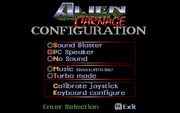
Apogee soon suggested a rename, worried that a game called Halloween Harry would only sell well in October, the team agreed, and the game was reissued in 1994 as Alien Carnage. A sequel, Zombie Wars, followed in 1996, and Passfield and 3D Realms eventually released the complete game as freeware in May 2007.
Tips for New Players
- Jetpack fuel isn’t unlimited, treat vertical flight as a resource to spend on reaching ledges and dodging ground hazards rather than a default way of moving through every level.
- The flamethrower is short-ranged but devastating against clustered zombie aliens, while missiles and energy weapons are better saved for tougher single targets encountered in tighter corridors.
- Since levels mix wide-open vertical shafts with cramped passageways, get comfortable switching between hovering and precise, low-altitude flying rather than relying on one flight style throughout a stage.
- Rescuing civilians along the way adds bonus points, it’s worth a short detour when one is visible rather than rushing straight to the level exit.
Why It’s Still Memorable
The jetpack is what makes Halloween Harry unique in the DOS platformer landscape. Flying freely through levels while fighting zombie aliens with a flamethrower is genuinely exhilarating, and the game has personality to spare, Harry’s quips, the B-movie monster designs, and the relentless action combine into something memorably over-the-top.
It’s worth appreciating just how tangled this game’s development history is compared to most Apogee releases of the era. A 1985 Australian home-computer game, an abandoned Amiga prototype, a UK magazine demo, a rename forced by seasonal marketing concerns, and a freeware release more than a decade after the sequel, that’s an unusually winding road for a shareware side-scroller, and it says something about how scattered and international early PC game development already was, even before the internet made global collaboration routine.
Comparing It to Its Jetpack-Free Contemporaries
Set next to Commander Keen or Duke Nukem’s early platformer, Halloween Harry’s jetpack-driven vertical freedom is the single biggest thing separating it from the pack. Most Apogee-era platformers of this vintage are built around careful horizontal traversal and precise jumps; Harry inverts that by making altitude a resource you manage rather than a puzzle you solve one jump at a time. That’s a meaningfully different design problem, and it’s why levels built for Harry don’t really translate to other games in the genre, or vice versa.
The closest point of comparison is probably Crystal Caves or Duke Nukem’s occasional flight power-ups, but neither commits to vertical movement as a core mechanic the way Halloween Harry does from the very first level. Most platformers of the era treat flight, when it appears at all, as a temporary bonus; here it’s simply how the character moves, all the time, which changes how level designers had to think about hazard placement, enemy positioning, and pacing across every stage in the game.
B-Movie Energy, Played Straight
Part of what makes Halloween Harry memorable is that it commits fully to its own absurd premise rather than winking at the player. Zombie aliens, a flamethrower-toting hero named after a magician, a jetpack, none of it makes a lot of sense stacked together, but the game plays it with the straight-faced enthusiasm of a genuine B-movie rather than a joke. That sincerity is a big part of why it still feels charming rather than dated.
The honest criticism: the free-flight movement takes some getting used to if you’re coming from ground-based platformers, and a few later levels lean hard on trial-and-error hazard placement. Once the jetpack controls click, though, few DOS platformers feel quite like this one.
Downloading and Running Halloween Harry
First time with an emulator? The DOSBox guide on this site gets you from download to running game. When you finish this one, the free DOS games roundup has your next download.
Running It With DOSBox
Run HARRY.EXE from the mounted game folder once DOSBox is set up.
You might also like: