A popular shorthand says Dangerous Dave is the game that started id Software. The dates say otherwise. Dave was a program John Romero wrote at home in 1988 for an Apple II disk magazine, two years before the Mario demo. What pushed a handful of colleagues toward their own company was a one-night demo in September 1990 that happened to borrow Dave’s sprite. The character was the costume. The idea underneath was a scrolling trick.
Written for UpTime by a Mario fan
Romero’s own page on the game gives the origin plainly. He began Dangerous Dave in June 1988, just after leaving Origin Systems and co-founding Inside-Out Software, and worked on it at home while his day job was porting the Apple II version of Might & Magic II to the Commodore 64. The impetus, in his words, was being a huge fan of Super Mario Bros. on the Nintendo and wanting a game like it for himself, which is why Dave jumps, collects and finds secret areas outside the level edges. Mario never had a gun or a jetpack, Romero notes, and he was determined to give Dave both.
The game was also a demonstration. He was writing a series of articles for UpTime Disk Monthly about GraBasic, a 6502 graphics library he had built, and the magazine published the library in three installments, each with a utility and a game. Dangerous Dave was the game in the third. Its title screen reads “Episode 1,” which tells you he hoped for sequels, and its full title is Dangerous Dave in The Deserted Pirate’s Hideout. The story is simple: get back the trophies that a bully named Clyde stole from your clubhouse, across ten levels. Romero also wrote his first full level editor for it, a habit that later impressed John Carmack when the two started working together, according to Romero’s page on the Apple II original.
Two details from that page show where the PC lineage starts. The Apple II game draws one frame while you look at the other, using page-flipping to keep the animation from flickering, and Romero says it was the first game he wrote under ProDOS. The same page says the PC version handled climbing “the correct way,” where the Apple II edition used a color trick to fake it. UpTime’s editor, Jay Wilbur, whom Romero met at AppleFest in 1987, was later hired as chief executive of id Software in April 1992.
Overnight, one level of Mario
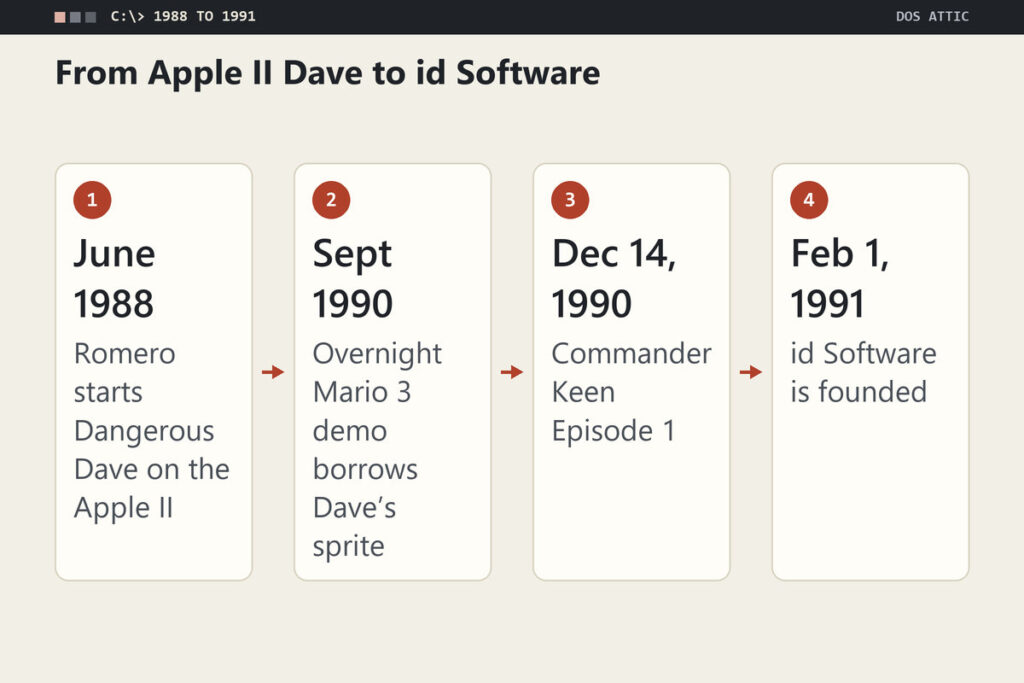
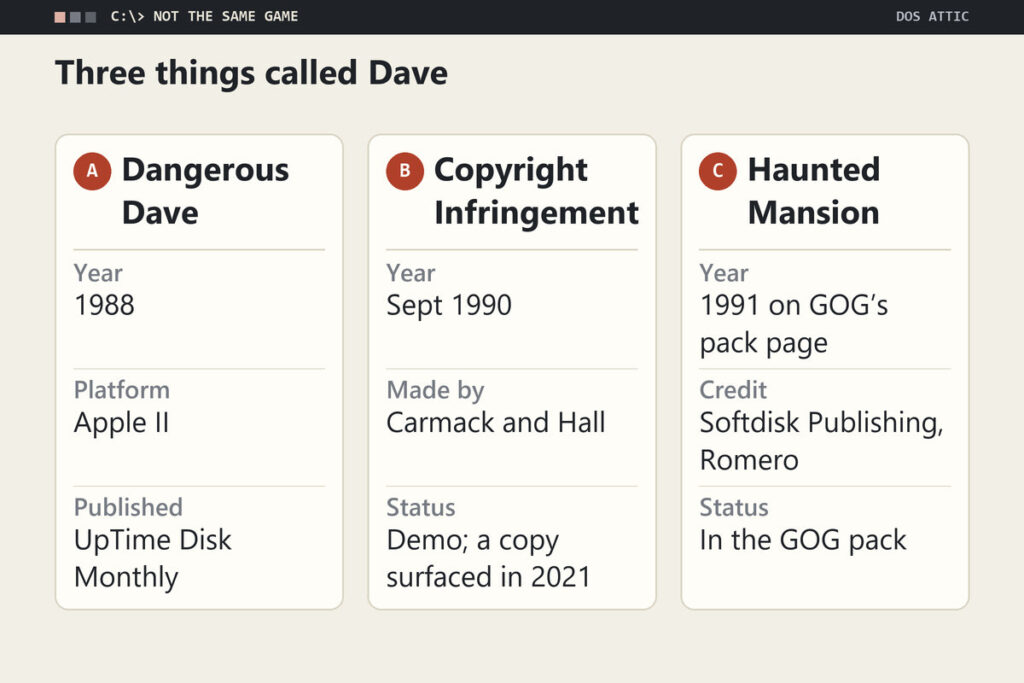
The move from a hobby game to a company happened in September 1990 at Softdisk in Shreveport, where Romero, Carmack and Tom Hall were building games for the company’s monthly disks. Carmack had worked out an efficient way to side-scroll graphics rapidly on a PC. According to the history of id Software, he and Hall stayed up late into the night rebuilding the first level of Super Mario Bros. 3, dropping stock graphics of Romero’s Dangerous Dave in place of Mario. They called the result Dangerous Dave in Copyright Infringement, and when Romero saw it he realized that Carmack’s breakthrough could have potential as a product.
The demo mattered because it proved a point rather than because it was a finished game. The group then moonlighted for about a week and two weekends to build a larger version of the Mario demo. A working copy of the demo, long assumed lost, was found in July 2021 and is preserved at the Museum of Play, which is a good reminder that this is a documented object and not only an anecdote.
Nintendo’s reply
They sent the work to Nintendo. Romero recalls the answer: the demo was impressive, but Nintendo did not want its intellectual property on anything other than its own hardware. A Mario game for PCs was never going to happen, but the scrolling engine was real, and nobody had to ask permission to use it for a new character.
Dave games on sale now
The Apple II original from 1988 has no store listing that this article could find, but PC Dave games are on sale. GOG sells a Dangerous Dave Pack whose store description lists four games: Dangerous Dave in the Haunted Mansion, Dangerous Dave’s Risky Rescue, Dave Goez Nutz! (Romero spells it Dave Goes Nutz) and The Deserted Pirate’s Hangout, with Softdisk Publishing and John Romero credited and a 1991 date. The page says the pack runs in DOSBox and includes a configuration tool with a CGA, EGA or VGA choice. It does not say whether the 1988 game appears in some form, and the last title has a name close to the Apple II game’s subtitle, so read the page before assuming what it contains.
The scrolling that came out of the demo is easier to find in Commander Keen, the series covered in the next section. Commander Keen on Steam lists id Software as developer and Bethesda Softworks as publisher, with Episode 1 dated December 14, 1990, and calls it the debut of id’s side-scrolling technology. If your interest is what the Mario demo proved, that is the faithful way to see it. Beyond those two store pages, treat any other copy of a Softdisk-era Dave game as unverified.
Miller’s letters and the first Keen
Dave also drew the attention of the publisher who gave the team its first deal. A Game Developer feature on the making of Doom describes how Scott Miller saw one of the games Romero and his colleagues made for Softdisk and wanted it for his shareware business. He wrote to the programmers under invented fan names, Romero realized that all of the letters had one return address, and Miller followed up with a $2,000 check and a request for a game idea. The idea, a paragraph long, became the first Commander Keen trilogy. The history of id adds that Keen reused the work done on the Mario demonstration.
Keen’s first episode went on sale on December 14, 1990, three months after the demo night, and id Software was formally founded on February 1, 1991. If you want the other side of the deal, how Miller’s free-first-episode system worked as a business, the history of the Apogee shareware model covers it.
Judging Dave as a game today
As a game, Dangerous Dave is brisk and strict. Romero’s hint notes for the Apple II version reveal how little the design forgives: you need only one trophy to leave a level, extra trophies cannot be picked up, and the fireball from a killed enemy can kill you too. He says the jump needs a firm hand, with a dedicated key to stop yourself in midair. That rough, personal design is what you get from a program written to show off a graphics library, and it is also why it feels more like a sketchbook than a finished product.
Romero is also frank about which Dave games he counts. He calls The Deserted Pirate’s Hideout and The Haunted Mansion the only real Dave games, and he is dismissive of Risky Rescue and Dave Goes Nutz (his spelling), which Softdisk chose to make as sequels. Take that as a creator’s opinion rather than a verdict, but it is a useful guide. If you want one Dave and one evening, the Haunted Mansion in the GOG pack is the sequel Romero himself counts as real, and the later pair can wait.
For id history rather than play, the better route is a short one. Read the demo story, try Keen’s first episode, and see how the same ideas look once they stop being a joke. For the PC display hardware of the period, the history of CGA, EGA and VGA graphics covers the modes involved, and what Wolfenstein 3D sold by mail shows where the same team went next.