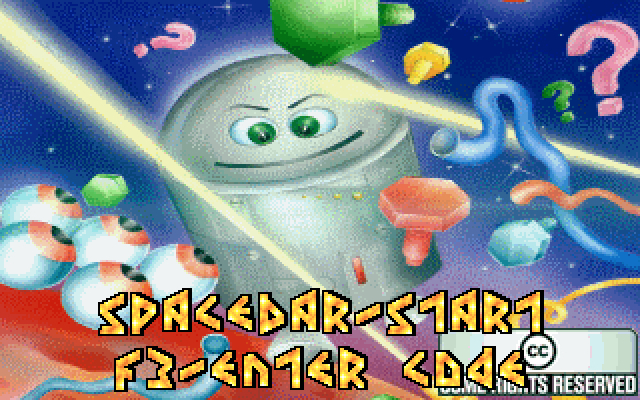
Some game legacies never quite cross borders the way they deserve to. Robbo, the small robot at the center of Adventures of Robbo, was already a beloved fixture of 8-bit gaming before this 1993 MS-DOS entry from Polish studio xLand Games arrived, but outside Eastern Europe, most players have never heard the name.
A Cult Favorite Rebuilt for DOS
This DOS release continues Robbo’s story with new mazes, new enemies, and the same block-pushing, key-collecting formula that made the earlier games a cult favorite. xLand Games had already built a strong reputation off the back of prior Robbo entries, and this one expands the concept with a larger set of level groups than you’d typically expect from a single shareware episode.
The core loop will feel immediately familiar if you’ve played Sokoban or Boulder Dash: navigate a grid-based maze, push crates onto pressure plates, avoid or destroy hostile robots, and collect keys to unlock doors, all while managing a limited supply of laser shots. Every level functions as a self-contained logic puzzle, and a single careless move can trap you or destroy a crate you needed later.
What separates Robbo from a straight Sokoban clone is the addition of active threats. A standard block-pushing puzzle is purely about spatial logic and has all the time in the world to solve; Robbo adds patrolling enemies and a limited laser that can permanently alter the puzzle’s geometry, meaning you’re solving a logic problem and managing a light action layer at the same time.
Thinking Ahead in the Maze
- Robbo has no undo for a pushed block — pause before every push and consider whether you’ll need that crate’s original position again later in the level.
- Ration your laser shots. Destroying a wall for a shortcut is sometimes correct, but a wasted shot early can leave you without a way to clear a hostile robot later.
- Timed gates and moving enemies punish hesitation just as much as impulsiveness — study a hazard’s pattern for a beat before committing to a route past it.
- When a level feels unsolvable, look for a destructible wall you haven’t tried shooting yet; later levels often hide their real solution behind one.
- Treat each level group as a difficulty ramp rather than a random assortment — skills you build in earlier groups are usually assumed knowledge by the time you reach the later ones.
Robbo’s Roots on 8-Bit Hardware
It’s worth knowing that Robbo didn’t start on DOS at all. The character and the core push-block puzzle formula trace back to earlier 8-bit computer games, where the series built the cult following that made a DOS revival worth making in the first place. That lineage is part of why the puzzle design here feels so confident and well-tested — xLand Games wasn’t inventing the formula from scratch, they were refining a design that had already proven itself with an earlier generation of hardware and players.
That history also explains why Robbo never became a household name outside Eastern Europe the way Western shareware mascots did. The series grew up on hardware and in a market that had relatively little overlap with the Apogee-and-Epic-dominated American shareware scene, so its reputation stayed largely regional even as the games themselves held up just as well as their more famous Western counterparts.
A Long Legacy, Mostly Unseen Outside Poland
Robbo has a long legacy in Polish gaming history, and this DOS shareware entry is a great entry point for players outside that scene who want to see what made the series so beloved. The puzzle design holds up remarkably well decades later, rewarding patience and careful thinking over fast reflexes in a way that a lot of contemporaneous action-platformers simply didn’t attempt.
If you’ve spent time with Sokoban clones and found most of them interchangeable, Adventures of Robbo is a cut above — the hazard variety (moving enemies, timed gates, destructible walls) keeps the puzzle logic from ever feeling stale across its full set of levels, even if a handful of later puzzles lean a little too hard on trial and error before their solution clicks.
The honest downside is presentation more than design: the visuals are functional rather than striking, even by 1993 shareware standards, and newcomers expecting something visually flashy might bounce off before the puzzle design has a chance to win them over. Stick with it past the first couple of level groups, though, and the mechanical depth more than makes up for the plain presentation.
My honest recommendation: play it with a notepad or scratch paper nearby for the trickier later levels. Some of the multi-step solutions genuinely benefit from sketching out crate positions before committing to a sequence of pushes, and that kind of deliberate planning is exactly where the game’s puzzle design shines brightest.
Downloading Adventures of Robbo
Getting DOSBox running for the first time is easier than it looks — our complete setup guide covers it step by step.
Booting Robbo in DOSBox
Extract the archive into its own folder, something like C:\GAMES\ROBBO. In DOSBox, run mount c C:\GAMES\ROBBO followed by c:, then launch the EXE from that directory. Robbo runs comfortably even at fairly low DOSBox cycle counts, so if timing feels erratic, try lowering the emulated CPU speed — check our DOSBox guide for more tips on classic DOS puzzle games specifically.
See the Puzzles in Motion
You might also like: