An adventure game about surviving your own side
Most spy fiction is about the danger of the enemy. KGB, developed by Cryo Interactive Entertainment and published by Virgin Games in 1992, is more interested in the danger of your own institution. Set in Moscow during the final, chaotic days of the Soviet Union, the game casts you as a KGB officer investigating a case that becomes tangled in the political upheaval of glasnost and perestroika, where the real threat is as likely to come from a suspicious superior as from any external enemy.
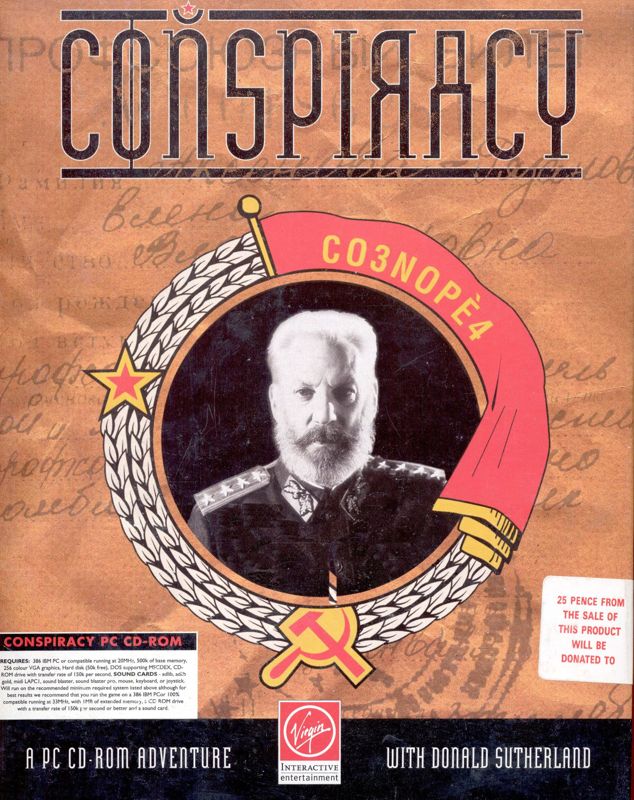
The game was later re-released in an expanded CD-ROM edition retitled Conspiracy, which added video sequences featuring actor Donald Sutherland. But the core MS-DOS release stands on its own as one of the more politically charged adventure games of its era, trading fantasy and science fiction trappings for a grounded, paranoid Cold War thriller unlike almost anything else being made in the genre at the time.
Interrogation rooms instead of inventory puzzles
KGB is built around interrogation, investigation, and navigating the bureaucratic and political dangers of Soviet institutional life. You move through Moscow locations, question suspects and colleagues, and gather evidence, all while managing the constant risk that a wrong move could draw suspicion from superiors or rivals within the agency.
The game is notable for its time-limited structure and the way conversations can shift depending on how you’ve behaved up to that point, giving it a tenser, higher-stakes feel than many contemporary adventures. There’s little in the way of traditional item-combination puzzles; instead, the tension comes from reading people and situations correctly under pressure, which makes KGB feel closer to a social-deduction game wearing an adventure game’s clothes.
The setting itself deserves credit for how unusual it was at the time. Very few games, adventure or otherwise, were willing to place players inside the collapsing Soviet state as anything other than an external threat to be defeated, and KGB’s decision to make you a product of that system rather than an outsider fighting it gives the whole story a moral murkiness that most Cold War fiction from Western studios never really attempted.
Staying out of trouble in Moscow
- Choose your words carefully in every conversation – KGB tracks how your behavior is perceived, and there’s rarely an undo for a careless answer given to the wrong person.
- Pay attention to the game’s time limits from the very start; unlike a lot of adventure games, dawdling has real consequences here rather than just being a pacing inconvenience.
- Treat every NPC as a potential source of danger as well as information – the game’s paranoid atmosphere isn’t just flavor text, and misjudging a colleague’s loyalty can cost you the case.
- Replay early sections if a later consequence surprises you; because behavior is tracked cumulatively, understanding which of your earlier choices led to a bad outcome usually requires going back further than the immediate scene.
A political thriller unlike its contemporaries
KGB stands out from its contemporaries for setting an adventure game inside the machinery of a real, recently-collapsed political system, using that backdrop for genuine tension rather than spectacle. Cryo Interactive’s willingness to build a game around bureaucratic paranoia rather than treasure hunting or monster fighting makes it a memorable outlier in the genre, closer in mood to a le Carre novel than to the swashbuckling adventures more commonly associated with the era.
My honest opinion: the behavior-tracking system is fascinating in concept but can feel opaque in practice, since it’s not always clear which specific choice tipped a relationship or a superior’s trust in one direction or another. That opacity is frustrating on a first playthrough, but it also gives KGB real replay value once you understand how the system works. Players interested in Cold War history or unconventional adventure game design will find it a genuinely unforgettable period piece, even with its rough edges. It rewards careful, cautious play and offers a very different mood from the swashbuckling adventures more commonly associated with the genre, closer in spirit to a paranoid thriller than to a puzzle box.
It’s also worth playing simply as a historical curiosity. Very few games made during the actual collapse of the Soviet Union tried to process that moment in real time the way KGB does, released in 1992 while the political ground it depicts was still settling. That immediacy gives it a documentary-adjacent quality that a game made even a few years later, with the benefit of hindsight, couldn’t have replicated. Playing it today is as much a small window into a specific, anxious historical moment as it is a piece of entertainment, which is a genuinely rare quality for any game, let alone a modestly-budgeted 1992 adventure title, to actually carry off convincingly and consistently, start to finish.
Getting your hands on a copy
Setup takes about ten minutes if you follow our DOSBox walkthrough. And if you want more games like this, our free DOS games list is the place to browse.
KGB is a commercial title and is not legally available as a free download. Look for official re-releases on GOG or Steam.
Configuring DOSBox for Moscow
Mount the folder containing your game files with mount c [folder], switch to that drive with c:, and run the EXE. See our DOSBox guide for full configuration details, including getting period-accurate Sound Blaster audio working for the game’s dialogue-heavy scenes.
Moscow on Screen
You might also like: