Every major shareware empire started somewhere smaller and stranger than its later hits suggest. For Apogee Software, that starting point was a text adventure about escaping the Titanic and ending up somewhere far weirder than history books describe.
Before Apogee had a name for itself
Beyond the Titanic was written by Scott Miller for MS-DOS in 1986, published under what would soon become Apogee Software. It predates the company’s famous shareware action titles by years, arriving at a time when text-based interactive fiction was still a dominant format for PC gaming rather than a niche throwback.
The premise casts players as a passenger on the doomed ocean liner, tasked with finding a way to escape the sinking ship, only to be swept into a bizarre underground complex far removed from the historical tragedy that inspired the setup. Like most of Apogee’s earliest work, it was distributed as shareware before eventually becoming freeware, preserving a piece of the company’s pre-Duke Nukem history that’s easy to miss entirely.
What’s striking in hindsight is how little the setting has to do with the actual historical Titanic disaster once the escape sequence ends. Miller uses the ship as a launching point rather than a subject, which was a fairly common trick in 80s text adventures: borrow a recognizable, evocative setting for the opening, then pivot hard into whatever wilder idea the writer actually wanted to explore. It’s a structure you’ll recognize if you’ve played much interactive fiction from the period.
A parser, your imagination, and nothing else
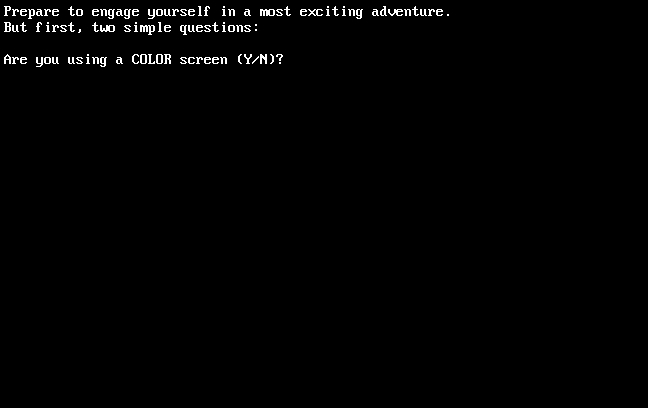
There are no graphics here beyond the text itself, not even the simple line-art some contemporary parser games used. Progress depends entirely on typed commands: examining objects, moving between rooms, interacting with an environment that only exists in your head and the game’s descriptions. After escaping the sinking ship, the story pivots hard into stranger territory, sending the player through an underground complex on a journey home to San Francisco.
Success comes down to careful reading, methodical exploration, and a willingness to experiment with the parser to figure out exactly which verbs it actually understands, very much in the tradition of 1980s text adventures where half the challenge is learning the game’s vocabulary.
That vocabulary-learning process is honestly part of the appeal for anyone who grew up on later, more forgiving adventure games. There’s a specific satisfaction in finally landing on the exact phrasing a stubborn 1986 parser wants, one this genre has mostly lost now that point-and-click interfaces removed the guessing game entirely.
Tips for working the parser
- Keep commands short. Two-word inputs like “open door” or “get key” work far more reliably than full sentences.
- Examine every object mentioned in a room description, even ones that sound like scenery. Text adventures from this era rarely describe something that doesn’t matter.
- Map rooms on paper as you go. There’s no in-game map, and the underground complex branches more than it first appears to.
- If a command fails, try a close synonym before assuming the puzzle needs a different item entirely.
- Read item descriptions twice on pickup; 1980s text adventures often bury the hint for later use inside a throwaway sentence you’ll otherwise skim past.
Why this matters more than its size suggests
Beyond the Titanic offers a genuine glimpse into Scott Miller’s earliest work, years before he founded Apogee and helped popularize the shareware model that would define ’90s PC gaming through id Software’s early releases. Seeing his roots in text adventures adds real context to the company’s later, far more famous action catalog.
It’s a reminder that the shareware pioneers of the early ’90s didn’t arrive fully formed as action-game specialists. Miller cut his teeth writing parser-driven fiction like this before the industry’s center of gravity shifted decisively toward graphics-first, reflex-driven design later in the decade, and that trajectory, text adventure to arcade action to full 3D, mirrors the broader path the whole PC industry took over roughly the same ten years.
Downloading it
New to DOSBox? Our complete setup guide walks through everything you need, and if text adventures aren’t usually your thing, our list of free DOS games covers plenty of other genres too.
Running it in DOSBox
Extract the files into their own folder, mount that folder with mount c [folder], switch to it using c:, and launch the EXE. As a pure text adventure, there’s no graphics or sound configuration to fuss over, which makes this about as painless a DOSBox setup as you’ll find; our guide above covers the rare edge case where it doesn’t.
Worth the short detour?
As a game on its own merits, Beyond the Titanic is slight, and the format has largely fallen out of favor for good reason; parser-guessing can be genuinely tedious by modern standards. But as a piece of pre-history for one of PC gaming’s most influential companies, it’s a short, free, and genuinely interesting curiosity that’s worth an hour of anyone’s time tracing the roots of Apogee and 3D Realms.
I wouldn’t recommend it as anyone’s first text adventure; the vocabulary is narrower and less forgiving than later, more polished parser games, and newcomers will likely bounce off the trial-and-error verb guessing faster than genre veterans will. But taken on its own modest terms, as a piece of a much bigger company’s origin story, it’s an easy hour well spent.
Watch Gameplay
You might also like: