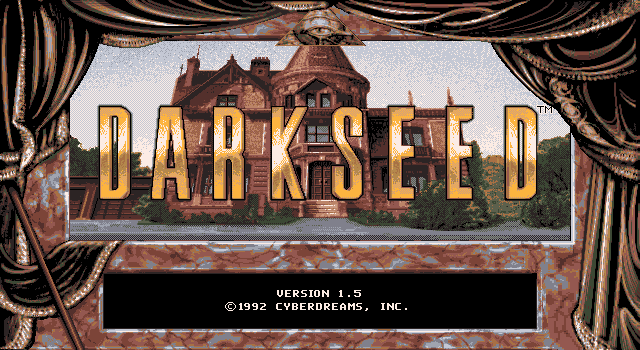
Imagine your own house, rendered faithfully down to the furniture, and then imagine it again as a biomechanical nightmare where the walls seem to breathe. That’s the pitch behind Dark Seed, and it’s still an unusual one more than thirty years later.
Cyberdreams’ Strange Debut
Dark Seed was released in 1992, developed and published by Cyberdreams as the studio’s debut title. It puts you in the shoes of Mike Dawson, a writer who moves into a new house only to discover an alien embryo has been implanted in his skull, tethering his world to a nightmarish parallel dimension. The game’s defining feature is its collaboration with Swiss surrealist artist H.R. Giger, best known for designing the creature in Alien, who contributed the grotesque, biomechanical artwork that defines the game’s “Dark World” locations. Arriving right as adventure games were starting to push toward full-motion video and higher-resolution art, Dark Seed instead built its identity around atmosphere over technical spectacle, and it established Cyberdreams as a studio willing to gamble on unconventional, mature horror concepts in a genre still mostly aimed at lighter fare.
It’s also worth remembering how unusual it was for a young studio to build its entire debut around a single outside artist’s vision. Most publishers of the era treated art direction as an in-house function, not something worth licensing the way you’d license a movie tie-in or a musician’s soundtrack, and Cyberdreams betting its first release on Giger’s involvement says a lot about how seriously the studio wanted horror fans to take it from day one.
The Dual-World Puzzle Structure
The interface is a real-time, icon-based point-and-click setup in the mold of Sierra’s adventures of the period. Mike explores his new home and the surrounding town in the “normal” waking world, gathering clues and talking to a small cast of townsfolk while slowly uncovering the truth about the alien presence growing inside him. The standout mechanic is the ability to cross into the Dark World at set points — a grotesque mirror of the same locations rendered in Giger’s biomechanical style, where objects and solutions in one world frequently affect the other. You’re constantly shuttling between the two realities to make progress, and the contrast between mundane suburbia and its warped counterpart is where most of the game’s impact lives.
Practical Tips (the Clock Is Real)
- Don’t dawdle. Dark Seed runs on a real-time clock, and the alien embryo’s gestation keeps advancing whether or not you’re making progress — wasted time is a real cost here, unlike in most adventure games of the era where you can dither indefinitely.
- Cross into the Dark World early and often to compare locations, rather than treating it as a last resort. Many puzzles only make sense once you’ve seen both versions of a room side by side.
- Pay close attention to objects that seem out of place in the normal world — they often have a direct, sometimes non-obvious counterpart waiting in the Dark World, and the connection isn’t always visually obvious at first glance.
- Talk to every townsperson you can find before assuming you’re stuck. The cast is small, but their dialogue changes as the plot advances, and a conversation that seemed like a dead end early on can open up later.
How It Compares to Later Cyberdreams Horror
Cyberdreams would go on to publish I Have No Mouth, and I Must Scream a few years later, and the contrast is instructive: that game commits to psychological horror through story and voice acting, while Dark Seed leans almost entirely on visual atmosphere, with Giger’s artwork doing work that dialogue never really needs to. Compared to Sierra’s contemporaneous adventures, Dark Seed is far less interested in clever puzzle logic and far more interested in mood — it’s a slower, moodier cousin to the Sierra house style rather than a direct competitor to it.
Legacy: A One-Off Worth Remembering
Dark Seed spawned a direct sequel, Dark Seed II, in 1995, which continued the Giger-designed dual-world concept, though by most accounts it never quite recaptured the original’s novelty. More broadly, the game is remembered less for spawning imitators and more as a case study in what happens when a game studio hands genuine creative control of half its visual identity to an outside artist with a fully-formed style of his own. Few developers since have tried anything quite like it, which is part of why Dark Seed still gets brought up in conversations about horror game history despite its thin puzzle design — it’s a curiosity that earned its place by being unlike anything else, not by being mechanically influential.
Running Dark Seed in DOSBox
Dark Seed is a commercial title without a legal free-download option — look for official re-releases on GOG or Steam if you want to play it properly. If you own a copy, running it under DOSBox is straightforward: copy the files to a folder, mount it with mount c [folder], switch to the drive with c:, and launch the executable. Our DOSBox guide covers memory, sound card, and CD-ROM configuration if your copy shipped on disc, and it’s worth double-checking your cycles setting given the real-time clock driving the plot forward.
Verdict: Mood Over Mechanics
Dark Seed occupies a strange, singular place in adventure game history — few games before or since have handed an entire visual half of their world over to an outside artist with such a distinctive, disturbing style. The trade-off is real, though: the puzzle logic is thin and occasionally obtuse, and the real-time clock means a slow player can lose without much warning, which feels punishing rather than tense by modern standards. I still think it’s worth experiencing at least once, purely for the atmosphere Giger’s art creates — just go in knowing you’re here for mood, not clever puzzles.
Watch Gameplay
You might also like: