Licensed adventure games were usually bad. This one wasn’t.
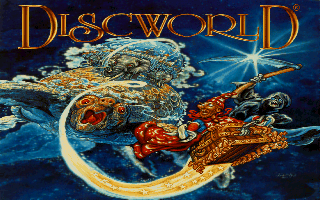
Licensed tie-in games had a rough reputation by the mid-90s, and adventure games based on beloved book series had an even rougher one. Discworld, developed by Perfect Entertainment and published by Psygnosis in 1995, is one of the exceptions. Based on Terry Pratchett’s Discworld fantasy novels, it stars the hapless wizard Rincewind, voiced by Eric Idle, as he’s dragged into a chaotic quest through the city of Ankh-Morpork to deal with a rampaging dragon.
What sets it apart from most licensed adventure games of the period is that it actually sounds like Pratchett. The script is steeped in the same absurdist humor and wordplay found in the books, rather than just borrowing character names and settings while writing generic fantasy-comedy dialogue around them. It released on PC, PlayStation, and Mac simultaneously, reflecting a level of production ambition that a lot of licensed games of the era simply didn’t get.
Rincewind’s tour of Ankh-Morpork
Discworld is a classic point-and-click adventure built around exploring Ankh-Morpork’s districts, talking to its eccentric inhabitants, and solving inventory-based puzzles. As Rincewind, you interact with a huge cast of characters drawn from Pratchett’s novels, and dialogue often serves as much for comedy as for actual clues, which is both a strength and, at times, a way to bury the hint you actually needed under three paragraphs of jokes.
The game is notorious among adventure fans for its difficulty, featuring puzzles that lean heavily on Discworld-specific logic and lateral thinking rather than straightforward cause and effect. This makes it a challenging but rewarding experience for players willing to embrace its offbeat sense of humor and occasionally obtuse puzzle design, though “occasionally” might be underselling just how far some of these logic leaps go.
The voice cast is a real highlight worth calling out on its own. Beyond Eric Idle as Rincewind, the game features Tony Robinson, Jon Pertwee, and other well-known British comedy and genre performers filling out the supporting cast, giving the whole production a level of vocal talent that most licensed games of the era couldn’t come close to matching. It’s one of the clearest signs that Psygnosis and Perfect Entertainment treated this as a genuine passion project rather than a cheap cash-in on Pratchett’s name, and it’s a big part of why the game still feels like a faithful adaptation rather than a licensed product wearing the books’ branding.
Surviving Ankh-Morpork’s puzzle logic
- Examine and try to use every object in your inventory on every other object, even combinations that seem absurd – Discworld’s puzzle logic rewards exactly the kind of silly experimentation the books encourage.
- Talk to background characters more than once; some of the game’s crucial hints are buried in dialogue trees that only unlock after repeated conversations.
- Don’t assume a joke response means you’re on the wrong track. Discworld frequently disguises real clues as throwaway gags, which is part of what makes it so notoriously tricky.
- Pay attention to Rincewind’s own sarcastic commentary when you try something obviously wrong – his reactions often narrow down what the game is actually looking for, even when the joke lands first.
- Keep a walkthrough bookmarked for emergencies without guilt. This is one of the few games where consulting a hint doesn’t feel like admitting defeat so much as translating Pratchett-brand logic into something workable.
Where it sits next to its fellow British comedy adventures
Compared to Adventure Soft’s Simon the Sorcerer II, released the same year and mining similar territory in British fantasy parody, Discworld leans harder into obtuse puzzle logic while Simon stays friendlier and more forgiving. Against LucasArts’ comedy adventures, Discworld’s humor is distinctly drier and more literary, closer to the source novels’ narrative voice than to the visual gags LucasArts favored.
My honest opinion: Discworld is one of the funniest scripts in 90s adventure gaming and one of the most frustrating to actually solve without help. The gap between “this is genuinely brilliant writing” and “I have no idea what the game wants from me” can be jarring within the same five minutes. For Pratchett fans, it’s worth pushing through regardless; for anyone lukewarm on the books, the puzzle difficulty alone might not be worth the fight without a walkthrough close at hand.
It’s also worth mentioning that a sequel, Discworld II: Mortality Bytes!, followed a couple of years later with a friendlier difficulty curve and an expanded cast, addressing exactly the complaint most players had about the original. If the puzzle logic here proves too much, it’s worth knowing the series course-corrected rather than assuming the whole franchise plays this unforgivingly, and returning to the original afterward with a walkthrough on hand is a perfectly reasonable way to experience it.
Where to get Discworld
The short version of DOSBox setup is below; the long version lives in our complete guide. Our roundup of free DOS games has plenty more where this came from.
Discworld is a commercial title and is not legally available as a free download. Look for official re-releases on GOG or Steam.
Running the CD-ROM release in DOSBox
Once installed, mount the game’s folder as your C drive in DOSBox, switch to that drive, and launch the EXE. Since Discworld was originally a CD-ROM title with full voice acting, getting the disc image mounted correctly matters more here than with earlier floppy-based adventures – our DOSBox setup guide covers mounting CD images properly so dialogue doesn’t stutter or cut out mid-line.
Ankh-Morpork in Motion
You might also like: