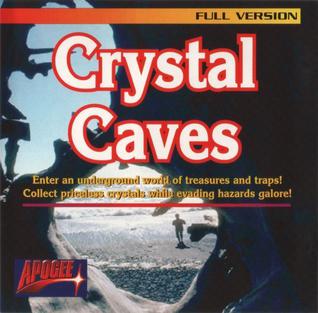
Not every DOS classic needed to reinvent the wheel. Crystal Caves knew exactly what it wanted to be — a tight, colorful, underground platformer where you collect crystals and blast alien critters — and it executed that vision with cheerful precision rather than chasing bigger ambitions.
A Platformer That Knew Exactly What It Wanted to Be
Crystal Caves was developed by David Joiner and published by Apogee Software in 1991. It spans three volumes, each with around 16 levels of underground platforming, and all three are now available as freeware, which makes the whole trilogy an easy, low-commitment entry point into early-90s Apogee platforming.
Mylo’s Debt and the Crystal Quota
You play as Mylo, a space trader mining crystals on an alien planet to pay off his debts — a lightweight premise that mostly just gives you a reason to be underground shooting things and grabbing gems. Each level requires methodically collecting a specific quota of crystals scattered around the map before the exit finally opens, which turns every stage into a small scavenger hunt as much as a platforming challenge.
Shooting in Four Directions and Wrapping Around the Screen
Crystal Caves is a side-scrolling platformer with a gun. Mylo can shoot in four separate directions to dispatch the various alien creatures inhabiting each underground level, and levels wrap horizontally — you can scroll off one side of a screen and appear on the other, which opens up some genuinely creative navigation and escape options once you get used to it.
The four-directional shooting is a small detail that ends up mattering a lot in practice. A lot of contemporary platformers only let you fire forward or forward-and-up, but Crystal Caves lets Mylo aim up, down, left, and right independently of which way he’s facing, which turns ceiling- and floor-mounted enemies into a manageable threat instead of a cheap-feeling one.
A Few Things That Trip Up New Players
- Don’t ignore the horizontal wraparound as an escape tool — it’s easy to forget it’s available mid-chase and take damage you didn’t need to.
- The crystal quota is mandatory, not optional, so don’t rush toward the exit before you’ve swept a level for its full collection.
- Hazards like spikes and lava are unforgiving on contact even though the overall difficulty curve is gentle, so treat environmental hazards with more caution than the enemies themselves early on.
Three Volumes Worth Playing in Order
Hazards found scattered throughout include spikes, pools of lava, moving platforms, and enemies that shoot directly back at you, and the overall difficulty is gentle early on before gradually increasing without ever feeling genuinely unfair. Playing the three volumes in order matters more than it might seem — later volumes assume familiarity with the wraparound mechanic and the enemy roster that earlier volumes spend time introducing at a comfortable pace.
Crystal Caves Next to Commander Keen and Duke Nukem
Set beside Commander Keen, Crystal Caves is the more combat-focused of the two — Keen leans on exploration and a non-lethal stunner, while Mylo is shooting things from the start. Compared to the original Duke Nukem, Crystal Caves is gentler and more forgiving, without the sharper edges Duke’s platforming would develop a couple years later. It sits comfortably as one of Apogee’s more purely arcade-flavored platformers from the era. David Joiner’s level design also shows a lighter touch than a lot of his contemporaries — levels feel handcrafted around specific crystal placements and enemy patterns rather than assembled from a small set of repeating chunks, which is part of why the three volumes hold up as a full trilogy rather than one good episode padded out twice. Playing all three back to back also shows a steady hand at pacing difficulty — new hazard types and enemy behaviors get introduced gradually enough across the roughly fifty combined levels that the jump from volume one to volume three never feels like a wall, which is exactly the kind of care that separates a well-tuned shareware trilogy from three loosely related level packs sold under one name. Joiner clearly designed the trilogy as a single arc rather than three separate, disconnected releases stitched together after the fact, and that continuity of vision is exactly what makes the comfort-food comparison hold up under scrutiny rather than feeling dismissive. Comfort food, done well, still takes real skill and real care to prepare, and Crystal Caves earns that particular label through genuine, consistent craft rather than simply settling for it as a lazy, dismissive description of a lesser, quickly forgettable game that nobody actually remembers fondly.
DOSBox Setup
All three Crystal Caves episodes are available free on the Internet Archive. Grab DOSBox first if you have not already — our setup guide shows exactly how. See also our free DOS games collection for similar titles.
See our DOSBox guide, then mount the folder with mount c C:\Games\CrystalCaves, type c:, and run CC1.EXE.
Is It a Good First DOS Game?
Crystal Caves is the DOS equivalent of comfort food — bright, bouncy, and consistently enjoyable rather than demanding. The EGA graphics use a vivid underground color palette that still looks distinctive today. For players new to DOS gaming, it’s an excellent entry point: accessible enough not to frustrate, deep enough across three episodes to stay interesting.
Watch Gameplay
You might also like: