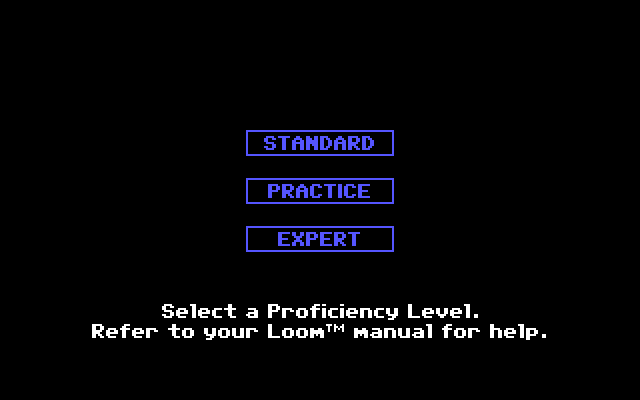
Loom is the LucasArts game that dared to ship an adventure with no verbs, no inventory screen, and technically no way to fail. In 1990, while the rest of the studio was busy refining the multi-verb SCUMM interface in games like Maniac Mansion and Zak McKracken, designer Brian Moriarty stripped the whole toolkit down to a single idea: music as magic.
A Different Kind of LucasArts Game
You play Bobbin Threadbare, a young outcast of the secretive Weavers Guild, thrown into a quest to find out why his entire guild has vanished and to stop the return of the Age of Chaos. Where Lucasfilm Games’ other adventures of the period leaned hard into puzzle chains built from picking up items and trying verbs on them, Loom cuts all of that away. There’s no “use,” no “open,” no inventory to dig through — just a magic distaff and the notes you’ve learned to play on it. It’s one of the most deliberately minimalist designs the studio ever shipped, and it stands out from Monkey Island and its siblings as a genuine experiment rather than an iteration.
Learning to Cast by Ear
The core mechanic is the Draft — a four-note spell woven on the distaff. Play a Draft forward and you get one effect; play the same four notes backward and you get its opposite. Open becomes Close. Dye becomes Undye. You don’t start knowing any of this; you learn Drafts by watching them cast around you, by NPCs, by creatures, by the world itself, and the game quietly writes each one into your Book of Patterns as you go. Moriarty built the whole thing around a “no player deaths, no dead ends” philosophy, so the challenge isn’t survival — it’s paying attention and experimenting with what a Draft does when aimed at something unexpected.
That philosophy extended to the interface as well. Even the stripped-down SCUMM system LucasArts used elsewhere still gave players a row of verbs to click through; Loom drops that entirely in favor of the distaff sitting at the bottom of the screen, always visible, always the only tool you have. It’s a genuinely bold interface decision for a studio whose other big hits leaned on exactly the opposite idea — give players lots of verbs and let them experiment their way to a solution.
A Few Things I Wish I’d Known First Time Through
- Any Draft you’ve learned can be reversed. If forward does one thing and it isn’t what you need, try it backward before assuming you’re stuck.
- Pay close attention whenever another character casts something in front of you — that’s usually the only way you’ll ever learn that particular Draft.
- Try known Drafts on targets that seem unrelated to how you first learned them. Loom rewards curiosity more than it rewards a checklist.
- Since there’s no way to die and no real dead end, don’t be afraid to experiment freely — the worst outcome is usually just a funny response, not a reload.
- The distaff can usually be aimed at scenery and objects that don’t seem like obvious puzzle pieces. Some of the game’s best moments come from trying a known Draft on something the game never explicitly points you toward.
- Keep an eye on the Book of Patterns itself. Reviewing which Drafts you’ve already learned, and in what order, makes it much easier to spot the one you actually need when you get stuck.
Setting It Up in DOSBox Today
Getting Loom running is painless once DOSBox is installed — our setup walkthrough covers mounting drives and getting sound working if you’ve never done it before. Mount the folder containing your copy as a virtual drive, switch to it, and launch the EXE; there’s no combat or timing-sensitive sequences here, so cycle settings are the least of your worries with this one.
Where Loom Sits Next to Monkey Island and Zak McKracken
The Secret of Monkey Island shipped later the same year and represents the polished, verb-driven direction LucasArts would ride for most of the decade. Zak McKracken, a couple years older, is built the same way. Loom is the odd one out — shorter, more linear, and far less interested in inventory-combination puzzles that can leave you stuck for hours. If those longer puzzle chains ever wore you down, Loom is proof the studio knew how to build something gentler without losing its identity.
It’s also worth setting Loom against Sierra’s contemporaneous King’s Quest games, which took the opposite approach to nearly everything — frequent, sudden death, a text parser that could reject perfectly reasonable phrasing, and an open world that expected you to save constantly. Loom’s insistence that failure shouldn’t be part of the fun feels almost like a direct rebuttal to that Sierra house style, even if that wasn’t Moriarty’s explicit intent. Coming to Loom right after a Sierra adventure feels like exhaling — the tension of possibly losing progress simply isn’t part of the experience here.
Does It Still Hold Up in 2026?
The painterly backgrounds and the score — built around themes lifted from Tchaikovsky’s Swan Lake — still make this one of the best-looking and best-sounding games of its year. My honest criticism is length: Loom is short, and players coming from meatier adventures may finish it in an evening and want more. But as a showcase of a studio willing to throw out its own rulebook, it’s still worth the few hours it asks of you.
You might also like: